
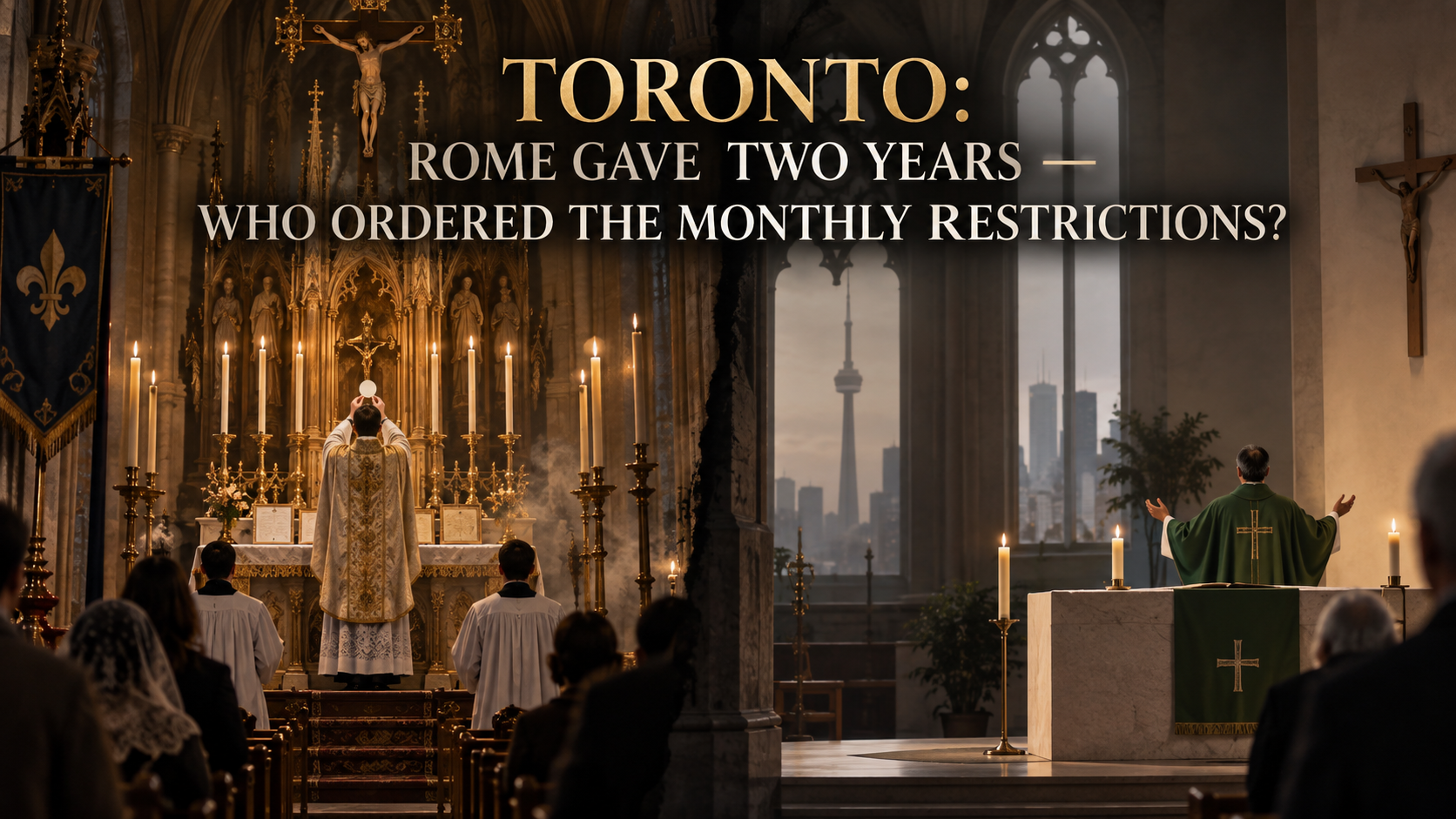
The Vatican’s own published record shows that on 5 December 2025 the Archdiocese of Toronto received a two-year permission for celebrations according to the 1962 Missal in precisely the four parish churches now being restricted. Nine months later, Traditional Mass provision is being reduced and the older sacramental rites withdrawn. Yet the decisive document explaining whether the monthly Novus Ordo substitutions were imposed by Rome or chosen in Toronto has not been made public. That is not a technical detail. It is the question on which responsibility turns.
There is an irony about the timing, but accuracy requires that it be stated properly. The prepared announcement at the Toronto Oratory was reportedly read from the pulpit on Sunday, 13 September, the Sixteenth Sunday after Pentecost. The restrictions became widely reported the following day, 14 September: the Feast of the Exaltation of the Holy Cross. That was the very feast on which Benedict XVI ordered Summorum Pontificum to take effect in 2007.¹ No evidence establishes that anyone in Toronto deliberately chose the anniversary. There is no need to manufacture the symbolism. The coincidence is eloquent enough.
Beginning on Sunday, 20 September, according to the prepared announcement reported from Toronto, the 9.30 a.m. Traditional Mass at St Vincent de Paul is to be replaced once each month by an English-language Mass according to the reformed Missal. The parish already has English Sunday Masses at 8.30 and 11.00. At Holy Family, where the 11.00 Sunday Traditional Mass is a Solemn Mass, one Sunday each month is likewise to be replaced, beginning on 27 September, by a sung Latin celebration according to the reformed Missal, reportedly versus populum. Existing bookings for traditional baptisms, marriages and funerals are said to be honoured, but new celebrations of the other sacraments according to the older books will cease.²
These details have now been repeated by several Catholic outlets. What has not appeared is equally significant. The Archdiocese of Toronto has not published the operative decree or correspondence setting out the conditions. One of the earliest local reports expressly acknowledged that its author possessed no written document from either Toronto or Rome. Subsequent reporting has confirmed the practical arrangements but has not supplied the missing instrument.³
That would matter less if nothing documentary were available. But something is.
The Dicastery for Divine Worship and the Discipline of the Sacraments has published its official Index Decretorum Anni MMXXV. The entry for 5 December 2025, protocol 244/24, is headed TORONTINÆ. It expressly names four parish churches: St Lawrence the Martyr in Scarborough, St Patrick in Schomberg, Holy Family in Toronto and St Vincent de Paul in Toronto. It grants permission to celebrate according to the Roman Missal promulgated by St John XXIII in 1962 in those churches ad biennium — for two years.⁴
That fact changes the question.
Toronto’s permission did not expire during the summer. It was not refused in December. Rome did not merely tolerate the four locations for a few final months while arrangements were made to close them. The public Vatican record says that the Dicastery granted the four named parish churches a two-year permission on 5 December 2025.
But there is an equally important qualification. What the Vatican has published is the Dicastery’s summary entry, not the complete text of decree 244/24. The published entry records the locations, the 1962 Missal and the two-year duration. It does not disclose a requirement that one Traditional Sunday Mass each month be replaced by the reformed liturgy. That does not prove that the unpublished decree contains no such condition. It may. There may also have been subsequent correspondence between Toronto and the Dicastery which has not been made public.
That leaves the central question unresolved but sharply defined. Did Rome grant the two-year permission on condition that the Traditional Mass be progressively reduced? Did a later Roman instruction impose the monthly substitution? Or did the Archdiocese itself choose that mechanism while implementing the permission it had received?
At present, the public record cannot tell us.
That distinction is essential because Traditionis custodes itself does not prescribe a monthly Novus Ordo replacement. Francis gave the diocesan bishop responsibility for regulating liturgical celebrations and, in Article 3 §3, specifically charged him with establishing the days on which celebrations according to the 1962 Missal are permitted. The February 2023 rescript then reserved to the Apostolic See the dispensation necessary to use a parish church for those celebrations.⁵ In Toronto, Rome demonstrably supplied that dispensation for these four parish churches. The remaining question is what conditions accompanied it and which authority devised the present timetable.
The distinction between the Mass and the other sacraments must also be maintained. The December 2021 Responsa ad dubia is much more explicit concerning the older Rituale Romanum. It permits the diocesan bishop to authorise use of the 1952 Rituale only in canonically erected personal parishes celebrating according to the 1962 Missal, while excluding use of the pre-reform Pontificale Romanum. Francis confirmed those Responsa in the 2023 rescript.⁶ The reported cessation of traditional baptisms, marriages and funerals therefore rests upon a considerably clearer Roman foundation than does the particular device of replacing one Sunday Traditional Mass each month.
Good criticism requires good distinctions. If Rome required something, Rome should bear responsibility for it. If Toronto chose something that Rome did not require, responsibility belongs in Toronto. Traditionis custodes is restrictive enough without attributing to it provisions which its published text does not contain.
There is, however, no mystery about the direction of Roman policy. The Responsa says that the diocesan bishop “must work to ensure that his diocese returns to a unitary form of celebration”. It speaks of accompanying Catholics rooted in the older liturgy towards the reformed books. Francis’s legislation had already declared the books promulgated by Paul VI and John Paul II to be the “unique expression of the lex orandi of the Roman Rite”.⁷ Those are not interpretations supplied by traditionalist critics. They are the Holy See’s own explanation of the policy.
That allows the cui bono? question to be answered without inventing private motives.
One need not suppose personal hostility on the part of Cardinal ✠Francis Leo. One need not posit a secret faction in the chancery. One need not know whether the monthly substitution originated in Rome or Toronto in order to see what it does. A community accustomed to assembling every Sunday for the Traditional Roman Mass is required, once a month, to assemble at the same hour but receive the reformed liturgy instead. At Holy Family even Latin and sacred music are reportedly retained while the Missal changes and the priest is required to face the people.
In practical terms, it is acclimatisation by substitution.
That corresponds closely with the publicly stated policy of moving Catholics attached to the older books towards what the Responsa calls a “unitary form of celebration”. This does not establish who designed Toronto’s particular arrangement. It does establish that such an arrangement advances an objective which the Dicastery has already stated openly: gradual convergence upon the reformed liturgy.
The pastoral necessity for the substitution is much harder to discern. The Archdiocese’s own published schedule lists at St Vincent English Sunday Masses at 8.30 and 11.00, surrounding the 9.30 Latin Mass. Holy Family offers English Sunday Masses at 8.00, 9.30, 12.30 and 8.00, as well as the Saturday evening vigil, around its 11.00 Latin Mass. During the week Holy Family likewise combines English Masses with its Latin provision.⁸
No shortage of the reformed liturgy is being remedied.
Traditional Catholics are not occupying the only Sunday Mass and depriving other parishioners of ordinary parish provision. Nobody needs to remove their Mass in order to create access to an English Novus Ordo. That access already exists abundantly. A Mass for which a particular congregation already gathers is instead being periodically converted into a form already readily available before and after it.
That is why saying that the faithful can simply attend the Novus Ordo once a month misses the issue. Of course they can. The relevant question is why the provision exists in the first place. It exists because those faithful have a stable attachment to the traditional liturgy. Replacing that liturgy at the very hour appointed for it does not meet that pastoral need. It suspends it.
The reported requirement that the Holy Family replacement Mass be celebrated versus populum raises a separate question. Traditionis custodes contains no prohibition of ad orientem celebration according to the reformed Missal. The General Instruction provides that an altar should be arranged so that celebration facing the people is possible and describes this as desirable wherever possible; it does not turn ad orientem celebration into an illicit act.⁹ If Toronto has imposed versus populum as a specific condition, that condition should therefore be identified as such rather than treated as though it followed automatically from Traditionis custodes.
Nuntiatoria has also received local testimony alleging a wider discouragement of ad orientem worship, diminished ceremonial at the cathedral, difficulties within its musical establishment and an instance in which an Ordinariate priest was reportedly constrained as to the form and orientation of a Mass celebrated in a diocesan church. These accounts may merit further investigation. At present we have not found sufficient published evidence to present them as an established diocesan programme. They should remain what they presently are: local testimony requiring corroboration. The documented restrictions are serious enough without attempting to strengthen them with claims that cannot yet be independently demonstrated.
There is another irony which deserves careful treatment. Local Catholic accounts maintain that the Traditional Mass at St Vincent was originally encouraged under Cardinal ✠Aloysius Ambrozic after the Society of St Pius X established a nearby presence. The object, according to that account, was to give Catholics attached to the older liturgy a diocesan home rather than encourage them to seek it from the Society. That history has been repeated in recent Toronto reporting, although Nuntiatoria has not located a contemporary archdiocesan document establishing Cardinal Ambrozic’s precise intention.¹⁰
If the account is accurate, the pastoral reversal is striking. A diocesan provision reportedly fostered in part to keep traditional Catholics within normal diocesan structures is now being reduced while the SSPX remains capable of providing precisely what those Catholics are losing.
That question has acquired additional force after this summer’s events at Écône. Nuntiatoria has consistently rejected the idea that canonical irregularity should itself become an ecclesial ideal. But the corollary cannot be ignored. If Catholics are urged to remain within regular diocesan structures, those structures should not gratuitously make the very liturgical life drawing them elsewhere steadily less available. Ecclesial communion is not strengthened by creating practical demonstrations for the argument that traditional Catholics require irregular institutions simply to obtain the traditional rites.
Only last week, Nuntiatoria examined Archbishop ✠Richard Moth’s markedly different application of the same post-Traditionis custodes regime in Arundel and Brighton. Archbishop Moth described the process plainly: identify genuine pastoral need, make the case to Rome and seek the permissions required. He complied with the restrictive legislation and reported that the necessary permissions had been granted. The significance was not that Traditionis custodes had ceased to operate, but that restrictive universal law still leaves room for consequential episcopal choices about how vigorously a bishop advocates for the faithful entrusted to him.¹¹
Toronto cannot yet be placed neatly on the opposite side of that comparison because the decisive evidence remains unpublished. Perhaps Cardinal Leo argued for the existing provision and Rome imposed these reductions as the price of its continuation. If so, fairness requires that responsibility rest principally with Rome. Perhaps Rome granted what its public index records — permission for four parish churches for two years — and the monthly substitutions were subsequently chosen locally. If so, it would be wrong to shield a local decision behind the general invocation of Traditionis custodes.
This is why publication matters.
The faithful should not have to reconstruct the government of their sacramental life from a pulpit announcement, reports by local Catholics, parish timetables and a Latin entry in a Vatican index. The Archdiocese need not publish private correspondence indiscriminately. It can simply explain the operative terms. Was the once-monthly substitution required by the Dicastery? Was versus populum required? Were these conditions proposed locally? Were they negotiated? Does the December 2025 decree itself contain them?
Those are straightforward questions.
Nor are they rebellious questions. Canonical government is not weakened when responsibility is made intelligible. On the contrary, obscurity encourages precisely the rumours and suspicions which clear administration should prevent. If a decision comes from Rome, saying so protects the diocesan bishop from misplaced blame. If it comes from the bishop, saying so permits the faithful to understand the pastoral judgement actually being made.
The curious feature of Toronto is therefore no longer merely that Traditionis custodes is being “implemented”. It is that we now possess enough documentary evidence to know that this description is incomplete.
Rome expressly granted permission for these four parish churches for two years.
Rome’s published summary does not disclose the monthly Novus Ordo substitution.
The faithful have nevertheless been told that the substitution will begin.
Somewhere between those three facts lies the decision which has not yet been publicly explained.
There is no need for conspiracy theory. There is no need to speculate about Cardinal Leo’s private opinions. There is no need even to dispute that the Holy See possesses extensive authority under the present legislation.
There is simply a document missing from the public account.
If the restrictions are Rome’s, Rome should own them. If they are Toronto’s, Toronto should own them. If they are the product of negotiation between both, both should say so.
Until then, one fact stands beyond reasonable dispute: on 5 December 2025 the Holy See granted Toronto a two-year permission for the Traditional Mass in four named parish churches. Nine months later those communities are being given less than they had before.
The question is no longer whether there is a restriction.
The question is who chose it — and why.
¹ Benedict XVI, Summorum Pontificum, 7 July 2007; Rorate Cæli, “Limitations for Traditional Latin Mass in the Archdiocese of Toronto, Canada”, 15 September 2026.
² Rorate Cæli, “Limitations for Traditional Latin Mass in the Archdiocese of Toronto, Canada”, 15 September 2026; Archdiocese of Toronto, “Holy Family Parish Information”; Archdiocese of Toronto, “St Vincent de Paul Parish Information”.
³ Toronto Catholic Witness, “Rome is suppressing the Latin Mass and Traditional Sacraments in the Archdiocese of Toronto”, 13 September 2026; InfoVaticana, “Toronto restricts the Traditional Mass that the archdiocese itself promoted to prevent the faithful from attending the FSSPX”, 15 September 2026.
⁴ Dicastery for Divine Worship and the Discipline of the Sacraments, Index Decretorum Anni MMXXV, 5 December 2025, Prot. N. 244/24, p. 16.
⁵ Francis, Traditionis custodes, 16 July 2021, arts. 2–3; Dicastery for Divine Worship and the Discipline of the Sacraments, Rescriptum ex Audientia SS.mi, 20 February 2023.
⁶ Congregation for Divine Worship and the Discipline of the Sacraments, Responsa ad dubia on certain provisions of Traditionis custodes, 4 December 2021; Dicastery for Divine Worship and the Discipline of the Sacraments, Rescriptum ex Audientia SS.mi, 20 February 2023.
⁷ Congregation for Divine Worship and the Discipline of the Sacraments, Responsa ad dubia on certain provisions of Traditionis custodes, 4 December 2021; Francis, Traditionis custodes, 16 July 2021.
⁸ Archdiocese of Toronto, “Holy Family Parish Information and Mass Schedule”; Archdiocese of Toronto, “St Vincent de Paul Parish Information and Mass Schedule”.
⁹ Congregation for Divine Worship and the Discipline of the Sacraments, General Instruction of the Roman Missal, no. 299.
¹⁰ Canada Free Press/Vox Cantoris, “Archdiocese of Toronto implements Traditionis Custodes!”, 14 September 2026; InfoVaticana, “Toronto restricts the Traditional Mass that the archdiocese itself promoted to prevent the faithful from attending the FSSPX”, 15 September 2026.
¹¹ Nuntiatoria, “Pastoral Need not Extinction: Archbishop Moth and the Choice Traditionis Custodes Still Leaves Bishops”, 11 September 2026.



Leave a Reply