
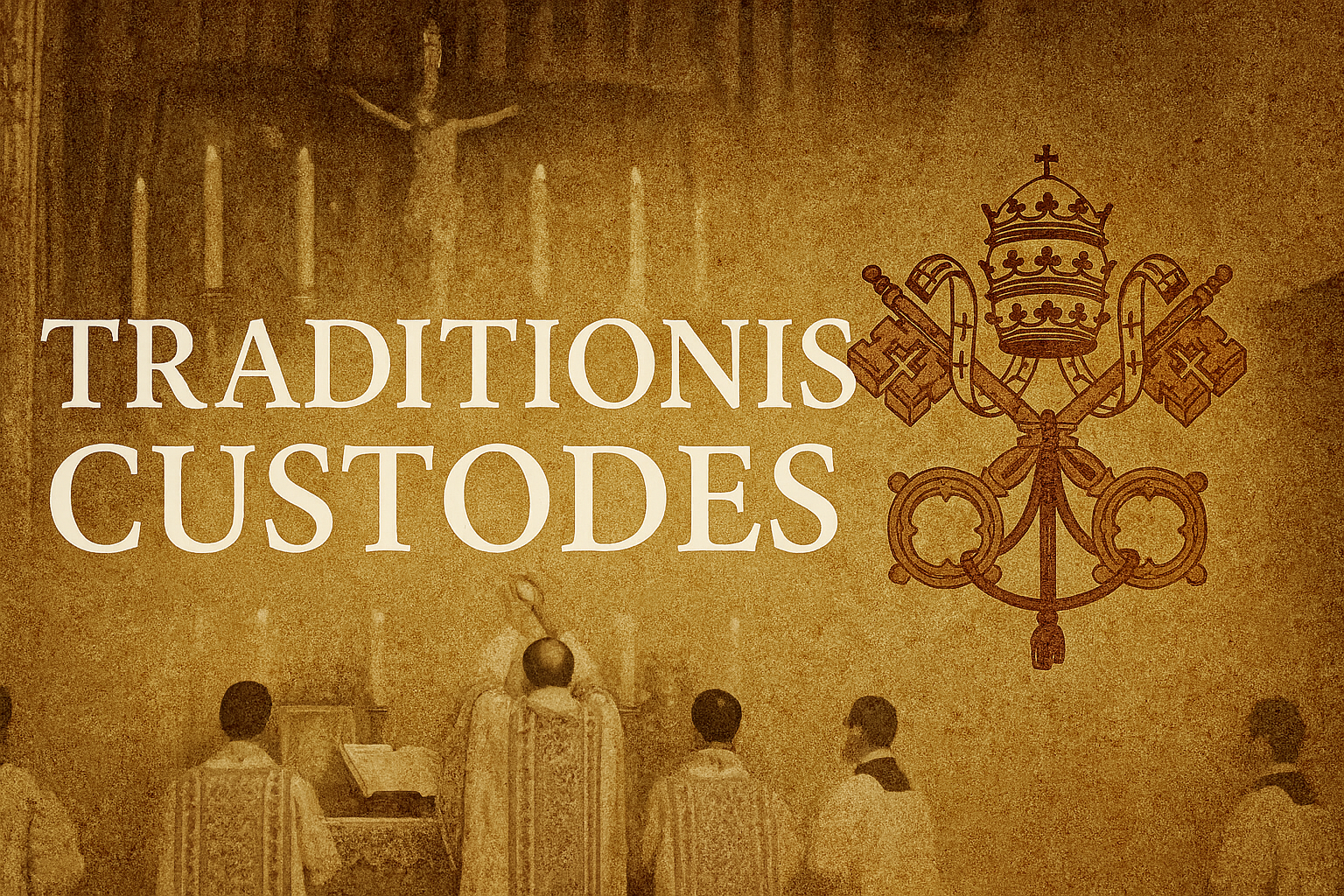
Archbishop Gänswein, Liturgical Continuity, and the Question Pope Leo XIV Cannot Avoid
In December 2025, Archbishop Georg Gänswein—former Prefect of the Papal Household and longtime personal secretary to Pope Benedict XVI—publicly urged Pope Leo XIV to end restrictions on the Traditional Latin Mass and to restore the juridical settlement established by Summorum Pontificum.¹ His remarks, delivered in an interview with German Catholic broadcaster K-TV, constitute one of the most senior and explicit interventions by a Vatican prelate since the promulgation of Traditionis Custodes in 2021.
The intervention occurs at a critical juncture. Pope Francis’ motu proprio Traditionis Custodes radically reversed Benedict XVI’s framework by asserting that the post-conciliar liturgical books are the “unique expression” of the Roman Rite, subjecting the 1962 Missal to restriction, supervision, and gradual elimination.² The document was justified publicly as necessary to preserve unity and prevent doctrinal dissent, despite later evidence indicating that the majority of bishops responding to the Vatican’s 2020 consultation did not regard the traditional Mass as a source of division.³
With the death of Pope Francis and the accession of Pope Leo XIV, the Church stands in a transitional moment. Reports from diplomatic and ecclesial sources suggest that the new pontificate does not intend an immediate abrogation of Traditionis Custodes, but is instead pursuing a quieter strategy of dispensations and delegated faculties.⁴ It is into this unresolved landscape that Archbishop Gänswein speaks—not as a partisan agitator, but as a custodian of Benedict XVI’s theological and juridical vision.
What follows is not nostalgia, but a challenge to the internal coherence of the Church’s liturgical governance.
Archbishop Georg Gänswein’s appeal is not an exercise in sentiment or personal loyalty. It is a measured but unmistakable challenge to the logic by which the Church now governs her own worship, and it lands with particular force under the pontificate of Pope Leo XIV.¹
When Gänswein observes that the traditional Roman Mass “cannot be valid and valuable yesterday, and suddenly no longer valid today,” he is not making an emotional plea on behalf of a marginalised subculture. He is articulating a claim about continuity, authority, and juridical honesty—and about the limits beyond which ecclesiastical administration begins to undermine the Church’s own credibility.⁵
Continuity, not nostalgia
Gänswein’s argument is fundamentally theological and juridical. The Roman Rite, as codified and organically developed over centuries, was not merely permitted by the Church but actively proposed, defended, and canonised as a norm of worship that sanctified innumerable saints. Pope Benedict XVI articulated this with precision in Summorum Pontificum, insisting that what was sacred for previous generations cannot suddenly be deemed harmful or divisive.⁶
If the Church can reclassify her received liturgical tradition as a problem to be managed rather than a treasure to be safeguarded, she implicitly claims an authority that is no longer custodial but creative—an authority extending not merely to discipline, but to tradition itself. That claim strikes at the heart of Catholic self-understanding.⁷
The implicit rebuke of Traditionis Custodes
Although Gänswein does not polemicise, his remarks amount to a quiet but devastating critique of the rationale offered for Traditionis Custodes. That document justified sweeping restrictions on the traditional Mass on the grounds of unity, obedience, and the assertion that the post-Vatican II liturgical books are the “unique expression” of the Roman Rite.²
Three difficulties immediately arise.
First, a problem of coherence: a rite cannot simultaneously be a legitimate expression of Roman worship and an ecclesial danger by its very nature. Second, a problem of evidence: subsequent documentation and reporting indicate that many bishops were broadly satisfied with the Summorum Pontificum framework and warned against renewed conflict.³ Even where Vatican officials dispute the completeness of leaked materials, the contradiction itself undermines the claim of necessity. Third, a problem of authority: a law that must be constantly mitigated through dispensations reveals a mismatch between principle and lived reality. If the traditional Mass exists everywhere by exception, then the principle against it is not truly believed.
Why restoration does not require reversal
This is why Gänswein’s words matter now. If Pope Leo XIV is unwilling to repeal Traditionis Custodes outright, he nevertheless retains the capacity to govern honestly. Restoration does not require theatrical reversal; it requires juridical clarity.
If the traditional Mass is to continue—and in practice it clearly does—it must be recognised not as a grudging exception but as a legitimate, stable, and intelligible expression of Roman worship. This was precisely Benedict XVI’s approach. Faculties can be normalised, structural humiliations removed, and bishops instructed to govern with continuity rather than suspicion.
Yet this inevitably raises a deeper question—one that Gänswein gestures toward but does not explicitly articulate.
The unresolved question of the Roman Rite
For the Old Roman Apostolate and for traditional Catholic apostolates worldwide, the issue is not merely the right to exist alongside the Novus Ordo. It is the more fundamental question of which liturgy truly belongs to the Latin Rite.
The traditional Roman Mass is not one option among many. It is the Mass that organically developed within the Latin Church, was codified after Trent, transmitted without rupture, and embedded in Catholic law, spirituality, and doctrine. It expresses the Church’s theology of sacrifice, priesthood, propitiation, transcendence, and divine worship with clarity and continuity.⁸
The Novus Ordo Missae does not stand within that same tradition. It was not the reform mandated by the Fathers of the Second Vatican Council. Sacrosanctum Concilium called for modest, organic development and the preservation of received rites, not wholesale reconstruction.⁹ The post-conciliar rite emerged instead from committees, experimentation, and modern liturgical theories foreign to the Roman tradition, resulting in a rupture with inherited custom.¹⁰
From a traditional Catholic theological perspective, the Novus Ordo lacks legitimacy not merely because of abuses, but because it does not arise organically from the liturgical life of the Latin Church. It is a novel rite imposed by authority, rather than a received inheritance governed by tradition.
Conclusio: beyond tolerance to restoration
Archbishop Gänswein’s appeal is therefore significant not merely as a plea for mercy, but as a moment of clarity in the Church’s unresolved liturgical crisis. Ending persecution is the minimum requirement. Restoring juridical honesty is the next step. Yet the final question remains unavoidable: whether the Church will once again recognise the traditional Roman Mass not as a tolerated relic, but as the normative expression of her worship.
For the Old Roman Apostolate and for traditional Catholic apostolates more broadly, peace will not come through permanent duality or managed pluralism. It will come only when the Church acknowledges that the liturgy which formed her saints, articulated her doctrine, and sanctified her faithful for centuries is not a problem to be contained—but the Mass of the Church herself.
Whether Pope Leo XIV is prepared to face that question remains to be seen. Archbishop Gänswein has ensured that it can no longer be avoided.
- Archbishop Georg Gänswein, interview with K-TV (Katholisches Fernsehen), 7 December 2025; reported by LifeSiteNews.
- Francis, Apostolic Letter Traditionis Custodes (16 July 2021), art. 1.
- Diane Montagna, documentation and analysis of the 2020 CDF survey, 2024–2025.
- Vatican diplomatic and episcopal sources, November–December 2025.
- Gänswein, K-TV interview.
- Benedict XVI, Summorum Pontificum (7 July 2007), Letter to the Bishops.
- Joseph Ratzinger, The Spirit of the Liturgy (Ignatius Press, 2000).
- Council of Trent, Session XXII, Doctrine on the Sacrifice of the Mass.
- Second Vatican Council, Sacrosanctum Concilium, nn. 21–23.
- Annibale Bugnini, The Reform of the Liturgy 1948–1975.


Latest
- THE KING’S OATH AND THE DEAD OF SAINT GEORGE’SA tragic attack during a Christian funeral in Karak, Jordan, resulted in nine fatalities and numerous injuries. King Abdullah II has pledged severe retaliation, leading to the arrest of three suspects. The Latin Patriarchate supports the monarchy’s role in ensuring religious freedom, while the Orthodox community vows to remain in their homeland amidst ongoing concerns for their safety.
- THE LAW OF A CHURCH THAT HAS NOT YET BEEN REUNITEDAt the Angelicum conference, Orthodox and Anglican scholars discussed the future of ecclesiastical law alongside Vatican cardinals. Cardinal Koch advocated for a new ecumenical juridical order, connecting these discussions to the upcoming Synodal Assembly of 2028. The conference aimed to address how different Christian governance models could influence Catholic law and authority.
- ‘DWARFS TAVISTOCK’: Baroness Cass demands Inquiry into Brighton NHS ScandalBaroness Hilary Cass has called for an independent inquiry into Brighton’s WellBN practice, claiming it overshadowed the Tavistock scandal. An investigation revealed severe clinical failures affecting 78 children, alongside the distressing treatment of safeguarding GP Dr Sarah Redvers, who raised alarms about these practices and faced retaliation. Accountability within the NHS is urgently needed.
- “THAT’S JUST PARANOIA”: Dr Joseph Shaw and the Crisis beyond the Latin MassDr Joseph Shaw’s recent interview highlights his support for the Traditional Latin Mass but inadequately addresses the Society of Saint Pius X’s (SSPX) concerns regarding the Church’s doctrinal crisis. He dismisses SSPX’s fears as paranoia, yet the Society’s extensive theological arguments underscore that preserving the older liturgy is insufficient for restoring Catholic Tradition.
- THE REFUSAL IS NOW IN WRITINGThe Vatican has formally denied the Summorum Pontificum pilgrims permission to enter St Peter’s Basilica together for prayer, a decision communicated through published correspondence. The situation has sparked debate over administrative failures and the Church’s treatment of traditional Catholics. Key questions remain regarding the explanation for this refusal amidst wider pastoral concerns.




Leave a Reply