
Christendom and Islamism: Two Fundamentally Different Conceptions of Religion, Authority, and Society
The contrast between Islamism and Christendom is not a superficial difference of theology or culture; it is a structural difference in how religion, law, and political authority are conceived and ordered. Where Islamism seeks the fusion of religious doctrine and state power into a single, undifferentiated system of control, Christendom—at its classical height—was built upon a principled distinction between spiritual and temporal authority, even while affirming their mutual orientation toward the good.
Christendom was never conceived as a theocracy in the Islamist sense. It did not posit revelation as a comprehensive civil code to be imposed mechanically upon society. Rather, it understood Christianity primarily as a religion of salvation, concerned first with man’s reconciliation to God, the formation of conscience, and the ordering of the soul toward eternal beatitude. Political authority, while morally accountable to divine law, was recognised as a natural institution, grounded in reason and oriented toward the temporal common good.¹
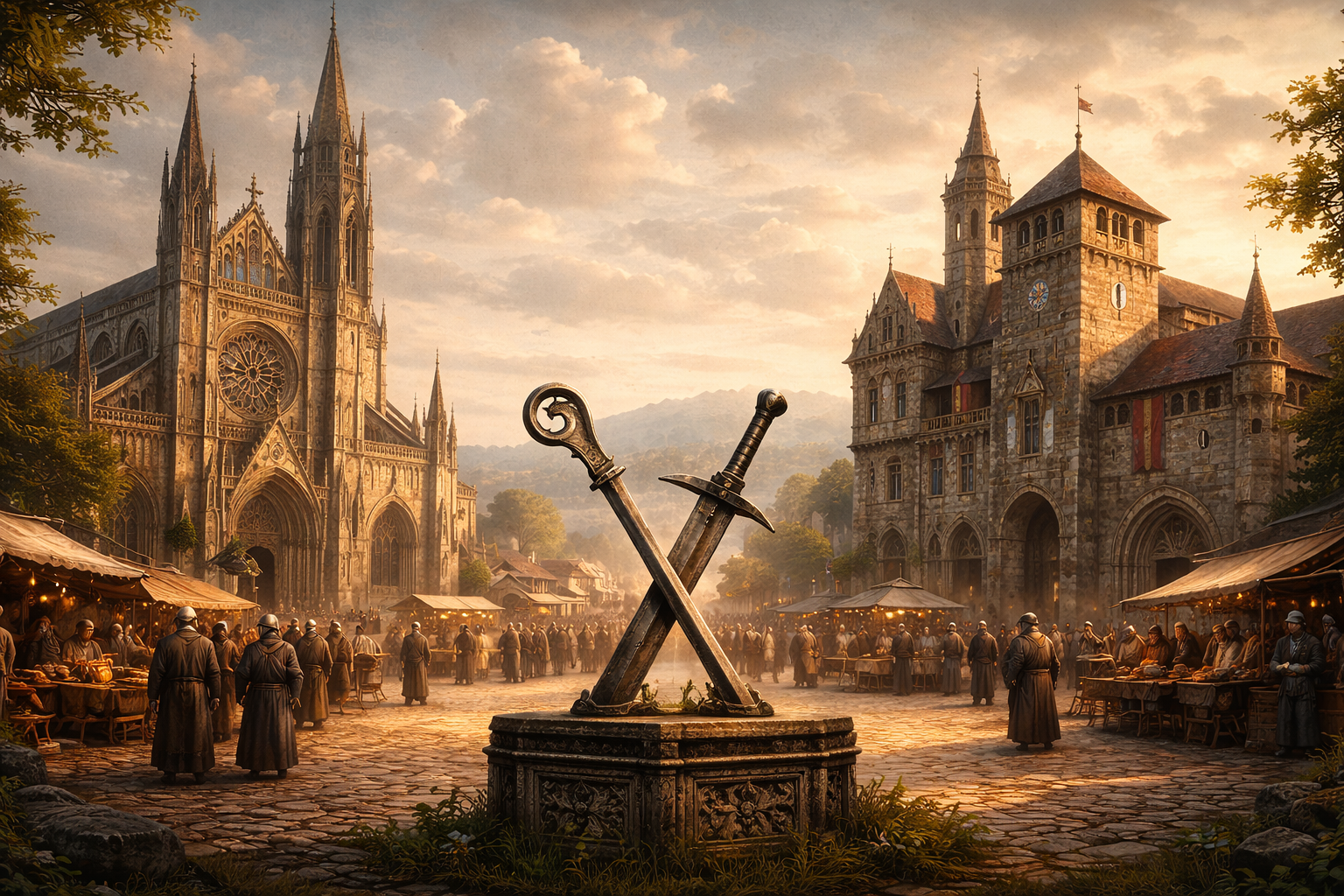
This distinction was articulated early and decisively. In the late fifth century, Gelasius I set out the doctrine of the two powers (duo sunt): the sacred authority of priests and the royal power of kings. Each possessed its own competence, limits, and responsibilities. The Church did not rule by the sword, and the state did not define doctrine or administer the sacraments. While the two were meant to cooperate harmoniously, neither absorbed the other.² This framework became foundational for medieval political theology.
By contrast, Islamism explicitly denies such a distinction. In Islamist theory, sovereignty belongs directly to God, not mediately through natural law or political reason. Human legislation is inherently suspect unless it directly implements divine command. There is therefore no autonomous civil sphere, no independent legal reasoning, and no principled limitation on religious authority. Law, politics, and coercion collapse into a single theological mandate. Christendom never operated on this basis.
The medieval Christian synthesis reached its most precise articulation in the thought of Thomas Aquinas. Aquinas distinguished clearly between eternal law, natural law, human law, and divine law. Civil law derived its authority not from revelation but from natural reason, and its purpose was limited: the maintenance of peace, justice, and the conditions necessary for virtuous life. Divine law addressed man’s supernatural end and exceeded the competence of the state. Even when rulers were Christian, they governed as rulers, not as priests.³
This distinction proved decisive for social cohesion. Because Christianity did not demand the juridical enforcement of every moral or theological truth, Christendom could accommodate legal plurality, local custom, and political diversity. A pagan, Jewish, or later Muslim subject could live under Christian rule without being compelled to convert or conform to sacramental life. While Christendom certainly affirmed the truth of Christianity and privileged it publicly, it did not require uniform religious identity as a condition of civic participation.⁴
Equally important is what Christendom did not claim. The Church never taught that the Gospel constituted a detailed civil constitution, nor that the state’s legitimacy depended on its explicit enforcement of Christian worship. Coercion was recognised as a tragic necessity of fallen human society, not a religious instrument for expanding the faith. Conversion was to be sought through preaching and witness, not conquest. Where Christian rulers failed to live up to this ideal, they were understood to be betraying Christian principles, not fulfilling them.⁵
Islamism inverts this logic. Political power is not a contingent arrangement ordered toward peace; it is a religious duty. Expansion is not an unfortunate historical by-product but a theological norm. Legal domination is not a means to protect the common good but a sign of divine order restored. The absence of a two-swords doctrine means there is no internal brake on sacralised coercion. This difference is decisive when assessing integration and pluralism.
Christendom also generated, over time, the conceptual resources that made modern constitutionalism possible. The separation of powers, the rule of law, limits on sovereignty, and the primacy of conscience all emerged from a civilisation that had already internalised the distinction between God and Caesar. Western liberalism did not arise despite Christendom but out of its internal tensions and moral framework, even as it later rejected many of its theological foundations.⁶ Islamism, by contrast, rejects these developments not as historical accidents but as principled errors.
This explains why Christianity, even when publicly established, proved compatible with plural societies in a way Islamism does not. Christendom could tolerate dissent because faith was not reducible to political allegiance. Islamism cannot do so consistently because belief, law, and loyalty are inseparable. Where Christendom recognised a legitimate secular sphere—even if imperfectly realised—Islamism denies its existence altogether.
The contemporary failure to grasp this difference fuels dangerous false equivalence. Islamism is often defended by pointing to Christendom’s historical abuses, as though both represented the same phenomenon in different religious dress. They did not. Christendom was built on distinction, limitation, and mediation; Islamism is built on fusion, absolutism, and direct sovereignty. Confusing the two is not merely a historical error—it is a conceptual one with serious political consequences.
- R.W. Southern, Western Society and the Church in the Middle Ages (London: Penguin, 1970), pp. 15–38.
- Gelasius I, Epistola ad Anastasium Imperatorem (“Duo Sunt”), in Patrologia Latina 59, cols. 41–45.
- Thomas Aquinas, Summa Theologiae, I–II, qq. 90–97.
- Augustine of Hippo, The City of God, XIX.17–24.
- Robert Louis Wilken, Liberty in the Things of God (New Haven: Yale University Press, 2019), pp. 121–156.
- Larry Siedentop, Inventing the Individual: The Origins of Western Liberalism (London: Penguin, 2014), pp. 1–38.
RELATED ARTICLES


Latest ARTICLES
- Today’s homily: St Pius X, PopeThe text reflects on the life and legacy of Pope St Pius X, who was chosen from humble beginnings to reform the Church. His pontificate focused on defending the Catholic Faith, restoring liturgical sanctity, and fostering deeper connections between believers and Christ. Pius X exemplified a balance of truth and pastoral charity.
- Today’s Mass: September 03 Pope St Pius X,Pope St Pius X, born Giuseppe Melchiorre Sarto, was a significant reformer who emphasised preserving the Catholic Faith against Modernism. His pontificate (1903-1914) featured reforms in liturgy, frequent Holy Communion, and seminaries, rooted in a pastoral desire to restore everything in Christ. He died in 1914 and was canonised in 1954.
- Today’s homily: St Stephen of HungaryThe homily reflects on the life of Saint Stephen of Hungary, illustrating his transition from a powerful ruler to a saint. He embraced the responsibilities of kingship guided by faith, understanding his authority as stewardship. His legacy teaches that true governance comes with surrender to God, ultimately placing his kingdom under the protection of the Blessed Virgin Mary.
- Today’s Mass: September 02 St. Stephen the GreatSt. Stephen the Great, King of Hungary (977-1038), was a significant Christian ruler who reinforced the faith throughout Hungary. Anointed king in 1000 by Pope Sylvester II, he fought against paganism and promoted the Church. He was canonised in 1083 and is the patron saint of Hungary, symbolising national identity.
- QUAERITE PRIMUM REGNUM DEI – Seek First the Kingdom: Spiritual Conference for Nuntiatoria CXXIA spiritual conference, “Seek First the Kingdom,” emphasises prioritising God’s reign within individuals over earthly concerns. It explores the necessity of internalising Christ’s teachings, the importance of discernment, and the critical evaluation of the faith in relation to contemporary issues. A genuine Catholic life centres on Christ, fostering holiness and transformation.



Leave a Reply