
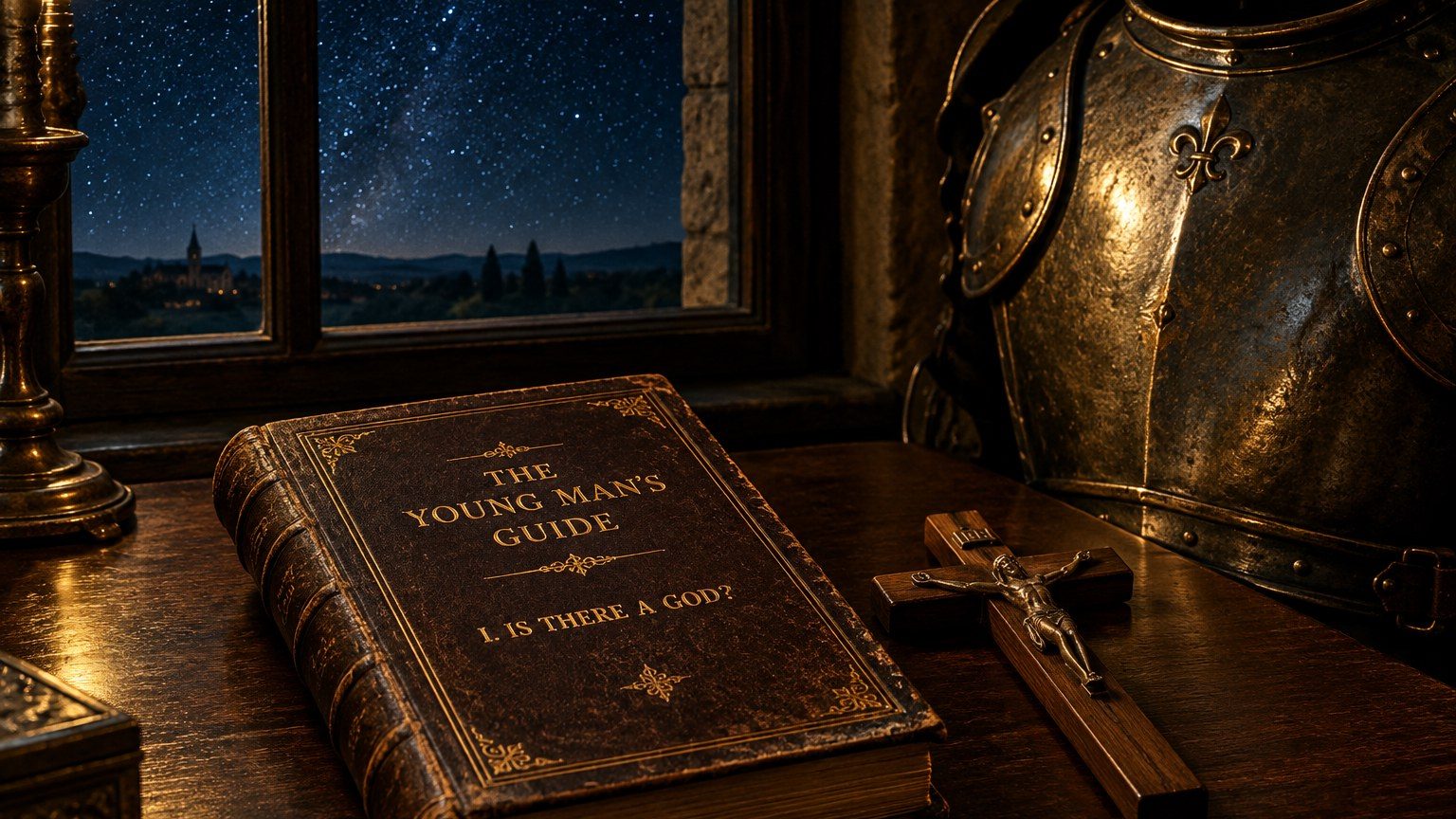
A Library of Catholic Formation | The Young Man’s Guide (1910) | Part First: The Panoply of War | The Shield of Faith | Chapter IV, pp. 13–17.
EDITORIAL NOTE. The text below follows the digitised 1910 edition, retaining its period language. The shuttered-window analogy challenges a materialist inference rather than independently demonstrating immortality. The author’s appeals to affection and happiness are pastoral arguments; Christian hope rests upon divine revelation. The missing word “go” in the online transcription of the concluding biblical quotation has been supplied.1
IV. Death Is Not Annihilation
1. IN THESE modern days, when faith has grown cold or vanished altogether, there are people, and even lads of fifteen or sixteen years of age, who, when they are exhorted to reflect from time to time upon death and eternity, merely reply: “I am no child to be frightened with nursery tales; who knows whether death is not annihilation!”
Words like these, when uttered by youthful lips, fill us truly with horror and pity. But how is it possible to speak in this way? Simply because, in the case of those who thus express themselves, the belief in one of the fundamental truths of all religion, the belief in the immortality of the soul, has been destroyed.
Since you, dear reader, must go forth into life and be exposed to the dangers of unbelief, it is of the utmost importance that the conviction that “death is not annihilation” should be deeply rooted in your heart; wherefore, ponder carefully the principal grounds upon which this conviction is based.
2. Death is not annihilation, but the soul lives on after the death of the body. It is immortal. The very nature of the soul proves this; it is a simple, indivisible being; it can not be separated into parts, or destroyed.
Now, however, the unbelievers, the so-called materialists, appear upon the scene, and say “Man does not possess a soul independent of the body, a soul which has its own separate existence.” And as proof (?) of this they assert that since a violent blow upon the head destroys consciousness, the power of thought is therefore dependent upon the brain; the brain being the cause of thought, no spiritual soul is needed for this purpose.
This conclusion certainly appears plausible, but it contains a grievous fallacy. In a similar manner I could “prove” that there is no sun! Just tell me whether, if you close the shutters of your room, the light does not disappear from it; but in proportion as you re-open them, the light streams in again more or less brightly.
Therefore the light in the room depends upon the window, the window is the cause of it; hence no other cause is needed, no sun! Thus, my young friend, if you had not seen the sun for yourself, you might believe that there is not a sun at all. In both instances, the fallacy of the deduction or conclusion is obvious. Just as certainly as there is a sun, so certainly does man possess an immortal soul, with an independent existence of its own.
3. The conviction of all nations bears witness to the immortality of the human soul; it is inscribed by the hand of nature in the heart of every man in characters which can never be effaced. Nature can never deceive. False representations concerning the future life of the soul by no means prove that it is not immortal. This belief in the immortality of the soul may indeed be dislodged from the head, but never torn out of the heart.
“It is difficult,” a simple person once remarked to me, “to believe that those whom we love do not merely die, but are dissolved into nothingness.” And, truly, all our feelings rise in revolt and the voice we hear within us protests against the assumption that death is annihilation.
4. No, no, thus it can not be: there shall be a “Wiedersehen” of our kindred; we shall meet again those whom we have loved and lost.
If, indeed, there were no such future meeting, we should be justified in raising an accusing voice to Heaven, and exclaiming: “Thou hast deceived us by implanting affections within our breast which are only doomed to be disappointed!” Is, then, everything to be ended at the close of this short life, so replete often with suffering, and is only nothingness to remain! Are love and friendship to be mere empty words, are virtue and justice to exist only in imagination?
What then! The robber and the robbed, the traitor to his country and he who gives his life for his fatherland, the martyr and his torturer, the unnatural son and the model daughter, are they all to share the same fate in annihilation — in the same nothingness? No, it is impossible even to imagine anything so preposterous.
5. But all has not been said. We have within us a heart which yearns after endless, everlasting happiness! Happiness! The mere mention of this word makes our heart beat more quickly, and stirs our being to its inmost depths. This craving for happiness, this intense longing, must be destined to be satisfied at some future period.
But where? Where is this endless and complete happiness for which we long so ardently — where is it to be found? Everything teaches us, everything proves to us, that it can not be found upon earth. Our heart is, indeed, not very large, but the universe does not suffice to fill it. Caesar, to whom at one time half the world was subject, said with melancholy discontent: “Is that all?”
Therefore, if the longing for happiness is so firmly rooted in our heart, and yet can never find complete or permanent satisfaction upon earth, it follows that it must be possible for man to attain it after this life is ended, that means that death is not annihilation. This reasoning should suffice.
6. But we have kept the most conclusive argument to the last. We have the words of Christ Himself as a pledge that there is a future life; and He speaks as follows: “The just shall go into life everlasting, and the wicked into everlasting punishment.”
There is no death! What seems so is transition.
— Longfellow, Resignation.
This life of mortal breath
Is but a suburb of the life elysian
Whose portal we call death.
CONTEMPORARY REFLECTION AND APPLICATION
The boy who first encountered this chapter in 1910 had already been introduced, in the preceding instalment, to the distinction between the rational soul and the bodily organs through which its faculties are exercised. Fr Lasance now asks him to consider what becomes of the soul when the body dies. He is concerned with a question which a young man may nowadays finish his education without having been invited seriously to consider: whether the life he is preparing to lead has an end beyond the grave.
The shuttered window illustrates a particular difficulty in the materialist argument. The disappearance of light when the shutters are closed establishes the importance of the window to the illumination of the room; it does not establish that the window produces the light. The analogy cannot prove the existence of the soul, any more than last week’s piano could. Nor does the soul inhabit the body as sunlight enters a room. St Thomas Aquinas describes the rational soul as the substantial form of the body and recognises the dependence of intellectual activity in our present condition upon images derived through the bodily senses. The impairment of these faculties by illness or injury is perfectly consistent with Catholic anthropology.2
A young man may eventually find himself caring for the father who once taught him to ride a bicycle or introduced him to his profession. The reversal of their circumstances will require patience, particularly if dementia deprives his father of the ability to recognise him. His father’s dependence has increased; the obligations of the son have not diminished. The dignity of the human person does not depend upon the continued ability to express his intelligence or return another’s affection.
Fr Lasance’s appeal to the desire for reunion and the demand for justice is readily understood by anyone who has suffered bereavement or witnessed an unremedied injustice. Such desires are not in themselves demonstrations of immortality. The Christian has a firmer ground for hope in the words of Christ and in His Resurrection. Nor is the survival of the spiritual soul the whole of the Christian expectation: the Creed professes the resurrection of the body. At death each soul undergoes its particular judgement, and at the end of time the dead shall rise.3
There is a practical consequence of this doctrine which deserves attention on the last Sunday of November. When a father dies, there are relatives to inform, a funeral to arrange, affairs to settle and perhaps a widowed mother to care for. Once these responsibilities have been discharged, a son may experience the peculiar helplessness of bereavement. The man for whom he has always been able to do something is no longer there to receive his assistance.
Catholicism has never regarded that helplessness as absolute. A son can have Mass offered for the repose of his father’s soul, remember him by name in his daily prayers, give alms in his memory and visit his grave. The souls undergoing purification can receive assistance through the suffrages of the faithful, especially the Holy Sacrifice of the Mass.4 These duties may be discharged long after the condolences have ceased. Children who learn to pray for grandparents whom they never knew are introduced, in a particularly natural manner, to the communion of saints.
The certainty of judgement ought also to inform the way in which a young man conducts his affairs. He may conceal a dishonesty from his employer or an injury from those who think well of him; he cannot conceal either from God. Regular confession, fidelity to Sunday Mass, honest work and the prompt repair of wrongs done to others are means of preparing for eternity whilst he is still young and healthy. Fr Lasance addresses a boy about to enter upon the most active years of his life. He wishes him to understand, before those years have passed, why they have been given to him.
FOOTNOTES
1. F. X. Lasance (ed.), The Young Man’s Guide (New York: Benziger Brothers, 1910), Part First, Chapter IV, pp. 13–17.
2. St Thomas Aquinas, Summa Theologiae, I, q. 75, arts. 2 and 6; I, q. 76, art. 1; I, q. 84, art. 7; Nuntiatoria, The Young Man’s Guide, III: The Music of the Soul, 22 November 2026.
3. Catechism of the Catholic Church, §§ 988–1019, 1021–1022; cf. 1 Corinthians 15 and Matthew 25:46.
4. Catechism of the Catholic Church, §§ 1030–1032; cf. 2 Machabees 12:43–46.
Next: Chapter V, “History, not Legend.”






Leave a Reply