
Christian Zionism, Israel, and the Jerusalem Statement: Clarifying a Necessary Distinction
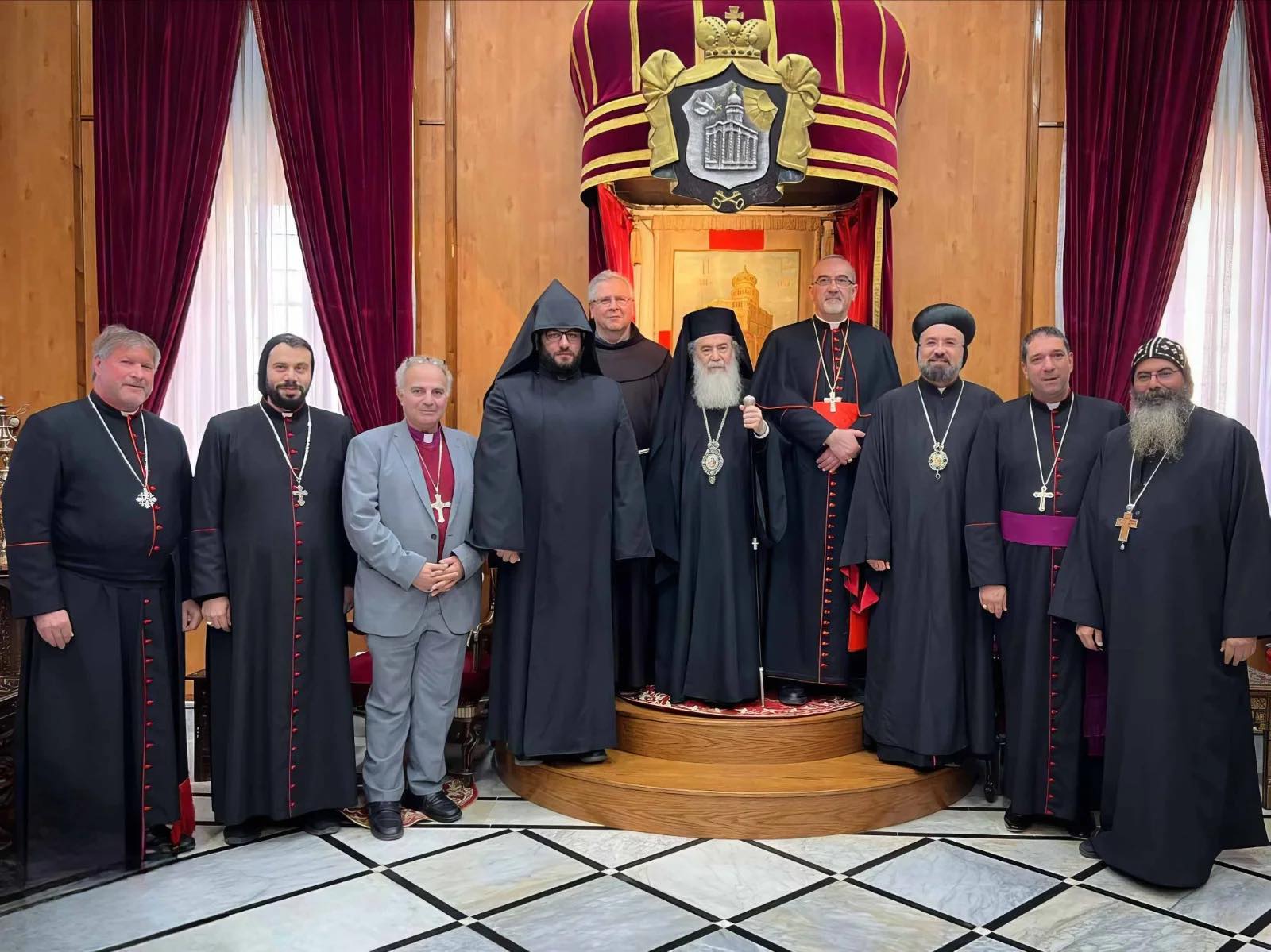
The January 2026 statement issued by the Patriarchs and Heads of Churches in Jerusalem condemns “Christian Zionism” as a damaging ideology and asserts exclusive authority to represent Christian communities in the Holy Land. The document has been widely cited, but often without sufficient clarity about what Christian Zionism actually is—or how it differs from ordinary political support for the State of Israel. Without this distinction, the statement risks generating confusion rather than understanding.¹

What Christian Zionism Is—and Is Not
Christian Zionism is not synonymous with support for Israel’s existence. It is a theological–ideological framework, developed largely within modern Protestant evangelicalism, that assigns biblical and eschatological significance to the modern State of Israel. Its classical form rests on three assumptions: a literalist reading of Old Testament land promises, a dispensationalist division of salvation history, and the belief that contemporary geopolitical events in Israel fulfil uncompleted biblical prophecy.²
Within this system, the Jewish people are understood to retain a distinct covenantal role alongside the Church, and territorial claims are often treated as divinely guaranteed. This theological construction is foreign to historic Christianity and is rejected by Catholic, Orthodox, and Oriental Orthodox theology, which affirm that the promises made to Israel are fulfilled in Christ and extended through His Church, not perpetuated as national or territorial entitlements under the Old Covenant.³
In its contemporary form, however, Christian Zionism is more often political than theological. It appears as uncritical or sacralised support for Israeli state actions, treating policy decisions as morally insulated because they are presumed to be part of God’s plan. In this guise, biblical language is used to override moral theology, and political judgement is replaced by prophetic certainty.⁴
It is this politicised form—encountered directly by local Christian communities—that the Jerusalem churches most forcefully oppose.
Support for Israel as a State: A Separate Question
Support for Israel as a state is not Christian Zionism. It is a prudential political position grounded in international law, diplomacy, and moral reasoning, not theology.
One may legitimately support Israel’s right to exist, defend its citizens against terrorism, oppose antisemitism, or favour diplomatic alignment with Israel without invoking Scripture, prophecy, or eschatology. Such support treats Israel as a modern nation-state—subject to the same moral evaluation as any other state—and does not claim divine mandate for its policies.⁵
This distinction is decisive. Support for Israel as a state allows for moral scrutiny of military conduct, proportionality, civilian protection, and justice. Christian Zionism, by contrast, often removes such scrutiny by sacralising political action.⁶
Failing to distinguish between these positions collapses political prudence into theology and theology into ideology.
Why Historic Churches Reject Christian Zionism
The historic churches reject Christian Zionism for four consistent reasons. First, they affirm fulfilment in Christ rather than the continuation of land-based covenantal claims. Second, they reject dispensationalism as incompatible with the unity of salvation history. Third, they distinguish biblical Israel from any modern political entity. Fourth, they confront the pastoral reality that imported ideological frameworks frequently exacerbate the vulnerability and marginalisation of local Christian communities, particularly Arab Christians.⁷
On these grounds, the theological rejection of Christian Zionism is sound and longstanding.
Where the Jerusalem Statement Goes Further
The difficulty lies not in the rejection itself, but in the absence of distinctions. The January 2026 statement condemns Christian Zionism categorically, without differentiating between theological systems, political advocacy, or ordinary diplomatic support for Israel. As a result, the term functions as a totalising label rather than a precise theological critique.⁸
This imprecision is not accidental. By collapsing all external Christian engagement with Israel under a single ideological heading, the statement delegitimises alternative Christian voices—especially those welcomed by political authorities outside established ecclesiastical channels.

Authority, Representation, and Access
The statement’s insistence that the Patriarchs and Heads of Churches alone represent Christian communities in all religious, communal, and pastoral matters reveals its deeper concern: who speaks, and to whom. The repeated reference to unauthorised individuals being received at “official levels” underscores that this is as much a diplomatic intervention as a theological one.⁹
In effect, the document serves as a warning to governments and institutions that engagement with alternative Christian representatives constitutes interference in the internal life of the churches. It is an assertion of representational monopoly aimed at preserving institutional authority under conditions of political and demographic pressure.
Yet this raises ecclesiological tensions of its own. In Catholic theology, representation flows from defined offices exercising ordinary jurisdiction, not from ecumenical consensus bodies claiming exclusive authority across confessional boundaries. The claim may be politically intelligible, but it is canonically and ecclesiologically ambiguous.¹⁰
Unity as Boundary Enforcement
Unity is the statement’s governing motif, grounded in Romans 12:5. But unity here is defined defensively. Communion is treated less as sacramental participation than as institutional alignment, and acting outside recognised structures is framed as a wound to the Body of Christ.
The result is that unity functions not primarily as a theological good to be discerned and deepened, but as a mechanism for boundary enforcement.¹¹
The Central Clarification
The essential clarification is this: One may reject Christian Zionism theologically, support Israel politically, criticise Israeli policies morally, and defend Jewish people unequivocally against antisemitism—without contradiction.
When these distinctions are ignored, political judgement masquerades as doctrine, and institutional authority risks substituting itself for theological clarity.
Conclusion
The Jerusalem statement is best read not as a definitive theological judgement, but as an act of ecclesiastical statecraft by historic churches seeking to preserve their voice in a politicised and volatile environment. Its warning against Christian Zionism addresses a real problem, but its lack of precision risks conflating ideology with legitimate political engagement.
Jerusalem has spoken with urgency. Whether it has spoken with sufficient care—and whether unity has been strengthened or merely enforced—remains the unresolved question at the heart of the debate.
¹ Statement by the Patriarchs and Heads of Churches in Jerusalem on Christian Zionism, 17 January 2026.
² John Nelson Darby, Synopsis of the Books of the Bible (London, 1857); C. I. Scofield, The Scofield Reference Bible (Oxford University Press, 1909).
³ Catechism of the Catholic Church, §§839–840; cf. Galatians 3:28–29; Ephesians 2:14–16.
⁴ Stephen R. Sizer, Christian Zionism: Road-Map to Armageddon? (Leicester: IVP, 2004).
⁵ Second Vatican Council, Gaudium et Spes, §§76–79 (principles governing political authority and moral responsibility).
⁶ Catechism of the Catholic Church, §§2307–2317 (just war doctrine and moral limits on state violence).
⁷ Pontifical Biblical Commission, The Jewish People and Their Sacred Scriptures in the Christian Bible (2001).
⁸ Cf. Gerald McDermott, Israel Matters: Why Christians Must Think Differently about the People and the Land (Grand Rapids: Brazos Press, 2017), for evidence of internal diversity within so-called “Christian Zionism.”
⁹ Statement by the Patriarchs and Heads of Churches in Jerusalem, §3.
¹⁰ First Vatican Council, Pastor Aeternus, chs. 3–4; Code of Canon Law (1983), canons 381–383.
¹¹ Joseph Ratzinger, Called to Communion (San Francisco: Ignatius Press, 1996), ch. 4.
RELATED ARTICLES


LATEST ARTICLES
- FR RIPPERGER’S YEAR OF SILENCE: Obedience is not an explanationFr Chad Ripperger has accepted a year-long withdrawal from public speaking as requested by Archbishop Golka of Denver, aimed at focusing on his priestly community. This decision, following the removal of another exorcist, raises concerns about the Church’s balance between discretion and public witness regarding exorcism and supernatural matters.
- Today’s Mass: October 20 Octave Day of St Edward, King & ConfessorEdward the Confessor, England’s last Saxon king, ruled from 1042 until his death in 1066. Born in 1003, he fled to Normandy during Danish rule and returned to take the throne. His reign is debated, seen as both weak and a time of peace. Edward’s legacy includes the establishment of Westminster Abbey, where he is buried.
- SYNODALITY CANNOT SUBSTITUTE FOR GOOD BISHOPSCardinal José Cobo has highlighted the extensive process behind episcopal appointments, which includes numerous consultations and documentation, yet questions the effectiveness of this method in selecting suitable bishops. He stresses the need for reform in canon law and cautions against equating thorough procedures with genuine ecclesiastical wisdom and accountability.
- GAZA’S DEAD and the Claims Made in Their NameWestern politicians and media vilify Israel with double standards, while ignoring massacres of Christians across the Middle East. A century ago Christians were 20% of the region; now less than 4%, with persecution “close to genocide.” Yet Israel is the only state where Christians grow and worship freely. The Vatican mobilises diplomacy for Palestine, climate, and migration, but whispers for its own martyrs. Truth, then justice, then peace — anything less is counterfeit.
- PORTSMOUTH’S MISSING GENERATIONBishop Philip Egan has cautioned about the potential disappearance of Catholicism in England. Reports reveal an alarming trend where young people disengage after Confirmation and parents withdraw after baptismal preparation, despite some recovery in Mass attendance. Egan’s missionary programme must effectively transmit the Faith to future generations.




Leave a Reply