
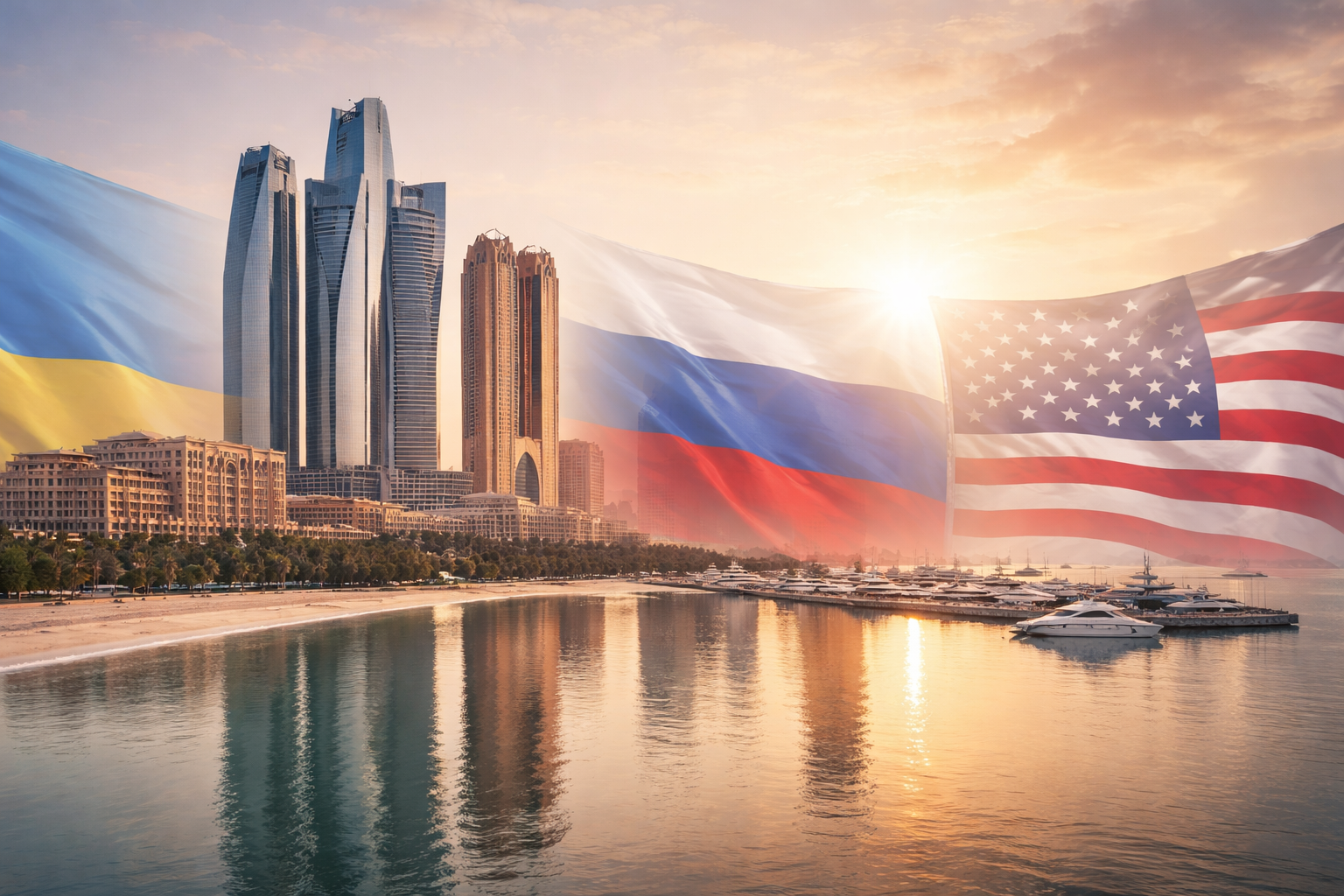
A Call to Prayer: Abu Dhabi Talks, A Tentative Opening for Peace in Ukraine
Representatives of Ukraine, Russia, and the United States have gathered today in Abu Dhabi for what officials describe as the first trilateral peace talks since the outbreak of Russia’s full-scale invasion of Ukraine in February 2022.¹ While expectations remain deliberately low, the mere fact of a three-party forum marks a notable diplomatic departure after nearly four years of war, attrition, and failed mediation efforts.
The initiative appears to have emerged at short notice from Washington. Ukrainian President Volodymyr Zelensky indicated late last night that the talks were proposed following a meeting with Donald Trump on the margins of the World Economic Forum in Davos, signalling a renewed American push to test whether a negotiated pathway—however narrow—still exists.²
Delegations and Representation
Ukraine is represented in Abu Dhabi by a senior and security-focused delegation. The talks are being led by Rustem Umerov, who has served as Kyiv’s chief negotiator in previous indirect contacts, alongside Kyrylo Budanov, the influential head of Ukraine’s military intelligence and a close adviser to the president. Their presence underscores that Kyiv views the discussions not as symbolic diplomacy, but as talks with direct implications for security, territory, and intelligence guarantees.³
Russia’s delegation is reported to include senior security officials, while the United States has dispatched envoys closely aligned with the current administration’s foreign-policy strategy. Details of the precise format remain unclear, with indications that some exchanges may take place through parallel or shuttle diplomacy rather than a single joint negotiating table.⁴
Why Abu Dhabi—and Why Now
Abu Dhabi’s role as host reflects its growing status as a neutral diplomatic hub, able to accommodate high-level talks between adversaries without the symbolic weight carried by European or NATO capitals. The choice of venue also suggests an effort to keep the discussions insulated from domestic political pressures and media spectacle.⁵
Substantively, the timing reflects strategic exhaustion rather than sudden optimism. The war has settled into a grinding pattern of incremental advances, high casualties, and mounting economic strain on all sides. Russian officials continue to insist that any settlement must address territorial realities created by the war, while Kyiv has repeatedly affirmed that sovereignty and security guarantees are non-negotiable. These positions remain fundamentally opposed.⁶
Measured Hope, Not Illusion
No serious observer expects a comprehensive peace agreement to emerge from Abu Dhabi. At best, the talks may clarify red lines, explore humanitarian or prisoner-exchange mechanisms, or test whether a ceasefire framework is even conceivable. Yet in a conflict where communication has increasingly narrowed to threats and intermediaries, direct trilateral engagement itself is significant.
History offers sobering lessons: peace processes often begin not with trust, but with fatigue; not with consensus, but with recognition that perpetual war corrodes nations, families, and generations.
A Call to Prayer
For Christians—and especially for readers of Nuntiatoria—this moment demands more than political commentary. It calls for intercession.
We urge our readers to pray earnestly for peace, for wisdom among negotiators, for restraint among military leaders, and for the protection of civilians who continue to suffer daily from this conflict. Pray that hardened positions may soften, that pride may yield to prudence, and that the Lord of history may draw good even from human failure.
“Blessed are the peacemakers, for they shall be called the children of God.” (Matthew 5:9)
Whether these talks bear immediate fruit or merely prepare the ground for future efforts, let them not pass without the prayerful attention of the faithful.
- Reporting on the convening of trilateral talks in Abu Dhabi, January 2026, widely covered by international media following confirmation from US and Ukrainian officials.
- Statements by Volodymyr Zelensky following meetings at the World Economic Forum, Davos, indicating a late-stage American proposal for trilateral engagement.
- Ukrainian government confirmations regarding the composition of its delegation, including Rustem Umerov and Kyrylo Budanov, January 2026.
- Diplomatic briefings cited by international correspondents indicating mixed bilateral and trilateral formats rather than a single plenary session.
- Analysis of Abu Dhabi’s role in recent high-level diplomatic initiatives involving adversarial states, including prior mediation efforts by the UAE.
- Public statements from Russian and Ukrainian officials reiterating opposing positions on territorial sovereignty and security guarantees throughout late 2025 and early 2026.
RELATED ARTICLES


LATEST ARTICLES
- The Church Does Not Need Our Denial: Truth, scandal and the false defence of ecclesiastical reputationThe text explores the concept of “spiritual denial” within the Catholic Church regarding serious allegations against church leaders. It argues that this denial, often perceived as loyalty, leads to evasion of uncomfortable truths. The piece emphasises that acknowledging these failures does not undermine the Church’s integrity, urging faithful confrontation of wrongdoing while maintaining justice for all involved.
- The Dossier against the Victim: Bergoglio, Grassi and the Counter-Investigation the Church CommissionedAfter Fr Julio César Grassi was convicted of child sexual abuse, the Argentine Episcopal Conference, under Cardinal Bergoglio, commissioned a counter-investigation claiming his innocence, allegedly costing US$300,000. A new book by Grassi’s victim details intimidation faced by him post-conviction, highlighting the disparity in institutional support between the abuser and the victim.
- What takes priority? Leo XIV, Sexual Morality and the Synodal Reordering of Moral EmphasisPope Leo XIV has not rejected Catholic sexual morality, but his remarks hint at a pastoral shift prioritising issues such as justice and equality over sexual ethics. As the Amoris Laetitia synod approaches, concerns arise about whether moral teachings will remain authoritative as pastoral priorities evolve. The Church’s foundational beliefs may risk being undermined in this reordering.
- After the Mistrial: The Lindsay Clancy Spectacle DeepensThe mistrial concerning Lindsay Clancy’s case revealed a split jury regarding her criminal responsibility for the deaths of her three children. Although eleven jurors seemed to lean towards a lack of guilt due to mental illness, the incident highlights the complex interplay between compassion, public perception, and accountability in tragic cases.
- Today’s homily: Feria II of the Fifteenth Sunday Post PentecostSt Paul urges us not to grow weary in doing good: every prayer, sacrifice, act of charity and fidelity is seed sown for eternity. Our task is to persevere in the sowing and trust God for the harvest.


Leave a Reply