

Quinquagesima: Let Me See — Charity at the Threshold of Lent
MASS Esto mihi in Deum protectórem
LESSON 1 Corinthians 13:1-13
GOSPEL St Luke 18:31-43
HOMILIST Mt Revd Jerome Lloyd OSJV

Beloved in Christ,
We stand today at a spiritual frontier. Quinquagesima — the fiftieth day before Easter by the Church’s ancient and solemn reckoning — is not merely a calculation of time. It is a warning bell. It is the last light before the desert begins.
In three days the ashes will darken our brows. The Alleluia has already fallen silent. The Church, like a wise mother, does not thrust us into Lent without instruction. She slows us. She examines us. She gathers us inward.
And today, alongside this mighty pre-Lenten liturgy, she commemorates the holy martyrs Saints Faustinus and Jovita, brothers in blood and in faith, who bore witness to Christ in Brescia in the second century. They were not theorists of charity; they were its embodiment. Their love for Christ was not decorative — it was decisive. It cost them their lives. Thus even in a quiet commemoration, the Church reminds us: charity, if real, will always demand something.
These three Sundays — Septuagesima, Sexagesima, Quinquagesima — have been a spiritual crescendo. The soil of the soul has been examined. The seed has been sown. Now the question becomes unavoidable: what kind of ground are we?
Last week, the parable of the sower asked: “He who has ears to hear, let him hear.” Today, the Gospel presses further: let him who has eyes, see.
But before our sight is healed, our heart must be purified. That is why Holy Mother Church gives us Saint Paul’s great hymn to charity. It is not sentiment. It is not liturgical ornament. It is judgment.
“If I speak with the tongues of men and of angels, and have not charity, I am nothing.”
Nothing.
Not “less.” Not “imperfect.” Nothing.
The Apostle strips us of illusion. We may fast. We may pray. We may defend orthodoxy. We may suffer inconvenience. But if sacrificial love does not animate our actions — love of God above all things, love of neighbour for God’s sake — we are sounding brass, a clashing cymbal, noise without substance.
Charity is patient. Charity is kind. Charity is not self-seeking.
And here is the sting: charity must cost us.
If we give only what is comfortable, it is not yet Christian charity. If we offer only spare time, spare patience, spare attention, it is not yet cruciform love. True charity presses upon our pride. It unsettles our self-will. It wounds our vanity.
That is why this Epistle stands at the gates of Lent. Lent is not a seasonal hobby. It is not an exercise in religious self-improvement. It is the purification of love.
We speak casually of what we shall “give up.” But the deeper question is more searching: how shall I love more? How shall I love God more intensely? How shall I manifest that love concretely, visibly, sacrificially?
To answer honestly requires courage. It means confronting habits we excuse, resentments we nurse, comforts we cling to. It means acknowledging that we have grown spiritually complacent.
Now we turn to the Gospel.
Our Lord draws the Twelve aside. He speaks with terrible clarity: He will be delivered, mocked, scourged, crucified — and rise again. The Passion is laid out before them.
“And they understood none of these things.”
The Cross is announced — and remains hidden.
Is that not our condition? We know Lent is coming. We know Good Friday stands ahead. We have heard the Passion read year after year. And yet we move forward as though it were distant history rather than imminent reality.
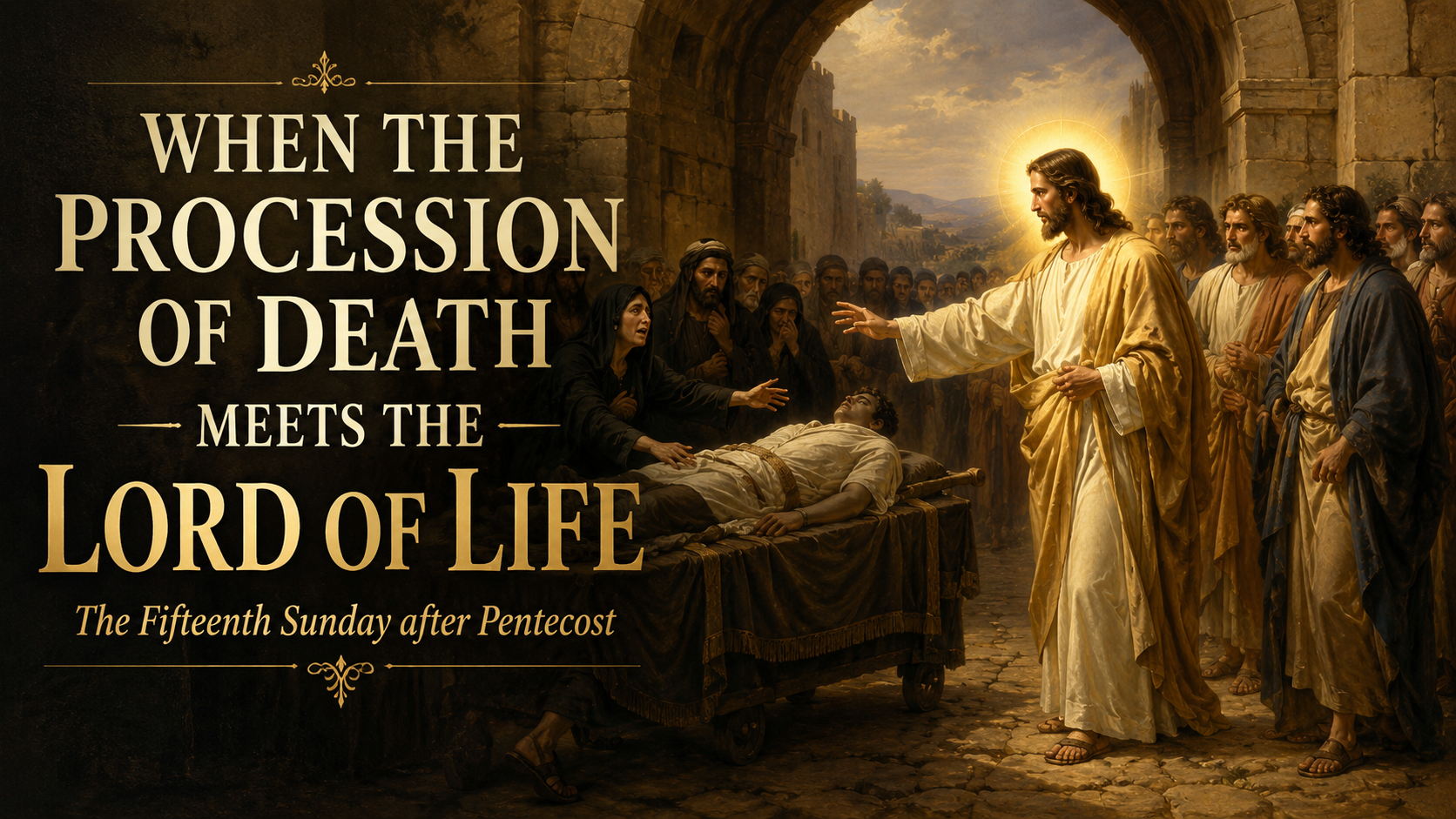
Then, on the road near Jericho, a blind man sits begging.
He cannot see — yet he sees more clearly than the Apostles.
“Jesus, Son of David, have mercy on me!”
The crowd rebukes him. They try to silence him. How familiar that is. The world tolerates spectacle and indulgence, but it grows impatient with repentance. It has little patience for cries of mercy.
Yet he cries out all the more.
He recognises Christ as the Son of David — the promised Messiah. He acknowledges his need. He does not demand prestige or power. He asks for sight.
“Lord, that I may see.”
And Christ replies: “Receive thy sight; thy faith hath made thee whole.”
That must become our prayer at the threshold of Lent.
Not: “Lord, improve my circumstances.”
Not: “Lord, make me comfortable.”
But: “Lord, let me see.”
Let me see my sin more clearly.
Let me see the Cross more dearly.
Let me see how little I have yet loved.
At every Mass we enter that same humility. “Behold the Lamb of God.” And we answer with the centurion’s words: “Lord, I am not worthy… but speak the word only and my soul shall be healed.”
This is Quinquagesima’s posture: humility before mercy.
When Passiontide comes, when we kneel before the Cross and kiss the wounded feet of Christ on Good Friday, what should stir within us? Not theatrical sorrow. Not passing emotion. But a deep interior vow: never again to presume upon such love.
The martyrs Faustinus and Jovita did not presume. They did not bargain. They gave all. Their charity was total.
And so our Lent must not be token. Every denied indulgence. Every act of discipline. Every confession. Every prayer. Every work of mercy. Let it be animated by real love — not by spiritual vanity, not by habit, not by comparison with others.
To see with the eyes of faith is to recognise ourselves in the light of Christ — the perfect Image of the Father — and to be humbled. But it is also to be drawn upward. We were created for union with God. That is why we exist.
Charity alone remains in eternity. Faith will give way to sight. Hope will give way to possession. But love endures.
Let charity, then, be our rule. Let love — sacrificial, persevering, costly love — be the force that drives us into Lent.
That we may begin here below to be conformed to Christ crucified — and one day behold Him face to face in glory.
In the Name of the Father, and of the Son, and of the Holy Ghost. Amen.
Homilies Archive

Mass Propers


DAILY MASS ONLINE
One of the earliest online apostolates dedicated to the Traditional Latin Mass, Old Roman TV began broadcasting the Holy Sacrifice on the Feast of the Assumption, 15 August 2008. During the COVID-19 pandemic, additional programming — devotions, catechesis, and conferences — was added to support the faithful in prayer and formation.
Support the daily Holy Mass on Old Roman TV by offering a Mass intention — for loved ones, thanksgiving, or the repose of souls. Your intention helps sustain the sacred liturgy and brings grace to those you remember before God’s altar.
SUPPORT THE DAILY MASS ONLINE
Likely the world’s longest-running daily online broadcast of the
Traditional Latin Mass, streaming faithfully since the
Feast of the Assumption 2008.

This apostolate cannot continue without immediate help
Please support us with a contribution toward
chapel rent, sacristy supplies, operating costs, and web-hosting.
Our essential monthly costs reach £1,000.




Leave a Reply