
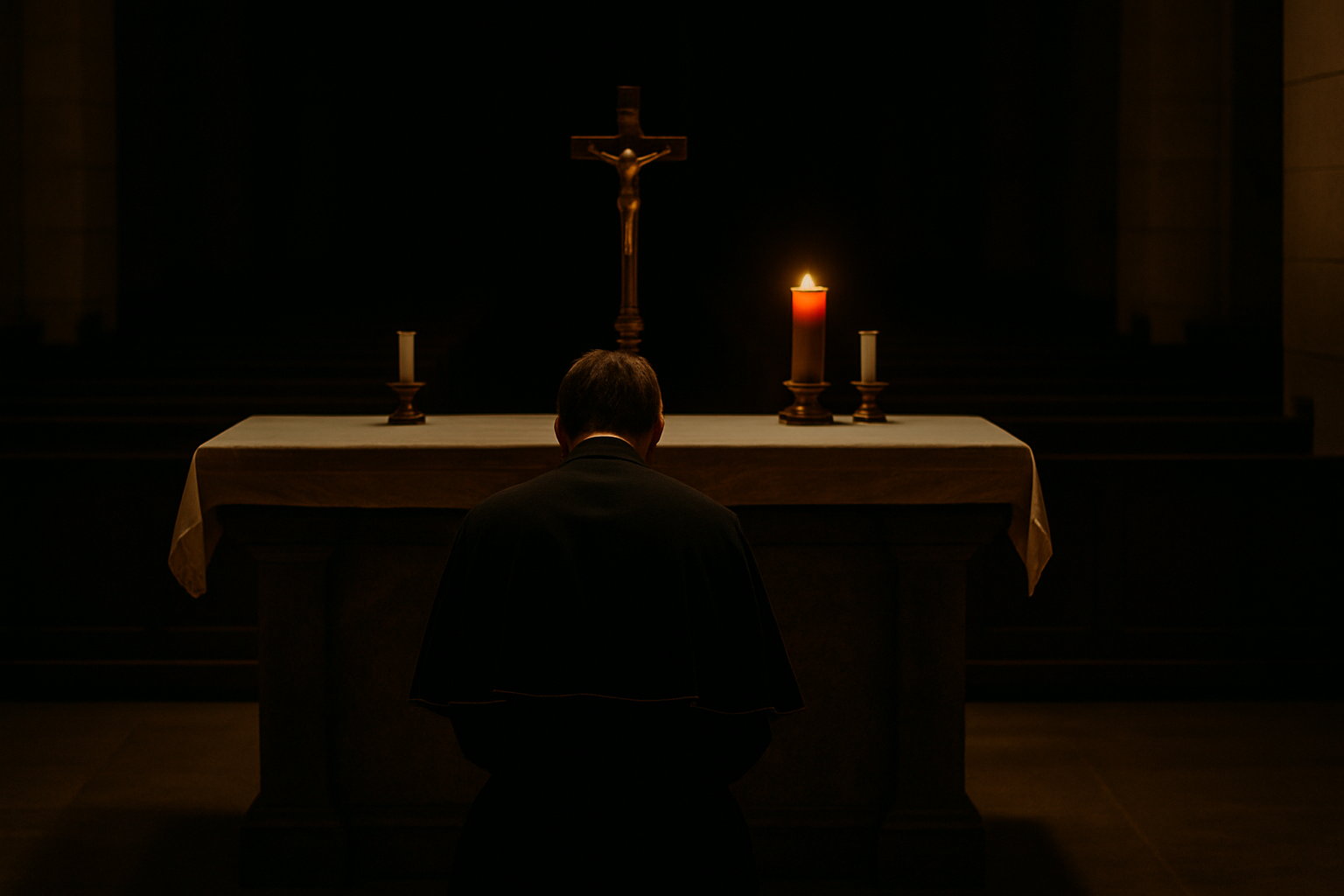
The Forgotten Disposition: The Crisis of Priesthood and the Loss of Sacramental Culture
The crisis in the contemporary priesthood is repeatedly described in the language of psychology: burnout, loneliness, exhaustion, alienation. These terms are accurate, and the data supporting them is real, but they tell only the surface of the story. Beneath the measurable symptoms lies a deeper spiritual contradiction: the Church continues to expect a sacrificial identity from her priests, even while removing the cultural, liturgical, and symbolic structures that once disposed them to receive the grace required to live that identity. Grace is not absent. What is missing is the interior disposition that allows the priest to cooperate with what he already receives.
This distinction is not academic. It is the difference between seeing the crisis as a private mental struggle, or as a structural weakening of the priestly form. Catholic theology insists that the sacramental grace of Orders is objective, given through the action of Christ. Yet it also insists that the fruit of that grace depends upon the interior readiness of the recipient. The Fathers understood this with burning clarity. St John Chrysostom explained that the priest stands on earth within a heavenly ordinance, “as if he stood in heaven itself,” and therefore must be formed by a purity that does not come from his own resources¹. Chrysostom’s insight is not about behaviour alone, but about interior shaping. Priesthood is not a private spiritual state; it is an identity formed by ritual density and sacramental enclosure.
In the traditional Roman rite, the priest was not asked to generate his own spiritual readiness. He was carried into mystery. The ritual protected him. The Canon concealed him. The direction of prayer drew him away from himself. The people saw Christ’s action; the priest disappeared behind it. The rite did not rely on the man; it formed the man. Through repetition, gesture, silence, orientation, posture, and the weight of inherited forms, the priest learned to see himself as a sacrifice with Christ, not as a performer before an audience. St Augustine expresses this interiorisation succinctly: the priest “is a sacrifice for the flock, for he is the minister of the one true Sacrifice”². Sacrifice is not a metaphor; it is a shape of existence given through the liturgy.
Today, the priest is often expected to supply personally what the rite once generated organically. The contemporary liturgical paradigm places him in a position of constant visibility, both spiritually and emotionally. He stands before the people not hidden in the action, but exposed within it. The altar becomes a point of engagement, not enclosure. The symbolic density that once formed the priest’s interior disposition has thinned, and what remains is the expectation that a young man can live sacrificially by the force of personality, emotional presence, and pastoral improvisation. St Ambrose warned that if the priest is not “hidden with Christ in God,” the weight of what he appears to be will eventually overcome him³. Ambrose is diagnosing the modern condition: the priest becomes the bearer of transcendence personally.
The result is a double burden. The priest must be simultaneously sacramental and therapeutic, mediator and companion, father and friend, sacrifice and social presence. St Leo the Great described the paradox of priesthood as a kind of death, where “he who presides at the altar must die to himself, that he may live for all”⁴. Dying to oneself requires a liturgical and cultural environment that supports self-emptying. When ritual enclosure is replaced by emotional exhibition, the priest is asked to die while remaining visible, to surrender while projecting confidence, and to disappear while being expected to hold a community together by the strength of his personality. This contradiction does not simply exhaust the priest; it makes interiorisation of grace unstable.
It is easy to romanticise the past or to accuse the present of corruption. Instead, the question must be asked clearly: why did previous generations of priests endure hardship with fewer signs of collapse? The answer is not that they were stronger. It is that the structure of priestly life provided armour. The rite absorbed their frailty. The culture reinforced their identity. The people shared their devotional imagination. The parish was not a marketplace of religious options but a living sacramental organism. The priest did not need to justify himself; the liturgical form justified his life. To use the language of anthropology: the environment provided the conditions of disposition.
Contemporary research supports this claim. A doctoral study conducted across four English dioceses demonstrates that the leading cause of stress among priests is not merely workload, but what it names “contradictions”: the collision between the priest’s sacramental identity and the secular expectations of the community he serves⁵. The study’s conclusion is strikingly theological in implication, even though it is sociological in method: “the clear identity of priesthood… began to blur”⁶. Here, empirical data confirms what the Fathers already explained: when priestly identity is not supported by a sacramental culture, it becomes psychologically fragile. Stress is not simply the result of too many tasks, but of an identity demanded without a structure that forms it.
The priests interviewed in the study reported a growing “convenience-store mentality” among the faithful⁷: the reduction of sacramental life to service provision, where the priest becomes the facilitator of religious options rather than the mediator of grace. St Gregory the Great predicted precisely this kind of fragmentation: the priest’s soul, scattered among the crowds, “returns to the altar bearing the wounds of his distractions”⁸. Without ritual orientation, a shared ecclesial imagination, and the shelter of a consistent sacramental grammar, the altar becomes the place where the wounds are carried, not the place where identity is renewed.
It is essential to stress what is not being claimed. The contemporary form of the Roman Rite remains a valid sacrifice, and Christ is truly present. The question is not one of objective grace, but of subjective reception. The Mass always gives what Christ intends to give. What has changed is the capacity of priests to receive and cooperate with that grace, because the structures that formed their interior disposition have been eroded. Grace has not vanished. The armour of ritual has.
This, then, is the heart of the crisis: the Church has maintained the theology of sacrifice, but weakened the anthropology of sacrifice. The priest is still called to be a victim with Christ, but the forms that train his heart into victimhood have thinned. The expectations have remained, while the methods of interior formation have been altered. In such a position, the priest experiences Christ’s command without Christ’s cultural support, and the result is often anxiety, loneliness, and confusion about identity. Many priests remain faithful at great personal cost; others quietly collapse under a double demand they cannot satisfy.
The renewal of the priesthood will not come from psychological techniques alone, nor from managerial reform, nor from demanding a heroic endurance from tired men. It will require the restoration of the conditions of disposition, the structures through which grace becomes life: the return of ritual density, sacred orientation, silence, and the concealment of the priest within the mystery; the rebuilding of priestly fraternity; the recovery of doctrinal clarity about sacrificial identity; the cultivation of devotional culture among the faithful; and the reduction of the expectation that the priest must generate unity by personality and affect. This is not nostalgia. It is a return to the logic that the Fathers regarded as essential: that the priest’s life be formed by the form of the liturgy.
The Church has not lost the Mass. She has lost the means by which the Mass becomes the priest’s life. The grace remains; the disposition has weakened. Behind every exhausted priest stands an unspoken claim: that identity can be lived from doctrine alone. The Fathers insist that it must be lived from doctrine in form. Until the Church recovers the sacramental and cultural conditions that dispose men to receive what they already possess, the priesthood will continue to suffer not from lack of grace, but from lack of access to the interior fruit of grace.
It is not the priest who has changed, but the world around him. And it is the work of the Church to place him again within the form that makes his sacrifice possible.
- St John Chrysostom, On the Priesthood, I.5.
- St Augustine, Sermon 340, On the Priest as Sacrifice.
- St Ambrose, De Officiis Ministrorum, I.50.
- St Leo the Great, Sermon 5 on the Nativity.
- U. Doyle, Stress in the Roman Catholic Priesthood (University of Nottingham, 2005), Abstract.
- Doyle, Stress in the Roman Catholic Priesthood, p. 3.
- Doyle, Stress in the Roman Catholic Priesthood, Abstract.


LAtest
- THE DATA YOU OUTSOURCE IS STILL YOUR RESPONSIBILITYThe RNLI’s exposure through the Beacon CRM cyberattack illustrates a problem far wider than one charity. Organisations can outsource their databases, hosting and technical security, but they cannot outsource responsibility for the information they choose to collect. Data minimisation, supplier scrutiny and controlled access are not merely GDPR exercises: they are duties of custodianship.
- “THAT THE WORLD MAY HAVE LIFE”: LEO XIV GOES TO FRANCEPope Leo XIV arrives in France five weeks after its assisted-dying law came into force and two years after guaranteed access to abortion was written into the Constitution. His first encyclical calls life from conception to natural death the first human right. At the Élysée, Notre-Dame and Lourdes, the question is now how explicitly he will apply that doctrine to France.
- Today’s homily: St Matthew, Apostle & EvangelistThe Reckoning of Mercy reflects on the transformative calling of St Matthew, a despised tax collector, by Christ. It illustrates the concept that God’s grace empowers genuine conversion, emphasising that true mercy requires both acknowledgment of one’s past and active adherence to justice. Matthew’s journey from publican to apostle embodies this principle.
- Today’s Mass: September 21 St Matthew, Apostle & EvangelistMatthew the Apostle and Evangelist, also called Levi, was sitting at his tax-collector’s desk in Capernaum when he was called by Christ. He followed Him at once, and also gave a feast for Him and the other disciples.
- Sermon for St. MatthewToday, we honour St. Matthew, a tax collector called by Jesus to discipleship. Despite their notorious reputation, tax collectors were essential to Jesus’ ministry of redemption. St. Matthew’s Gospel, aimed at a Jewish audience, emphasises Jesus as the fulfilment of prophecy and outlines Christ’s teachings, including the Sermon on the Mount.




Leave a Reply