

Time Redeemed by Obedience: The Circumcision of Christ and the Christian Meaning of the New Year
MASS Puer natus
EPISTLE Titus 2: 11-15
GOSPEL St Luke 2: 21
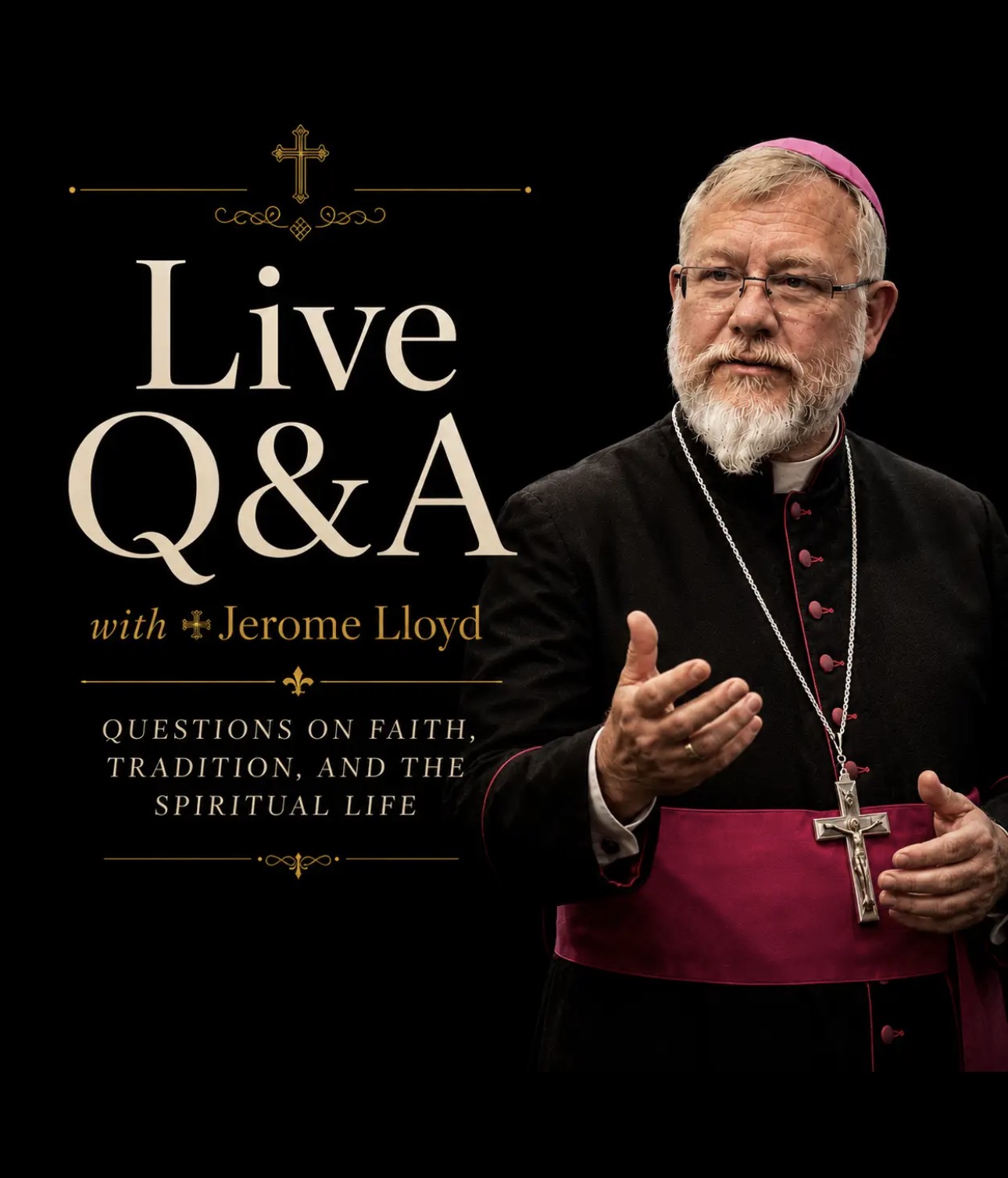
HOMILIST Mt Revd Jerome Lloyd OSJV

Beloved in Christ,
The Church begins the civil year not with optimism, resolutions, or abstraction, but with a wound. On the eighth day after His Nativity, the Child is circumcised. Blood is shed. A covenant is marked in flesh. Salvation history advances not by ideas, but by obedience.
Since at least the sixth century, this Octave day has been kept as the Feast of the Circumcision of Christ. The Gospel is stark in its simplicity: “After eight days were accomplished… the Child was circumcised” (Luke 2:21). Yet in that brief verse the entire drama of redemption is already present. Circumcision was the sacramental sign of the Old Law, instituted with Abraham as the seal of God’s covenant promise — that in his seed all the nations of the earth would be blessed. It was a rite of incorporation through blood, binding a man to God by obedience written into the body itself.
By submitting to circumcision, Christ manifests Himself as the true Seed of Abraham, born of a woman, born under the Law, to redeem those who were under the Law (Gal. 4:4–5). He who had no need of purification accepts the sign of sinners. He who is the Lawgiver places Himself beneath the Law. He does not abolish it; He exhausts it by fulfilling it.
Here, at eight days old, Calvary already begins.
The theology is precise and uncompromising. Circumcision involves the cutting away of flesh and the shedding of blood. It signifies both belonging and loss: belonging to God, and the removal of corruption. Christ’s first bloodshed is therefore no accident of history, but a deliberate assumption of the covenant in its most severe form. The Blood that will one day flow from His hands, feet, and side flows first here — quietly, hidden, without protest. Bethlehem has not finished speaking; it has begun to preach sacrifice.
At this same moment, the Child receives His Name: Jesus — Salvator. The Church insists that He does not bear this Name sentimentally or symbolically. He earns it immediately. He is named Saviour at the very moment He begins to save. One drop of this Blood, as the Fathers never tire of repeating, would have sufficed to redeem the world. The Holy Name and the Precious Blood are inseparable. To invoke one is already to invoke the Cross.
This feast also confronts us with what modern thought finds most offensive: the so-called scandal of particularity. Why should universal salvation depend upon the circumcision of a Jewish male child at a specific moment in history? Why should divine truth be bound to flesh, blood, time, and place? Would it not be more reasonable — more “spiritual” — to seek universal religious truth through abstract philosophy, as the Greeks attempted, or through private experience, as modernity prefers?
Sacred Scripture answers not with theory but with reality. Just as we cannot belong to humanity except through one particular family, so we cannot be redeemed except through one particular history. God does not reveal Himself by disembodied ideas, but by entering time, genealogy, and covenant. The Bible is not crude because it is historical; it is salvific because it is historical. The Incarnation is not an illustration of truth — it is truth lived in flesh and blood.
This is why the Church rejected the heresy of Marcion in the second century. Marcion attempted to sever Christ from the God of Israel, mercy from judgment, the New Testament from the Old. In doing so, he emptied Christianity of history, of creation, and ultimately of the Cross itself. The Church answered with unwavering clarity: the God of Abraham is the Father of Jesus Christ; the Creator is the Redeemer; the Old Covenant is not repudiated but fulfilled. Any Christianity that claims love without judgment, mercy without sacrifice, Christ without the Cross, is merely Marcionism reborn.
The liturgy itself teaches this unity. Twelve prophecies from Israel’s history are proclaimed at the Paschal Vigil. The Exodus is sung in the Exsultet. Abraham’s sacrifice is named in the Roman Canon. We call the children of Israel our forefathers because, by Baptism, we truly become heirs of their promise. Circumcision gives way to Baptism; the Law gives way to grace; blood in the flesh gives way to death and resurrection in Christ — but nothing is discarded. Grace perfects nature; it does not abolish it.
Thus the New Year is consecrated not to novelty, but to continuity; not to self-invention, but to obedience. The world begins its calendar with fireworks and self-assertion. The Church begins hers with a knife and a Child who submits. She teaches us that time is redeemed not by progress, but by conformity to Christ crucified.
If the coming year is to be holy, it must be marked not by our plans, but by His wounds. Marked by the Name that saves. Marked by the Blood that speaks more eloquently than that of Abel. The Circumcision proclaims this with terrible clarity: there is no covenant without blood, no salvation without sacrifice, no future without the Cross already begun.
Contemporary relevance and application — the New Year
As the civil year turns, the Feast of the Circumcision of the Lord confronts the faithful with a profoundly Christian way of entering time. The world welcomes the New Year with resolutions rooted in self-improvement, autonomy, and the illusion of control, as though the future could be mastered by optimism or willpower. The Church, by contrast, opens the year with Christ submitting Himself to the Law and shedding His Blood. She teaches us that the year ahead will not be sanctified by novelty or reinvention, but by obedience and fidelity.
In an age that seeks spirituality without discipline, belonging without obligation, and redemption without cost, the circumcised Christ stands as a living rebuke. He shows that covenant entails submission, that to belong to God is not a matter of self-definition but of being marked — decisively and irrevocably — by obedience. Baptism has marked us more deeply than circumcision ever could, not by a wound in the flesh but by incorporation into the death and resurrection of Christ. To enter the New Year as Christians, therefore, is not to ask what we shall make of our lives, but what God requires of us; not how we shall define ourselves, but how we shall conform ourselves to Him. The New Year will not be renewed by enthusiasm or activism, but by Christians willing to be governed — in body, mind, and life — by the Blood-marked obedience of the Incarnate Son, until time itself yields to eternity.
May we, who have received not circumcision in the flesh but Baptism into Christ, live as true heirs of Abraham — obedient, marked, and faithful — until the Blood first shed on this day is finally applied to us in glory.
Homilies Archive

Mass Propers


DAILY MASS ONLINE
One of the earliest online apostolates dedicated to the Traditional Latin Mass, Old Roman TV began broadcasting the Holy Sacrifice on the Feast of the Assumption, 15 August 2008. During the COVID-19 pandemic, additional programming — devotions, catechesis, and conferences — was added to support the faithful in prayer and formation.
Support the daily Holy Mass on Old Roman TV by offering a Mass intention — for loved ones, thanksgiving, or the repose of souls. Your intention helps sustain the sacred liturgy and brings grace to those you remember before God’s altar.
SUPPORT THE DAILY MASS ONLINE
Likely the world’s longest-running daily online broadcast of the
Traditional Latin Mass, streaming faithfully since the
Feast of the Assumption 2008.

This apostolate cannot continue without immediate help
Please support us with a contribution toward
chapel rent, sacristy supplies, operating costs, and web-hosting.
Our essential monthly costs reach £1,000.




Leave a Reply