

St Peter of Alexandria: The Crown of Life
MASS Statuit ei Dominus
EPISTLE James 1:12-18
GOSPEL St Luke 14:26-33
HOMILIST Mt Revd Jerome Lloyd OSJV

In the Name of the Father, and of the Son, and of the Holy Ghost. Amen.
Carissimi, beloved in Christ
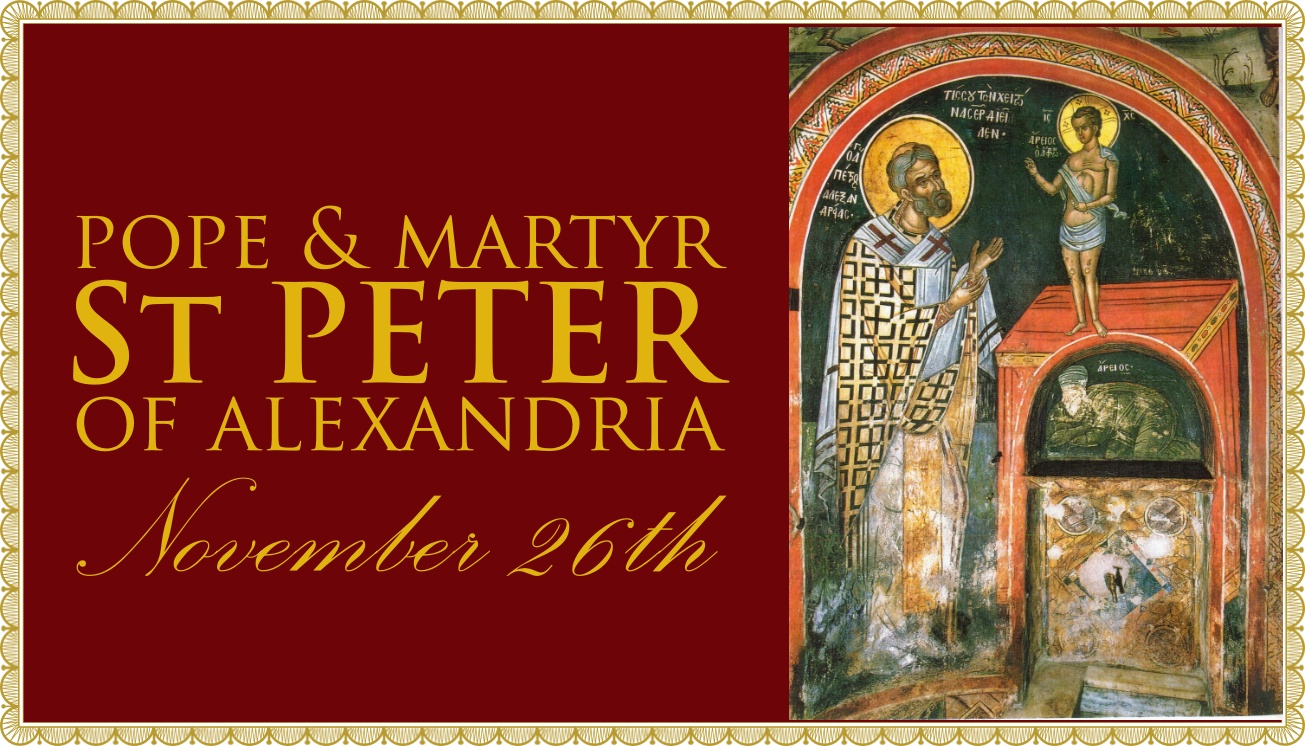
In the spring of 306, as the Christians of Alexandria prepared to celebrate Easter for the fourth time since the outbreak of persecution under Diocletian, their bishop, St Peter, addressed a particularly difficult question. How were those who had denied Christ during the persecution to be reconciled to the Church? Some bore upon their bodies the scars of torture which they had endured before finally capitulating. Others had abandoned their religion at the prospect of imprisonment. Their bishop had to determine how they might repent of their offences and recover their place amongst the faithful.
Peter had succeeded Theonas as Bishop of Alexandria about the year 300. His contemporary, the ecclesiastical historian Eusebius, commends his knowledge of Holy Scripture and the excellence of his Christian life. Alexandria, the city evangelised according to tradition by St Mark, possessed one of the most distinguished schools of Christian learning in antiquity. Yet within three years of Peter’s becoming bishop, imperial decrees ordered the destruction of churches and sacred books. Further measures brought imprisonment upon the clergy and eventually required Christians to sacrifice to the pagan gods.
The penitential canons which Peter issued at Easter in 306 have survived. For those who had endured terrible physical suffering before denying Christ, and who had already spent years repenting of their offence, Peter prescribed a further forty days of fasting and prayer. He directed them to meditate upon Our Lord’s rejection of Satan’s temptation in the wilderness. Those who had succumbed during imprisonment without undergoing torture were required to undertake a longer penance.
Peter encountered considerable opposition from Meletius, Bishop of Lycopolis in Upper Egypt. During the persecution, Meletius undertook ordinations in dioceses whose legitimate bishops were still alive. The resulting schism outlived both men and required the attention of the Council of Nicaea in 325. Even whilst the civil authorities were endeavouring to destroy Christianity, divisions amongst Christians themselves occasioned considerable suffering.
Peter’s solicitude for the fallen might have appeared excessively indulgent to some of his contemporaries. His own conduct eventually demonstrated how seriously he understood the obligation of fidelity. In November 311, during the persecution under Maximin Daia, Peter was arrested and beheaded. The Christians of Egypt honour him as the Seal of the Martyrs.
In today’s Epistle St James tells us that the man who endures temptation shall receive the crown of life promised by God to those who love Him. He proceeds to explain how disordered desire brings forth sin, and how sin leads to death.
We should remember that temptation itself does not constitute a sin. Some people become unnecessarily distressed because thoughts occur to them which they would much rather not entertain. Their very distress may indicate how little sympathy they have with the temptation. Our responsibility concerns what we voluntarily do with it. We may dismiss it and seek assistance from Almighty God, or permit ourselves to dwell upon it until what initially repelled us begins to appear rather attractive.
For mortal sin there must be grave matter, sufficient knowledge and deliberate consent. Fear and coercion may diminish culpability, as Peter recognised when considering the conduct of Christians who had suffered torture. Almighty God knows precisely how freely we have acted. We are generally rather less well informed concerning the interior dispositions of our neighbours.
In today’s Gospel Our Lord employs language which might initially perplex us. He speaks of hating father and mother, wife and children, and even our own life. St Matthew records the corresponding teaching in terms which help us understand it: whoever loves father or mother more than Christ is unworthy of Him. The commandments oblige us to honour our parents; the duties of marriage and parenthood oblige us to make considerable sacrifices for our families. Our Lord requires that these affections remain subordinate to our obligation towards Almighty God.
For Peter’s contemporaries, this teaching possessed an immediate and painful significance. A Christian father might have been prepared to endure imprisonment himself whilst finding the prospect of his children’s destitution almost unbearable. How tempting it must have been to persuade himself that a few grains of incense offered before a pagan image could hardly signify very much.
We encounter rather less dramatic temptations to compromise our religion for the sake of pleasing those whom we love. We may acquiesce in conduct which we know to be wrong because we fear causing offence. Genuine charity sometimes requires us to risk displeasing another person for the sake of his eternal welfare.
There is something particularly consoling in the history of the Apostle whose name today’s saint bore. St Peter had declared his readiness to accompany Our Lord to prison and to death. Within a few hours he denied Him three times. St Luke tells us that Our Lord turned and looked upon Peter, who went out and wept bitterly.
After the Resurrection, Jesus afforded him the opportunity to profess his love three times and entrusted to him the care of His flock. How extraordinary it would have been if the Church founded upon Peter had subsequently declared that there could be no forgiveness for those guilty of Peter’s own offence!
The ancient penitential discipline reminds us how precious the sacrament of Penance ought to be to us. Christians once undertook years of public penance before being restored to Eucharistic communion. We enjoy comparatively ready access to sacramental absolution, yet sometimes postpone confession for months because we find the prospect of spending ten minutes acknowledging our faults rather disagreeable.
People returning to confession after many years frequently discover that their greatest difficulty has been overcoming their embarrassment. They scarcely appreciate the joy which a priest experiences upon being afforded the opportunity to reconcile a soul to Almighty God after so long an absence.
A sincere purpose of amendment is necessary. We need not possess absolute confidence in our ability to withstand future temptation. St Peter the Apostle was, if anything, rather too confident in his own abilities. What we must possess is the present intention of avoiding sin, taking reasonable precautions against its occasions and relying upon the assistance of divine grace.
The Collect of today’s Mass acknowledges the burden which our own wrongdoing places upon us. We ask the protection of a bishop who devoted much of his ministry to assisting Christians in obtaining deliverance from precisely that burden.
We commemorate today also St Sylvester Gozzolini, the thirteenth-century Italian abbot and founder of the Sylvestrine congregation of the Benedictine Order. According to the account recalled in his Collect, it was whilst contemplating an open grave that he recognised the transitory character of earthly things and resolved to devote himself more entirely to Almighty God. Sylvester voluntarily relinquished those things which Peter was eventually required to surrender through martyrdom. Both understood the value of eternal life sufficiently to order their earthly lives accordingly.
Next Sunday begins Advent. We might profitably imitate St Sylvester by considering what occupies our attention disproportionately to its eternal worth, and St Peter by encouraging somebody who has fallen away from the practice of the Faith to seek reconciliation. Let us also attend to those matters in our own lives which require amendment before Christmas.
At this altar we shall receive the Body of Him whom St Peter of Alexandria preferred to his earthly life. The grace communicated to us through the Holy Eucharist strengthens charity and assists us in resisting temptation. We have every reason to place our confidence in the God who provides us with such means of perseverance.
May St Peter obtain for us something of his courage and something of his compassion towards those who have fallen. Let us never despair of recovering what we have lost through sin, nor presume upon the mercy of God by postponing repentance. The crown of life is promised to those who love Him.
In the Name of the Father, and of the Son, and of the Holy Ghost. Amen.




Leave a Reply