
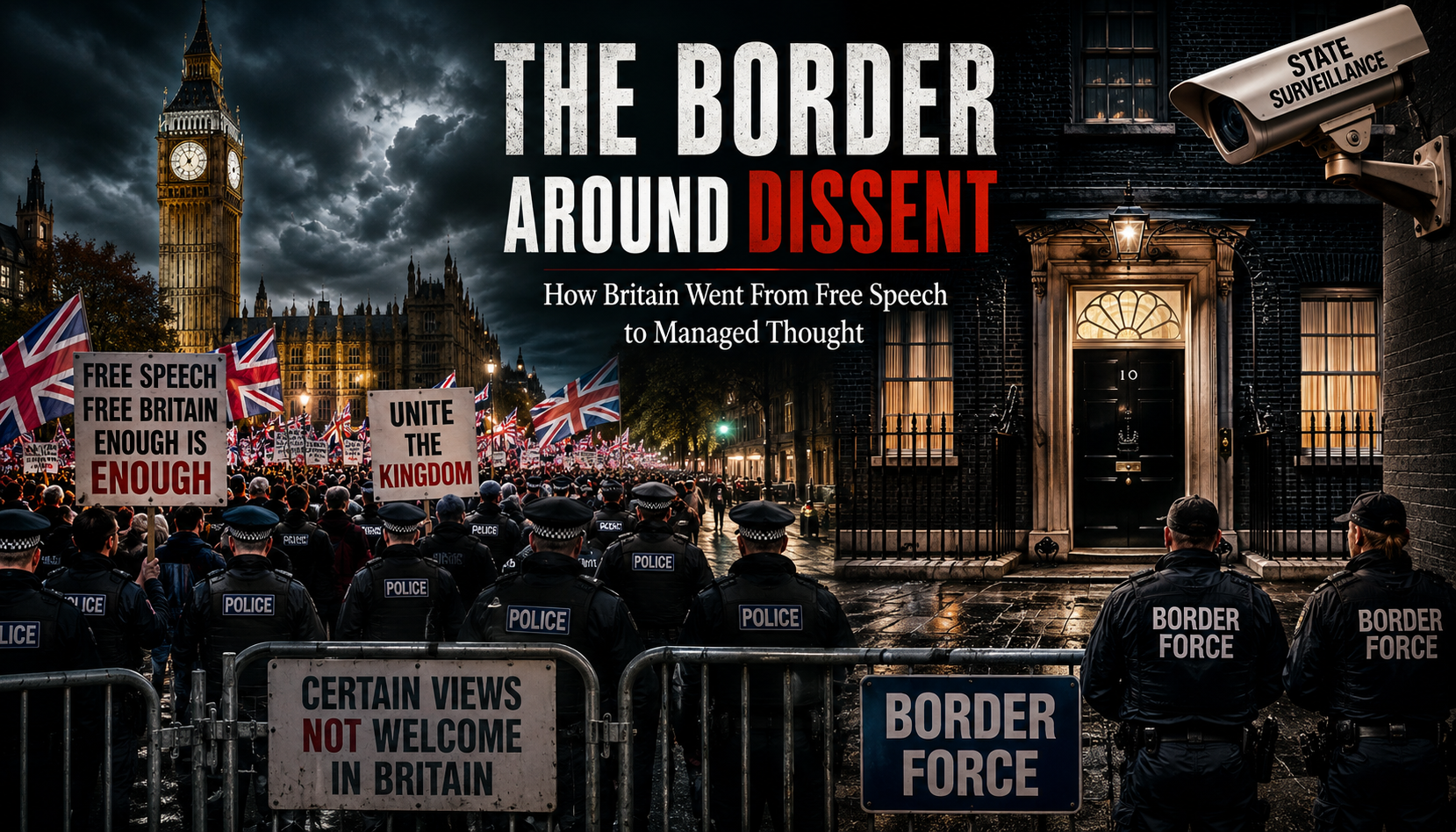
The Border Around Dissent: Labour, Ideological Power, and the Unmaking of Liberal Britain

Every political order eventually reveals what it truly fears.
Strong governments fear violence. Weak governments fear words.
For centuries Britain cultivated an extraordinary civilisational confidence in the principle of open argument. The nation that survived regicide, civil war, Jacobite rebellion, Chartist unrest, fascist agitation, communist activism, Irish terrorism, and decades of ideological conflict without abandoning parliamentary liberty understood a truth painfully learned through history: once governments acquire broad discretionary power to determine which opinions are permissible within public life, liberty itself becomes conditional upon political favour.
That principle was never based upon naïve optimism about human nature. Britain did not assume all opinions were wise, moral, or socially beneficial. It understood something more profound — that the state itself was often the greatest long-term threat to freedom. The answer to dangerous ideas was therefore not ideological quarantine enforced by ministers, but public rebuttal under conditions of open debate.
That inheritance now appears to be steadily disintegrating.
The Labour Government’s decision to bar seven foreign commentators from entering the United Kingdom ahead of Tommy Robinson’s “Unite the Kingdom” rally is not merely another transient political controversy. It marks a further stage in the quiet reconfiguration of Britain from a liberal democracy organised around liberty into a managerial state increasingly organised around ideological supervision.
The mechanism employed is deceptively mundane. Under powers contained within the Immigration Act 1971, the Home Secretary may exclude non-citizens whose presence is considered “not conducive to the public good.”¹ Historically such powers were primarily associated with terrorism, organised criminality, espionage, violent extremism, or direct incitement to unlawful acts. Increasingly, however, these powers are migrating into a different sphere altogether: the regulation of political legitimacy itself.
The individuals reportedly barred from entering Britain include Joey Mannarino, Valentina Gomez, Filip Dewinter, Ada Lluch, Eva Vlaardingerbroek, Dominik Tarczyński, and Don Keith.² They differ significantly in nationality, tone, style, and political background. Some are politicians. Some are social-media commentators. Some are provocateurs. Some are unquestionably inflammatory. Yet none represented an operational terrorist threat to the United Kingdom.
That distinction matters enormously.
Because free societies are not tested by their willingness to tolerate safe opinions. They are tested precisely by whether they uphold procedural liberty for controversial, abrasive, or unpopular voices. Once governments begin determining which political viewpoints may physically enter the national conversation, democratic pluralism itself becomes contingent upon ideological approval.
And the rhetoric accompanying this decision reveals the deeper transformation now underway within Britain’s political culture.
During his recent “reset” speech, Keir Starmer characterised the forthcoming rally as an attempt to “confront and intimidate this diverse city and this diverse country.”³ He then pledged that Labour would “block far-Right agitators from travelling to Britain” because the Government would not allow them to “spread hate on our streets.”⁴
This language is not politically incidental. It reflects an increasingly dominant governing assumption throughout much of the contemporary West: that certain forms of dissent are not merely wrong, but inherently destabilising to democratic society itself.
Observe carefully what has happened over the past decade. Opposition to immigration policy is no longer treated primarily as a political argument subject to democratic contestation. Instead, it is increasingly pathologised. Concerns regarding border control, demographic change, integration, social cohesion, cultural continuity, housing pressure, crime, and national identity are routinely reframed not as policy disputes but as manifestations of latent extremism requiring institutional management.
The vocabulary of democratic disagreement has gradually been replaced by the vocabulary of contamination.
Critics are not rebutted; they are deplatformed. Arguments are not answered; they are categorised as harmful. Opposition is not confronted politically; it is managed administratively.
One sees this transformation across the architecture of British public life. Police forces have investigated citizens over lawful speech under expansive “non-crime hate incident” frameworks later criticised judicially for their chilling effect upon free expression.⁵ Journalists and public commentators, including Telegraph columnist Allison Pearson, have faced police involvement following complaints regarding lawful online commentary, reinforcing public perceptions that speech policing is steadily expanding into areas once considered firmly protected within democratic culture.⁶ The Online Safety Act has intensified concerns regarding state-backed pressure upon lawful but controversial speech online.⁷ Public-order legislation has progressively expanded police discretion over demonstrations, assemblies, and disruptive protest activity.⁸ Universities, professional bodies, public institutions, and corporations increasingly operate through systems of ideological enforcement justified under the language of safeguarding, inclusion, safety, or harm reduction.
The cumulative effect is unmistakable. Britain is slowly transitioning from a culture organised around liberty into one increasingly organised around supervision.
And perhaps most revealingly, these developments are consistently justified as necessary for the protection of democracy itself.
History should make us profoundly cautious about such reasoning.
Virtually every system of ideological control in modern history has claimed protective intentions. Censorship is always introduced as necessary. Exclusion is always presented as temporary. Restrictions are always framed as safeguards against danger. Yet the logic of ideological management possesses an inherent tendency toward expansion. Once institutions acquire the authority to determine which opinions threaten social stability, the boundaries of unacceptable speech inevitably widen over time.
This is precisely why Britain historically maintained a sharp distinction between speech and direct criminal incitement. The liberal tradition recognised that governments themselves could not safely be entrusted with broad discretionary authority over political legitimacy.
That principle now appears increasingly fragile.
And nowhere is the growing asymmetry of contemporary political morality more visible than in the Government’s simultaneous diplomatic conduct. At almost precisely the moment foreign conservative commentators were being excluded from Britain as allegedly “not conducive to the public good,” Downing Street welcomed Ahmed al-Sharaa — formerly Abu Mohammed al-Jolani — outside Number 10.⁹ Al-Sharaa previously led Hay’at Tahrir al-Sham, itself descended from Jabhat al-Nusra, Al-Qaeda’s former Syrian affiliate.¹⁰
To state this fact is not to indulge in simplistic equivalence. States frequently engage pragmatically with former insurgents or transitional authorities in pursuit of geopolitical stability. Diplomacy often requires dealing with compromised actors emerging from civil conflict.
But politics does not operate solely according to diplomatic nuance. It operates through symbolism, consistency, and public perception.
And the symbolism here is extraordinary.
Foreign commentators expressing opposition to mass immigration are deemed sufficiently dangerous to justify exclusion from Britain, while a former Islamist militant leader may be received as a diplomatic partner under the language of pragmatic engagement. Whatever distinctions governments may advance, millions of ordinary citizens instinctively perceive a political order whose conception of “extremism” appears increasingly selective, ideological, and asymmetrical.
The inconsistency extends further still. Labour figures expressed little concern regarding cross-border political activism when Labour-linked operatives travelled to the United States to assist Kamala Harris’s presidential campaign efforts.¹¹ International political engagement was then framed as democratic solidarity. Yet conservative foreign participation in British political discourse is now treated as a threat to public order.
Progressive activism crosses borders as virtue. Conservative activism crosses borders as contamination.
Such asymmetry corrodes institutional legitimacy because citizens recognise double standards long before political elites acknowledge them. Public trust depends less upon universal agreement than upon confidence that rules are applied impartially. Once institutions appear to distinguish not between lawful and unlawful conduct but between ideologically approved and ideologically disapproved opinion, cynicism rapidly deepens into alienation.
And alienation carries consequences.
History repeatedly demonstrates that societies become unstable not merely when citizens are angry, but when they conclude peaceful participation within existing institutions no longer functions honestly. The more dissent is administratively constrained rather than publicly answered, the more democratic culture itself begins to deteriorate into resentment, tribalism, and mutual delegitimisation.
A government genuinely confident in its principles invites scrutiny.
A government increasingly dependent upon exclusion reveals insecurity.
That is the deeper significance of the present moment. Britain is not merely debating immigration policy or one controversial rally. It is confronting a far more consequential question: whether liberal democracy still fundamentally believes in liberal principles when confronted with populist dissent.
For generations Britain trusted free citizens to hear radical arguments without requiring state protection from them. Increasingly, however, modern governance appears animated by the opposite assumption — that uncontrolled public discourse itself constitutes a threat requiring institutional management.
That represents not the confidence of a mature democracy, but the exhaustion of one.
A state that fears foreign commentators while simultaneously accommodating former jihadist figures through diplomatic pragmatism is not displaying moral clarity. It is revealing a governing philosophy increasingly uncomfortable with uncontrolled dissent itself.
Britain once trusted free citizens to hear dangerous ideas without requiring government protection from them. Increasingly, it appears governed by institutions that fear not extremism alone, but uncontrolled thought itself.
And once democracies begin erecting borders around acceptable opinion, they slowly cease to be fully free long before they cease holding elections.
¹ Immigration Act 1971, c. 77, §3(5)(a), UK Public General Acts.
² “Seven Far-Right Agitators Barred from UK Before Tommy Robinson Rally,” The Times, May 2026; “People Barred from UK for Far-Right Rally,” The Guardian, May 2026.
³ Prime Minister Keir Starmer, “Reset Britain” speech, May 2026, transcript and government press release.
⁴ Ibid.
⁵ R (Miller) v College of Policing [2021] EWCA Civ 1926; College of Policing, “Non-Crime Hate Incidents: Code of Practice,” 2023.
⁶ Allison Pearson police investigation controversy, reported in The Telegraph, November 2024, concerning police action following social media complaints.
⁷ Online Safety Act 2023, UK Public General Acts.
⁸ Police, Crime, Sentencing and Courts Act 2022; Public Order Act 2023.
⁹ UK Government diplomatic meeting records and press photography concerning Ahmed al-Sharaa’s visit to Downing Street, 2026.
¹⁰ Charles Lister, The Syrian Jihad: Al-Qaeda, the Islamic State and the Evolution of an Insurgency (London: Hurst, 2015); reporting on Hay’at Tahrir al-Sham’s evolution from Jabhat al-Nusra.
¹¹ Reporting concerning Labour Party activists campaigning during the 2024 United States presidential election cycle.
¹² John Stuart Mill, On Liberty (London: John W. Parker and Son, 1859), chap. II.
¹³ George Orwell, “The Freedom of the Press,” proposed preface to Animal Farm (1945).
¹⁴ Hannah Arendt, The Origins of Totalitarianism (New York: Harcourt, Brace & Company, 1951), esp. pt. III.
¹⁵ Eric Barendt, Freedom of Speech, 2nd ed. (Oxford: Oxford University Press, 2005).
¹⁶ Timothy Garton Ash, Free Speech: Ten Principles for a Connected World (London: Atlantic Books, 2016).
RELATED ARTiCLES


LATEST ARTICLES
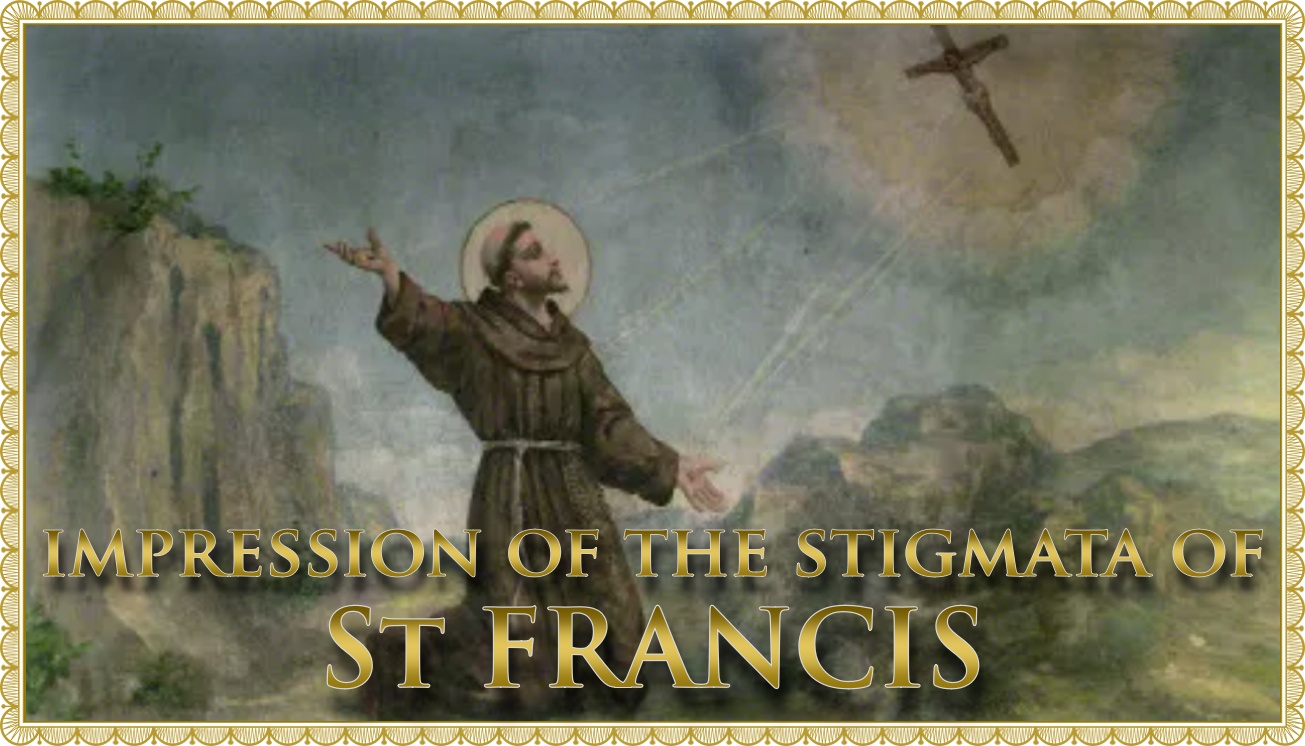
- Today’s Mass: September 17 Impression of the Stigmata of St Francis of AssisiSaint Francis received the stigmata because he had first allowed the Cross to transform his soul. His wounds were not a spectacle, but God’s answer to a world growing cold: the visible sign of a life consumed by crucified love. We may never bear Christ’s wounds in our flesh, but we must bear their likeness through penance, fidelity, patience, mercy and sacrificial love.
- Sermon for Stigmata of St. FrancisToday marks the feast of St. Francis’ stigmata, celebrating his transformation from a wealthy merchant’s son to a devoted preacher of poverty and humility. He founded the Franciscan order, emphasising evangelisation and simplicity. His experience of receiving the stigmata exemplifies the Christian doctrine of redemption through suffering, distinguishing it from other faiths.
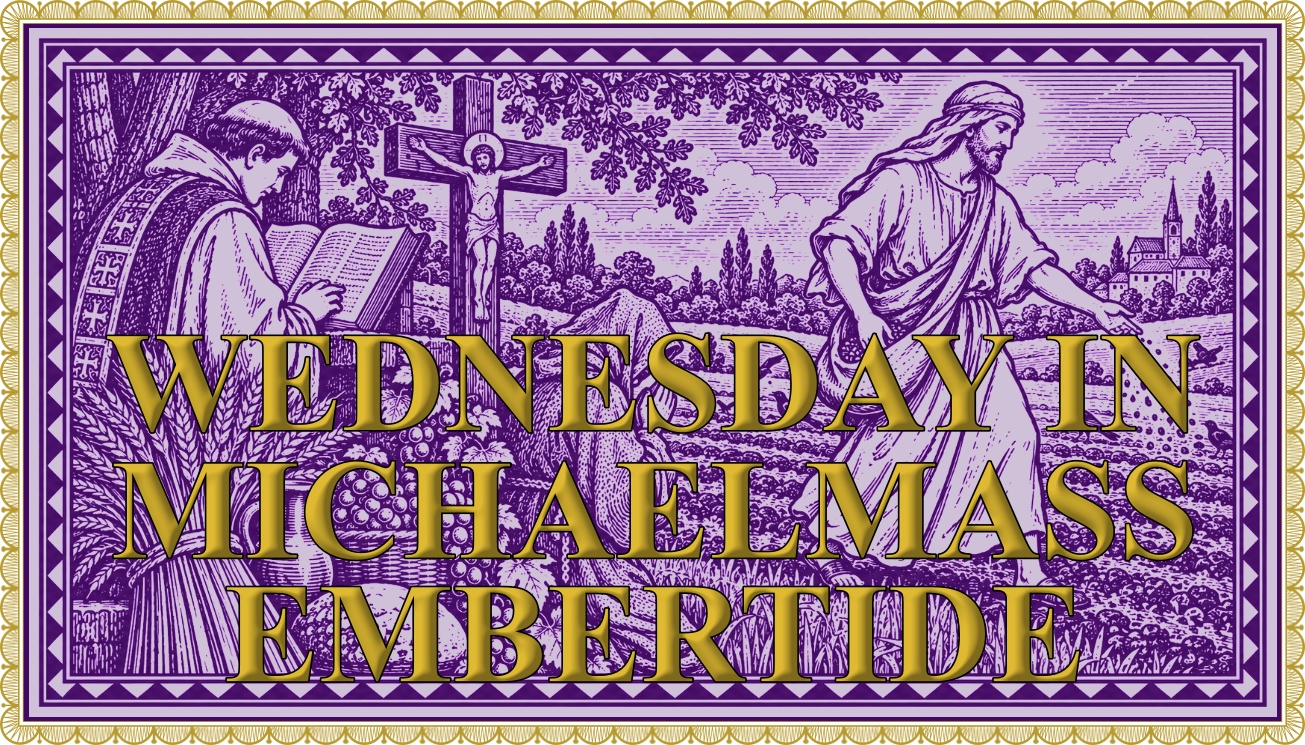
- Today’s homily: Wednesday Michaelmas EmberThe homily reflects on the significance of fasting and prayer in the Christian faith, emphasising their role in spiritual growth and self-mastery. By juxtaposing scripture from Amos and the Gospel of Mark, it highlights the need for gratitude and humility during abundance, urging believers to recognise their dependence on God. True repentance transforms and restores one’s relationship with Him.
- Today’s Mass: September 16 Wednesday Michaelmas EmberThe post commemorates the Ember Days, originally aligned with Roman agricultural festivals. The Catholic Church adopted these days early in its history to honour true worship and avoid disrupting Roman converts’ practices. The Ember Days promote fasting, prayer, and gratitude towards God for nature’s gifts while assisting the needy.
- SEPTEMBER EMBERTIDEThe September Ember Days, rooted in ancient Roman liturgy, are a time of reflection, fasting, and thanksgiving, coinciding with the autumn harvest. Marked by communal penance and prayers for clergy sanctification, these observances connect biblical themes of creation and sacrifice, urging Christians to evaluate their spiritual fruitfulness.
CURRENT EDITION


DAILY MASS ONLINE
One of the earliest online apostolates dedicated to the Traditional Latin Mass, Old Roman TV began broadcasting the Holy Sacrifice on the Feast of the Assumption, 15 August 2008. During the COVID-19 pandemic, additional programming — devotions, catechesis, and conferences — was added to support the faithful in prayer and formation.
Support the daily Holy Mass on Old Roman TV by offering a Mass intention — for loved ones, thanksgiving, or the repose of souls. Your intention helps sustain the sacred liturgy and brings grace to those you remember before God’s altar.
SUPPORT THE DAILY MASS ONLINE
Likely the world’s longest-running daily online broadcast of the
Traditional Latin Mass, streaming faithfully since the
Feast of the Assumption 2008.

This apostolate cannot continue without immediate help
Please support us with a contribution toward
chapel rent, sacristy supplies, operating costs, and web-hosting.
Our essential monthly costs reach £1,000.
MASS INTENTIONS
If your offering is for a Mass Intention, kindly complete the form below in full so we may correctly match it to your donation. For anniversary intentions — birthdays, wedding anniversaries, anniversaries of death — please be sure to include the relevant date.


Today’s Mass Propers
- Today’s Mass: September 17 Impression of the Stigmata of St Francis of Assisi
 Saint Francis received the stigmata because he had first allowed the Cross to transform his soul. His wounds were not a spectacle, but God’s answer to a world growing cold: the visible sign of a life consumed by crucified love. We may never bear Christ’s wounds in our flesh, but we must bear their likeness through penance, fidelity, patience, mercy and sacrificial love.



Leave a Reply