
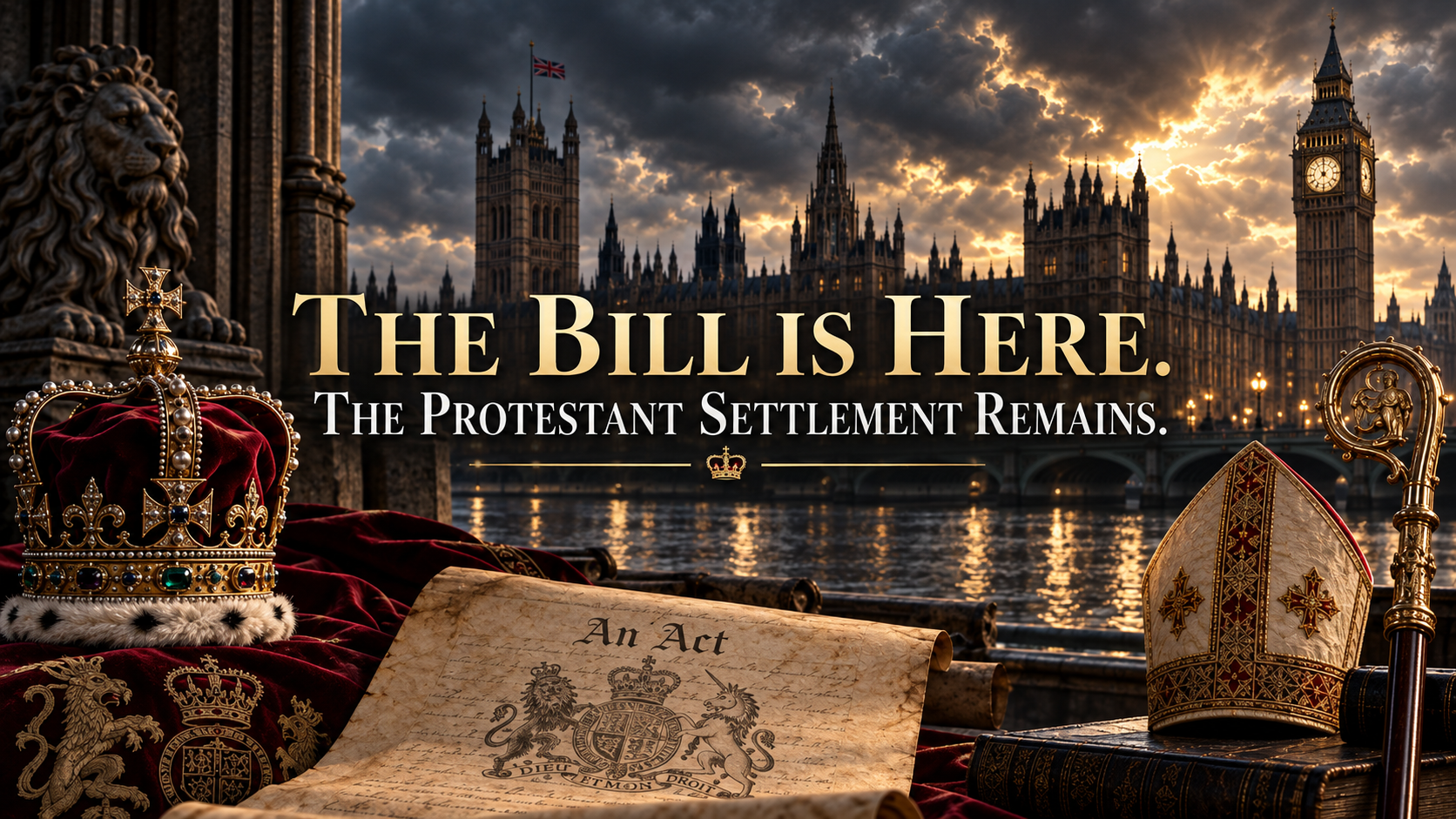
Parliament now has before it a Bill abolishing the extraordinary rule which prevents a Catholic Prime Minister from advising the Sovereign upon Anglican appointments. Yet Catholicism remains expressly disqualifying for the Crown itself. Stranger still, the present prohibition catches Catholics and Jews but not Muslims, Hindus, Buddhists, atheists or agnostics. The controversy exposes something larger than an historical anomaly: the uneasy survival of a Protestant constitution within a substantially post-Christian state — and a question more complicated than whether Britain is, or is not, experiencing a Catholic revival.
The argument has already moved on. When Charles Collins wrote in Crux on 13 September that the supposed “last vestige” of Britain’s anti-Catholic laws was coming to an end, legislation had merely been promised. Two days later the Government introduced the Church Appointments (Repeal of Discriminatory Provision) Bill, Bill 150 of the 2026–27 session. It has received its First Reading in the House of Commons. Its purpose is narrowly stated: to repeal the provisions preventing Roman Catholics and Jews from advising the Crown upon appointments in the Church of England or Church of Scotland, together with related restrictions upon making ecclesiastical appointments.¹
The Bill is therefore real. The law has not yet changed.
Nor, if the Bill becomes law, will Britain have abolished the last legal distinction affecting Catholics. That description was never accurate. The House of Commons Library’s own briefing records that a person professing the Roman Catholic religion remains incapable of succeeding to the Crown and consequently cannot serve as Regent or Counsellor of State. Section 12 of the Roman Catholic Relief Act 1829 also retains the restriction concerning a Lord Commissioner of the Great Seal. Parliament removed the Catholic disability affecting the Lord Chancellor in 1974 and the separate prohibition affecting the Lord High Commissioner to the General Assembly of the Church of Scotland only in 2025.²
What is being removed is nevertheless remarkable. Section 18 of the 1829 Act provides that it is unlawful for any person “professing the Roman Catholic religion” directly or indirectly to advise the Sovereign or Regent concerning appointments or preferments in the Church of England or Church of Scotland. The penalty written into the statute is formidable: conviction for a high misdemeanour and permanent disqualification from civil or military office under the Crown.²
Andy Burnham encountered the provision because, although reportedly no longer a regular Mass-goer, he told officials before becoming Prime Minister that he continued to profess the Catholic Faith. He therefore transferred his constitutional responsibility for Church appointments to the Lord Chancellor and, on 10 September, described the restriction as an “antiquated and archaic anomaly”.³
That detail about Burnham matters more than might first appear, because the argument is repeatedly expressed as though British law simply asks whether somebody “is a Catholic”. It does not.
The statutory language is “professing the Roman Catholic religion”. The Commons Library summarises the restriction as applying to practising Catholics and Jews and uses Benjamin Disraeli to illustrate the point: Disraeli was culturally Jewish but had been brought up as an Anglican from childhood and was therefore able to advise the Crown.² The relevant civil-law question is not ancestry, family background or the existence of an old baptismal certificate. It is the religion which the office-holder presently professes.
That produces distinctions which ought not to be blurred. A practising Catholic who openly professes the Faith falls squarely within the existing provision. A person who grew up Catholic but now regards himself simply as culturally Catholic and no longer professes the religion would not appear to be caught merely because of his background. A person merely baptised Catholic who no longer professes the Faith would not appear to fall within section 18 merely by reason of his baptismal history. Conversely, somebody may be a decidedly irregular Catholic and yet still profess himself Catholic. Burnham’s own case makes that plain: regular Mass attendance is not the statutory test.
The category of the “lapsed Catholic” is consequently less straightforward than ordinary conversation suggests. Catholic theology does not imagine that Baptism can be undone by ceasing to attend Mass; sacramental character is not erased by lapsation. English constitutional law is asking a different question. It is concerned with profession and adherence. Someone who rarely practises but continues to say, in substance, “I am a Catholic and profess that Faith” may remain within the words of the statute. Someone of Catholic upbringing who has actually ceased to profess Catholicism presents a different case. The law does not contain a Mass-attendance threshold by which the matter can be mechanically decided.
But the sharpest anomaly is simpler. A Muslim, Hindu, Sikh, Buddhist, atheist or agnostic Prime Minister is not caught by these restrictions at all. A professing Catholic or Jew is. The Government itself has now stated explicitly that the restrictions “do not apply to people of other faiths or of no faith”.⁴
That fact transforms what might otherwise look like a dusty technicality. Under the present law, a Prime Minister who professes Islam may perform the constitutional function connected with the appointment of Anglican bishops; a Prime Minister who professes Catholicism may not. An atheist may do so; a Jew may not. The discrimination is not between members and non-members of the Established Church. It singles out two particular religions.
If the underlying principle were protection of the Church of England from external religious influence, the present settlement would make little sense. It does not require the Prime Minister to be Anglican. It does not even require him to be Christian. It simply says that two historically distrusted religious professions — Catholicism and Judaism — are disqualifying where Islam, Hinduism, Buddhism, atheism and every other position are not.
That is difficult to defend as any coherent contemporary principle of Anglican Establishment. If the function is genuinely ecclesiastical, why is Anglican profession not required of the person exercising it? If it is merely constitutional and administrative, why should Catholicism or Judaism disqualify anyone?
This distinction also makes the surviving prohibition upon a Catholic Sovereign more interesting. The Act of Settlement belongs not primarily to the Catholic emancipation settlement of 1829 but to the Protestant constitutional settlement established after 1688. The Sovereign must be in communion with the Church of England, while those professing the Catholic religion are expressly incapable of possessing the Crown. Parliament revisited the succession in 2013, abolished male-preference primogeniture and removed the disqualification incurred by marrying a Catholic, but deliberately left the Catholic bar upon the Sovereign untouched.⁵
The constitutional position is therefore not simply the residue of legislation nobody has examined for three hundred years. Parliament examined the succession thirteen years ago and changed some of it.
That is the point which Jacob Rees-Mogg pressed in a video published on his YouTube channel on 15 September under the deliberately provocative title, “The King could be a Muslim but not a Catholic.” Rees-Mogg argued that once Parliament begins consciously modernising one part of the settlement, what remains can no longer be dismissed quite so easily as a sleeping historical anomaly. Change one discriminatory distinction, he suggested, and the surviving distinction becomes more visible as something the modern constitution has chosen to retain.⁶
That observation deserves attention. His headline, however, needs qualification.
Catholicism is unquestionably treated in a distinctive way by the succession legislation because it is expressly named as disqualifying. There is no parallel clause in the Act of Settlement declaring in equivalent words that anyone who “professes the Muslim religion” is incapable of possessing the Crown. In that limited sense Rees-Mogg has identified a real asymmetry.
It does not follow that a reigning Sovereign may simply become Muslim, Hindu or Buddhist while remaining constitutionally untouched. In March this year the Government told the House of Lords that, because the Sovereign must be in communion with the Anglican Communion, individuals practising other faiths cannot become Sovereign, Regent or Counsellor of State. At his Coronation King Charles III swore to maintain the “Protestant Reformed Religion established by law”, to preserve the settlement, doctrine, worship, discipline and government of the Church of England, and made the statutory declaration that he was a “faithful Protestant”.⁷
“The King could be a Muslim but not a Catholic” therefore works better as a provocation about the peculiar express wording of the Catholic exclusion than as a complete description of the constitutional position. A Muslim monarchy cannot simply be dropped into the existing settlement without colliding with the positive Protestant and Anglican obligations of the Crown.
The narrower point is stronger because it is incontestable: Catholicism remains specifically named in British constitutional law as a religion which disqualifies a person from the Crown.
Rees-Mogg raises another question which is at least as interesting. He does not merely ask why Catholics are excluded from advising upon Anglican appointments. He questions why a Catholic ought to want to make such appointments in the first place. His preferred logic is that ecclesiastical appointments in the Established Church should be dealt with by an Anglican minister where the Prime Minister is not Anglican. In his formulation, the defect in the present arrangement is not necessarily that Catholics and Jews cannot participate, but that there is no corresponding confessional requirement upon everybody else who does.⁶
The point is considerably stronger once the treatment of other religions is made explicit. The law is not presently saying, “Only Anglicans should participate in Anglican appointments.” If that were the rule, whatever objections might be made to Establishment, there would at least be an intelligible ecclesiological principle behind it. The law instead permits the function to be exercised by a Muslim or atheist while withholding it from a Catholic or Jew.
Here the controversy ceases to be simply about discrimination and begins to expose the theological incoherence of Establishment in a post-confessional political culture.
If the appointment of Anglican bishops is a genuinely ecclesiastical act, why should it be performed even formally by a Prime Minister who may be Catholic, Jewish, Muslim, Hindu, atheist or entirely indifferent to Christianity? If it is no longer meaningfully ecclesiastical when passing through Downing Street, why does the state retain the function? If Establishment means something, why should membership of the Established Church be irrelevant to those exercising its constitutional machinery? If Establishment means almost nothing, why preserve the machinery at all?
The contemporary appointment process makes the questions sharper. In the appointment of the Archbishop of Canterbury, the Crown Nominations Commission identifies its preferred candidate and sends the name to the Prime Minister. The Government’s own description of the process says that the Prime Minister has “no active role in the decision” and that since 2007 the Prime Minister has accepted the Commission’s recommendation and tendered the name to the Sovereign.⁸ Rees-Mogg describes the Prime Minister as effectively a rubber stamp. The language is inelegant but the constitutional point is difficult to miss.
Parliament is therefore legislating about religious discrimination in the exercise of a power whose substantive political content has already almost disappeared.
There is a specifically Catholic dimension which deserves to be stated without embarrassment. Pope Leo XIII’s Apostolicae Curae declared Anglican ordinations “absolutely null and utterly void”.⁹ Whatever ecumenical courtesies have subsequently developed, the doctrinal judgement remains part of the Catholic Church’s understanding of Anglican orders. It is consequently not self-evident why a Catholic statesman should regard participation in the designation of an Anglican bishop as some coveted expression of religious equality.
That does not make the present Catholic-specific disability disappear. It reveals that two questions have been bundled together which ought to be separated. One concerns equal eligibility to exercise the functions attached by law to public office. The other concerns whether an established Church ought to have its senior ecclesiastical appointments formally processed through politicians who need not belong to that Church.
The Government’s Bill answers the first question by removing the Catholic and Jewish exclusions. Rees-Mogg’s argument points towards a different answer to the second: retain a religious character to the function by passing it to an Anglican office-holder when necessary. A third possibility lies behind both: reconsider the surviving machinery of Establishment itself. These are different constitutional choices with different implications. Abolishing section 18 resolves the explicit Catholic and Jewish distinction. It does not resolve the deeper question of why Downing Street remains involved.
That is why this episode is more revealing than the easy language of a final anti-Catholic vestige suggests. Britain is not simply removing the last brick from the penal wall and emerging at last into complete religious neutrality. It is adjusting one component of a constitution which still requires a Protestant Sovereign, still establishes the Church of England, still places the Monarch at its constitutional summit and still formally connects the Government to the appointment of its bishops.
The social context makes the picture stranger still. Britain retains a confessional constitution after becoming, in everyday religious practice, substantially post-confessional.
Charles Collins is right on one important point in his Crux article: changing this law is not evidence that Britain is undergoing a Catholic revival.¹⁰ There is no logical connection between Parliament removing a religious disability and the number of people attending Mass, entering the Church, receiving the Sacraments or raising Catholic families. A secular state may abolish religious distinctions precisely because it considers religion decreasingly relevant.
Indeed, that possibility may explain this moment better than any tale of Catholic resurgence. The legislators of 1829 took Catholicism profoundly seriously. They believed Catholic allegiance made claims about Church, sovereignty, authority and society which might affect the constitutional order. Their solution was discriminatory, but it was not based upon the assumption that religion was trivial.
The political culture of 2026 increasingly approaches the matter from the opposite direction. The Catholic Prime Minister, the Jewish Prime Minister, the Muslim Prime Minister, the Hindu Prime Minister, the atheist Prime Minister and the Anglican Prime Minister ought, on this conception, to be interchangeable for civil purposes because religious confession is principally personal rather than constitutive of political office.
That is precisely why the present exception for Catholics and Jews has become impossible to defend. The modern state no longer accepts the premise upon which the distinction was built.
Yet this tells us remarkably little about whether Catholicism itself is reviving.
Here precision is especially necessary because the original Bible Society “Quiet Revival” research collapsed spectacularly. YouGov discovered apparently fraudulent responses among the survey data and withdrew confidence in the results. The latest British Social Attitudes figures provide no evidence of a national surge in Christian churchgoing. Only five per cent of British adults reported weekly Christian attendance in the 2025 survey, compared with eight per cent in 2018, while the figure among the under-35s was four per cent. Among those identifying as Catholic, weekly attendance stood at fifteen per cent, down from twenty-three per cent in 2018.¹¹
Those figures exclude any serious claim that Britain as a whole has suddenly returned to regular Christian worship.
They do not establish that nothing significant is occurring within British Catholicism.
Southwark reported more than 590 adult catechumens and candidates in 2026, the highest figure there since 2011. Half were aged thirty-five or younger and twenty per cent were between eighteen and twenty-five. The archdiocese reported more than 1,400 adults entering Catholicism since 2024.¹² Brentwood recorded more than 315 catechumens and candidates from almost forty parishes preparing for reception this Easter.¹³ The national Catholic statistics for 2024 recorded 6,276 catechumens and candidates receiving catechesis, 5,432 baptisms of persons over seven, 3,024 receptions into full communion and an average weekly Mass attendance of 575,453.¹⁴
Those numbers require the same discipline as the national surveys. Catechumens and receptions measure entry into the Church. They do not, by themselves, demonstrate net institutional growth. Deaths, lapsation, migration, demographic replacement, infant baptism, marriage, retention and regular sacramental practice all belong to a serious assessment of whether Catholicism is growing sustainably.
Nuntiatoria has been making precisely this distinction for months. In April, “The Quiet Revival — or the Search for Order? Britain’s Catholic Resurgence Examined” argued that the evidence suggested a movement towards the Church, especially among younger adults, but not yet the self-sustaining ecclesial renewal which would require sacramental transmission across generations. In May, “No Revival in Sight: Empty Churches, Searching Souls and the Spiritual Reckoning Facing Christian Britain” warned against confusing curiosity with commitment. Later treatments of the younger attraction to Catholic tradition, and August’s “England Must Be Converted — Not Merely Re-Enchanted,” insisted upon the same distinction from another direction: fascination with Christianity is not conversion, and aesthetic retrieval is not yet supernatural renewal.¹⁵
That earlier caution now proves useful. We need neither resurrect the discredited “Quiet Revival” statistics nor swing to the opposite exaggeration in which every report of younger converts must be dismissed because national church attendance remains poor.
Institutional contraction and concentrated renewal can coexist.
A denomination may continue losing nominal adherents while particular dioceses receive more adult converts. National Mass attendance may remain historically depressed while individual churches or apostolates become younger. Seminaries may struggle while particular communities attract vocations. The general standard of catechesis may be weak while those deliberately seeking Catholicism demand doctrinal seriousness. Traditional liturgical communities may form a small minority and yet display demographic characteristics quite unlike those of the surrounding ecclesial structure.
Nuntiatoria’s June examination of the youthful attraction to Catholic tradition made this point in relation to the older Roman liturgy. Young adults embracing inherited forms of worship cannot simply be dismissed as nostalgists for a Church they never personally knew. Whatever judgement one makes about the scale of the phenomenon, the phenomenon itself calls for explanation.¹⁶
None of this amounts to proof of a Catholic reconquest of Britain. It does something more modest and more useful: it prevents national decline from becoming an intellectual solvent in which every contrary local development is dissolved.
The choice between “Britain is experiencing a revival” and “Christianity is simply dying” is too crude. Religious change seldom occurs evenly. A movement which eventually becomes statistically significant must exist below the level of national statistical significance before it can ever rise above it. Conversely, enthusiasm among several thousand converts does not become a national spring merely because Catholics understandably find it encouraging.
The Catholic test is more demanding anyway. Revival is not finally measured by favourable headlines, registration figures or cultural fascination. It requires conversion of life, sacramental perseverance, doctrinal fidelity, vocations, Catholic marriages, children baptised and formed in the Faith, works of charity, public witness and the transmission of belief from one generation to the next. If the present increase in adult interest produces those fruits over twenty years, historians may describe its beginnings more confidently than journalists can today.
The Burnham controversy and the revival controversy therefore belong together only at a deeper level.
The first shows a state gradually ceasing to understand why religious confession once carried constitutional consequences. The second asks whether people living within that increasingly post-Christian state are beginning to discover that religion has consequences after all.
The old British establishment answered the religious question institutionally. The Sovereign was Protestant. The national Church was Anglican. Catholicism was distrusted and legally restricted. Much of that structure remains on the statute book after the population beneath it has ceased to inhabit the religious world which made it intelligible.
That is the real peculiarity of 2026.
A Catholic Prime Minister who admits he is no longer a regular Mass-goer nevertheless says that he still professes the Catholic Faith and therefore encounters a statute enacted in the age of Catholic emancipation. An atheist Prime Minister could perform the same constitutional function without difficulty. So could a Muslim or Hindu. Parliament now prepares to release the Catholic Prime Minister from the disability while leaving untouched the law which bars a professing Catholic from the Crown. A Catholic former Cabinet minister responds by asking why non-Anglicans should be participating in Anglican episcopal appointments in the first place. The King, meanwhile, remains by law and oath the Protestant Supreme Governor of the Church of England in a country where only a small minority of the population regularly attends Christian worship.
There is almost the whole religious history of modern Britain compressed into that spectacle.
The Bill may remove one anomaly. It cannot answer the larger question which the anomaly has exposed: what does a confessional constitutional settlement mean once the political culture operating it has become substantially non-confessional?
Nor can Parliament settle whether Britain is experiencing the first stirrings of Catholic renewal. Westminster can repeal an old disability. It cannot manufacture conversion.
That work happens somewhere much quieter: when an adult asks for Baptism; when a nominal Catholic returns to Confession; when a family begins to practise what it professes; when a young person discovers that Christianity is not merely part of his cultural inheritance but makes claims upon his intellect, body, time and conduct; when Catholic parents transmit to their children something stronger than an ancestral label.
There lies the final distinction which this entire debate unexpectedly illuminates. A cultural Catholic can survive for generations on memory. A lapsed Catholic can retain the name after abandoning most of the practice. A professing Catholic, in the language of the old statute, still makes a claim about what he believes himself to be. But the Catholic renewal Britain actually needs demands more even than profession. It requires profession to become practice, practice to become fidelity, and fidelity to become transmission.
Whether Parliament removes the words “professing the Roman Catholic religion” from one nineteenth-century statute is constitutionally significant. Whether Catholics themselves continue to profess, practise and hand on the religion those words describe is infinitely more consequential.
¹ UK Parliament, Church Appointments (Repeal of Discriminatory Provision) Bill, Bill 150, 2026–27.
² House of Commons Library, Historic restrictions on members of the Catholic and Jewish faiths, 10 September 2026.
³ UK Parliament, Church Appointments — Written Statement HCWS325, 10 September 2026.
⁴ Cabinet Office, Government introduces Repeal Bill to remove outdated constitutional rules, 15 September 2026.
⁵ Cabinet Office, Succession to the Crown Act 2013: Explanatory Notes; House of Commons Library, Historic restrictions on members of the Catholic and Jewish faiths.
⁶ Jacob Rees-Mogg, The King could be a Muslim but not a Catholic, Jacob Rees-Mogg YouTube channel, 15 September 2026.
⁷ UK Parliament, Public positions and constraints affecting practising Roman Catholics and other faiths — HL15746, 27 March 2026; Church of England, The Coronation Liturgy: ‘Called to Serve’.
⁸ Cabinet Office, Archbishop of Canterbury appointment process.
⁹ Pope Leo XIII, Apostolicae Curae, 13 September 1896.
¹⁰ Charles Collins, Crux, Last vestige of anti-Catholic laws in Britain ending not a sign of Church revival, 13 September 2026.
¹¹ National Centre for Social Research, Sir John Curtice, No revival in sight: Church attendance in Britain remains below pre-pandemic levels, 18 May 2026.
¹² Archdiocese of Southwark, Record number of adults received into the Catholic Church in Southwark, 21 February 2026.
¹³ Diocese of Brentwood, Diocese set to welcome more than 300 new members at Easter Vigil, 3 April 2026.
¹⁴ Catholic Bishops’ Conference of England and Wales, Statistics — 2024.
¹⁵ Nuntiatoria, The Quiet Revival — or the Search for Order? Britain’s Catholic Resurgence Examined, 18 April 2026; No Revival in Sight: Empty Churches, Searching Souls and the Spiritual Reckoning Facing Christian Britain, 26 May 2026; England Must Be Converted — Not Merely Re-Enchanted, 14 August 2026.
¹⁶ Nuntiatoria, The Future Is Tradition: The Young Are Passing Judgement on the Modern Church, 5 June 2026.



Leave a Reply