
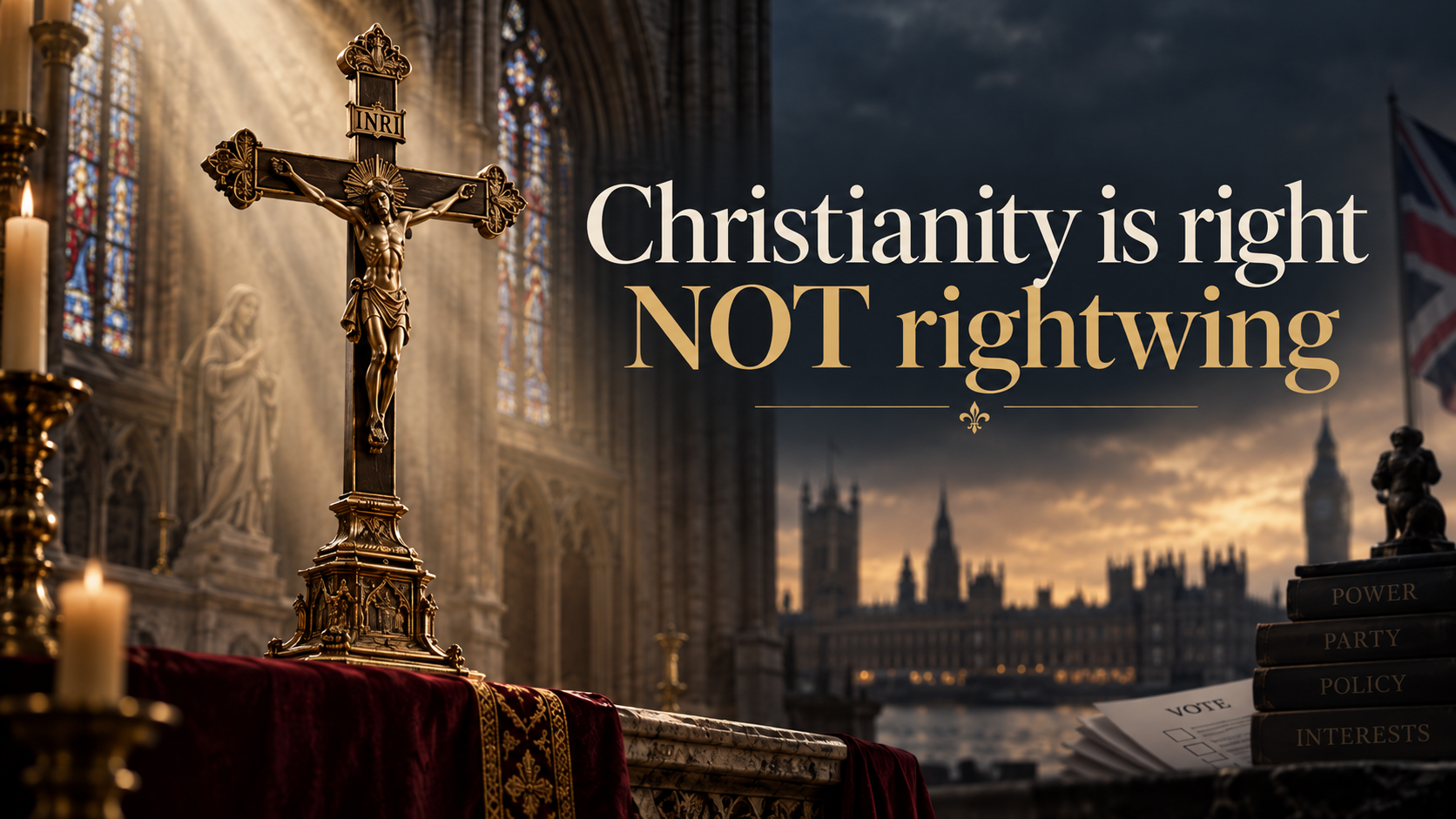
Ordo amoris, the Social Kingship of Christ, and why Catholic orthodoxy is not Christian nationalism
The modern political Right is not synonymous with Christian orthodoxy, and the “Christian Right” is itself largely a category formed by modern, especially American Protestant, political experience. Nationalism, racial chauvinism, market absolutism, hostility to environmental stewardship, authoritarian approaches to discipline and punishment conceived as vengeance can all arise within right-wing politics without belonging to Christianity. By contrast, natural marriage and family, the reality of biological sex, parental authority and an objective moral order are Christian convictions which long pre-date the political categories of Left and Right. Catholicism possesses its own measure of political life: the ordo amoris, the common good, the Social Kingship of Christ and the ultimate good of the human person in God.
The political Right is a modern and unstable political category. Although its conventional genealogy begins with the French Revolution, what subsequently came to be called right-wing has varied considerably between countries and generations. It has generally favoured inherited institutions, social continuity, private property, political authority, national sovereignty and resistance to revolutionary transformation; in the modern Anglo-American context it has also become strongly associated with free markets, limited government and individual economic liberty. None of this forms a coherent theology, nor even a wholly coherent political philosophy. Libertarians, national conservatives, Christian democrats and populists can all be described as belonging to the Right while disagreeing substantially about economic policy, welfare, international relations, immigration and the proper extent of State authority.
The “Christian Right” is a more particular phenomenon. In its recognisably modern form, the expression belongs especially to the political sociology of the United States, where conservative evangelical and fundamentalist Protestants emerged as an organised political force during the latter part of the twentieth century. The Moral Majority and the Christian Coalition became emblematic of an alliance in which Protestant concerns about abortion, pornography, education, homosexuality and the changing moral culture were translated into increasingly organised electoral politics. Conservative Catholics, Mormons and others became important partners in that coalition, particularly on abortion and the family, but the movement’s organisational culture and public vocabulary remained heavily shaped by evangelical Protestantism. The standard scholarly account therefore describes an ecumenical political coalition centred upon, but not exclusively composed of, conservative Protestants.¹
That genealogy matters when the expression is transferred casually into Catholic discussion. An orthodox Catholic may vote consistently for parties of the Right and may cooperate closely with evangelical Christians in defending unborn life, marriage or parental rights without understanding himself religiously as a “right-wing Christian”. Catholic self-understanding has generally developed through quite different categories. Traditional Catholics identify principally through adherence to inherited doctrine, liturgy and devotional life and, in contemporary usage, often through attachment to the Traditional Latin Mass. Catholics broadly accepting the post-conciliar settlement while defending doctrinal orthodoxy are more commonly described as conservative Catholics, sometimes—usually more loosely and often by their critics—as neo-conservative Catholics. Their normal liturgical context is the Novus Ordo Missae. Those categories are imperfect, but the questions separating them concern Tradition, liturgy, ecclesiology, authority and the interpretation of the post-conciliar Church rather than membership of a secular political ideology.
This is particularly important outside the United States, where the terminology of the “Christian Right” can import assumptions derived from American Protestant electoral politics into religious settings which developed independently of them. A Traditional Catholic attached to the old Roman liturgy might be unambiguously orthodox concerning abortion, marriage and sexual morality while rejecting libertarian economics, opposing racial politics and distrusting nationalist enthusiasms. A conservative Catholic attending the Novus Ordo might share precisely the same moral doctrines while supporting extensive social provision or robust environmental regulation. Neither position is anomalous. Catholic doctrine simply does not provide a ready-made manifesto corresponding to the contemporary political Right.
The expression “Christian nationalism” requires still greater care. There is a real political phenomenon to which the term can properly refer, especially where Christian identity becomes fused with national mythology, ethnic identity and political power. Current American polling continues to show white evangelical Protestants as the Christian group most favourably disposed towards positions commonly associated with Christian nationalism, although those attitudes are neither universal among evangelicals nor confined to them.² Yet the category becomes misleading once it is enlarged to include any Christian conviction that religion has public implications or that civil society remains subject to objective moral truth.
This distinction is especially important for Catholics because the traditional Catholic doctrine of the Social Kingship of Christ is not simply a Catholic version of Protestant Christian nationalism. Pius XI’s Quas Primas teaches that the sovereignty of Christ extends beyond private devotion and that individuals and societies cannot finally exclude His law from public life. The doctrine does not confer divine status upon a particular nation, ethnicity or political party. Its logic runs in precisely the opposite direction: because Christ is King, every temporal ruler and every nation stands beneath a sovereignty which it did not create and may not supersede.³
A Catholic influenced by Quas Primas, Leo XIII or the older conception of Christendom may therefore reject the proposition that political society can be metaphysically neutral towards God without thereby subscribing to American Christian nationalism. One may debate the prudential application of the older Catholic teaching under modern conditions, but its theological genealogy is distinct. Christian nationalism risks making Christianity an attribute of the nation. The Social Kingship of Christ makes the nation subject to Christ.
That difference reaches the heart of the present argument. Christianity itself belongs to an order which precedes modern politics. Its doctrines concerning human nature, sexual morality, marriage, family, authority and the moral law were not derived from political conservatism and do not depend upon the fortunes of the modern Right. Christians believed mankind to be created male and female while Europe was governed by Roman emperors. The Church taught the union of husband and wife centuries before socialism, capitalism and nationalism acquired their modern meanings. She understood parents to possess natural duties and authority towards their children before anyone had conceived of contemporary culture-war politics. To describe these beliefs as right-wing may tell us something about their present political location; it tells us almost nothing about their origin or meaning.
That distinction has become increasingly obscured. Opposition to same-sex marriage, abortion and gender ideology is often discussed alongside nationalism, populism, racial politics and authoritarianism beneath the general label of the “Christian Right”, as though coexistence inside a political coalition demonstrated common intellectual parentage. It does not. Christian teaching about marriage and sex belongs to an anthropology of Creation and natural law. The proper extent of markets, the character of national sovereignty or the severity of penal policy are different questions requiring their own moral analysis.
The historical process by which the confusion arose is not difficult to understand. In an increasingly secular culture, many people encounter orthodox Christianity principally at those points where it has become politically controversial. Someone whose first serious encounter with opposition to same-sex marriage comes through an American evangelical campaign or a conservative political party may reasonably but mistakenly assume that the doctrine originates in right-wing politics. In reality, Christianity retained an understanding of marriage which progressive Western politics abandoned. The resulting political reclassification tells us more about the movement of modern politics than about any transformation within historic Christian teaching.
Nuntiatoria has approached this larger problem through the principle Accipere, non fingere—to receive rather than fabricate. That editorial argued that Catholicism begins from realities which precede our choices. Revelation, nature, the moral order and Tradition are first received and only thereafter interpreted, developed and applied.⁴ The same instinct explains Catholic resistance to the modern reconstruction of sex and family. Man and woman, marriage and procreation are not regarded as inventions of a conservative politics but as realities carrying a meaning antecedent to political preference. The fact that conservatives now prove more willing than progressives to acknowledge that givenness does not make the givenness itself conservative.
There is, however, another reason for the conflation, and it is politically more consequential. Once a theological proposition has been converted into an ideological identity, the proposition can be avoided. Instead of asking whether marriage possesses a natural form, public argument can ask what political interests are served by the “Christian Right” in insisting that it does. Instead of examining whether biological sex belongs intrinsically to the human person, the discussion can be relocated into the cultural influence of conservative or “far-right” networks. Political sociology displaces anthropology, and classification begins to perform the work which argument ought to perform.
Contemporary progressive discourse is particularly susceptible to this procedure because much of its language is identitarian. Race, sexuality, gender, privilege, marginalisation and historical structures of power can reveal genuine injustice, but they become intellectually distorting when propositions are explained chiefly by locating the identity of the speaker. At that point the question is no longer simply whether something is true, but which group is asserting it and what position that group occupies within a structure of power.
The language of “white Christianity” illustrates the problem particularly clearly. There are unquestionably movements in which Christianity becomes fused with racial identity or ethnic nationalism. Where Christian language is employed to claim racial superiority or to imply that one ethnicity possesses an intrinsically greater human worth, Christians should condemn the corruption without hesitation. The universality of the Gospel is incompatible with a Christian racial caste system. But that real phenomenon cannot justify the expansion of the category until ordinary Christian doctrine concerning marriage, family or sexual morality itself becomes evidence of “white Christian nationalism”.
Christianity resists this racial confinement in its very history. It began in the Middle East, and some of its oldest civilisations flourished in Africa and Asia. In the modern world its demographic centre has shifted still further from the Western European setting with which secular discourse often instinctively associates it. Pew’s latest global estimates place a larger proportion of the world’s Christians in sub-Saharan Africa than in Europe.⁵ To describe the doctrine of marriage professed by Christians across Africa, Asia, Latin America and Europe as intrinsically “white” because of its contemporary political associations in the United States is not merely inaccurate. It applies an identitarian category to a transracial religion and then mistakes the imposed category for an explanation.
Western political culture can be curiously asymmetrical in this respect. Christianity, because of its historic predominance in Europe, is readily analysed through majority power and privilege, while Islam, Hinduism, Sikhism and Buddhism are more often encountered through the categories of migration, minority identity and cultural protection. Members of those religions plainly deserve protection against discrimination, as do Christians. Yet a socially conservative doctrine does not change its moral or intellectual character according to whether the person professing it belongs to a racial majority or minority. The same proposition about marriage cannot coherently be treated as oppressive “white Christianity” when expressed by one believer and as protected cultural difference when expressed by another.
The historical relationship between Christianity and the political Left provides part of the explanation for the modern alignment. The revolutionary Left did not begin merely as a proposal for greater social spending or economic equality. The French Revolution included the confiscation of ecclesiastical property, coercion of clergy and periods of systematic dechristianisation. Later socialism developed in many directions and cannot be reduced to Marxism, but Marx himself understood religion as belonging to an alienated social order which human emancipation would transcend, while Lenin stated the socialist struggle against religious belief more directly.⁶ When revolutionary Marxism acquired political power, suppression of churches, religious education and clergy was frequently not an accidental excess but the practical expression of an atheistic anthropology. Pius XI’s Divini Redemptoris recognised that the conflict concerned not simply ecclesiastical privilege but the family, property, parental authority and the existence of a moral order beyond the State.⁷
Nuntiatoria recently examined an analogous problem in The Constitutional Church and the Patriotic Church: The Lesson Rome Forgot. The editorial did not equate revolutionary France mechanically with Communist China; it identified instead the underlying question of whether civil power can determine the conditions under which the Church exists and governs herself. Its conclusion—Caesar cannot give what belongs to Christ and His Church—applies beyond the Chinese dispute.⁸ A Left-wing State can attempt to subordinate Christianity to revolutionary ideology, but a nationalist State can equally demand that religious loyalty become an instrument of political loyalty. The Catholic answer to both must begin by refusing to make Caesar the source of the Church’s identity.
None of this warrants the simplification that everyone on the political Left is hostile to Christianity. Christian socialism existed, labour and trade-union movements contained committed Christians, and Catholic social doctrine condemned grave economic injustices which many defenders of laissez-faire capitalism preferred not to see. Yet it would be equally misleading to erase the longstanding conflict between important strands of socialist thought and those inherited forms of family, religion and moral authority which they regarded as obstacles to emancipation. Contemporary progressivism retains something of that instinct wherever sexual morality, biological nature or parental authority are treated primarily as limitations upon autonomous self-definition.
Orthodox Christians have therefore found themselves increasingly aligned with political conservatives. The alliance is not mysterious. Where one side of the political spectrum progressively abandons the Christian understanding of abortion, marriage, sexuality and family while another continues to defend at least part of that inheritance, Christians will naturally cooperate with the latter. The theological mistake begins when political refuge is converted into confessional identity and the entire ideological architecture of the Right is treated as though it arrived with the Deposit of Faith.
Catholicism possesses a much older principle by which those political goods are judged: the ordo amoris, the ordering of love. St Augustine understood moral disorder not merely as the love of evil but as love wrongly proportioned to its object. St Thomas developed the same insight through the ordo caritatis. God is the supreme Good and therefore the ultimate measure of all lesser loves. Human beings nevertheless live within concrete relationships that create real obligations. The duty of parents towards their own children is not dissolved by the universal command of charity, nor does love of humanity abolish legitimate attachment to one’s homeland.⁹
This is sometimes difficult for modern political ideologies to grasp because both universalism and tribalism can flatten the Christian order of charity in opposite directions. Christianity does not demand that every human being have an identical practical claim upon us regardless of relationship or responsibility. A parent really does owe something distinctive to his own child; a government really does bear a particular responsibility towards those entrusted to its care. Yet these particular obligations remain within a universal moral order. A family cannot legitimately enrich itself by deliberately defrauding another, and a nation cannot appeal to national interest to convert injustice into justice. The stranger may stand beyond the immediate circle of civic responsibility without standing beyond Christian charity.
The ordo amoris is therefore a more exact defence of legitimate patriotism than nationalism can provide. It permits a man to love his country because country is genuinely a good, while denying the country any claim to become the highest good. Pius XI’s condemnation in Mit Brennender Sorge of elevating race, people or State beyond their proper dignity follows the same logic.¹⁰ Patriotism remains Christian precisely while the homeland is loved beneath God rather than in God’s place.
The same principle explains why the Social Kingship of Christ should not be confused with Christian nationalism. Quas Primas does not proclaim a sacral nation whose political destiny embodies the will of God. It proclaims a universal King to whom nations themselves owe obedience. The doctrine thus sets a limit to political sovereignty at the very moment it refuses the secular fiction that Christ’s authority concerns only private belief. A nation may be Christian; Christianity cannot be reduced to the nation.
This theological ordering also determines what Christians mean when they speak of loving another person. Charity does not mean simply willing that another should possess whatever he presently desires. Because man has an objective nature and a supernatural destiny, Christian love seeks his actual good, not merely his satisfaction. Ultimately it desires that he know truth, become holy, be reconciled to God and attain salvation.¹¹ The supernatural end does not make temporal wellbeing irrelevant; it places temporal goods in their proper perspective.
That point is indispensable in contemporary moral controversies. The Church’s refusal to redefine marriage is not explained adequately by saying that Catholics belong to a conservative political constituency. Catholic doctrine concerning homosexual acts exists alongside an equally real obligation to treat persons experiencing homosexual attraction with respect, compassion and sensitivity and to reject unjust discrimination.¹² Neither half of that teaching can simply swallow the other. Charity cannot be transformed into contempt because moral truth matters, but neither can charity require a Christian to call morally good what he believes contradicts the good of the person.
Nuntiatoria’s recent treatment of public Catholic identity has made the corresponding point about progressive politics. In Proud Catholic, Public Defiance and When Proximity Becomes Compromise, the question raised by Governor Maura Healey’s invocation of Catholic identity was whether “Catholic” remains an objective moral and doctrinal description when political conviction openly contradicts grave Catholic teaching.¹³ The principle applies equally here. If the word Catholic cannot be emptied of its doctrinal meaning in order to accommodate the progressive Left, the word Christian should not be stuffed with nationalist, libertarian or punitive political content merely because Christians presently find useful allies on the Right. Christianity must qualify political allegiance, not the other way round.
The same is true of gender ideology. A person distressed by his sex is not an enemy but a person whose good must be taken seriously. Yet Christian compassion remains governed by Christian anthropology. If the body belongs intrinsically to the person, rather than functioning as accidental biological material subordinate to an autonomous inner identity, affirmation of every subjective account of the self cannot become the definition of love. Recent Nuntiatoria and related safeguarding work has repeatedly returned to the importance of distinguishing genuine concern for vulnerable children from ideological certainty about the interpretation of gender distress. Respect for the person and scrutiny of contested propositions are not opposites. The obligation is to seek what actually serves the child’s good rather than what happens to satisfy a prevailing ideological expectation.
Here there is a further danger in contemporary Catholic discussion. The necessary recovery of social justice, economic responsibility, environmental stewardship or concern for the marginalised cannot be permitted to create a reversed form of selective morality in which sexual ethics is quietly demoted as though it were an embarrassing secondary preoccupation. Catholic morality is integral. The Christian Right can certainly err by speaking loudly about abortion and marriage while neglecting justice in economic life or the duties attached to wealth and power. The answer is not to invert the selection and treat justice, equality or ecology as “greater” moral concerns which somehow relativise chastity, marriage or the sanctity of life. The same moral law governs the whole human person. There is no authentically Catholic route from concern about one category of injustice to indifference about another.
The family occupies a privileged place within this order precisely because it is not merely a political preference. Marriage creates a bond with its own moral structure and establishes obligations which no bureaucracy can replicate. Parents acquire responsibilities for care and formation which arise from nature before positive law begins to regulate them. The family thus becomes one of the primary settings in which the ordo amoris is learned: affection becomes duty, authority becomes service and sacrifice becomes inseparable from love. A political philosophy which regards every particular attachment with suspicion risks misunderstanding a fundamental feature of human society.
Catholic social doctrine applies the same ordering to property and economic life. Leo XIII defended private ownership against socialism partly because property could give working families greater independence and security. Yet Catholicism never inferred that market outcomes are automatically just or that ownership escapes social obligation. John Paul II’s defence of entrepreneurship and markets in Centesimus Annus remained accompanied by his warning against the “idolatry” of the market and his insistence that an enterprise is a community of persons rather than merely an instrument of profit.¹⁴
The contrast with some strands of the American Christian Right is important. There has often been a close alliance in American evangelical politics between religious conservatism and a strongly libertarian account of economics. Catholic social teaching has no corresponding obligation to accept that alliance. The same Catholic who rejects socialism because it unjustly absorbs property and intermediate institutions into the State may criticise economic conditions which prevent ordinary families from acquiring homes, sustaining children or possessing meaningful independence from employers, landlords and financial institutions. That is not an ideological concession to the Left. It follows from asking what economic life is for.
The common good supplies the answer. Catholic teaching does not reduce it to aggregate wealth, majoritarian preference or the largest possible State apparatus. It concerns the social conditions within which persons and communities can attain their proper perfection.¹⁵ The moral quality of an economy therefore cannot be measured solely by growth or consumer choice if family life becomes progressively less attainable, communities are hollowed out and ordinary people possess less genuine economic independence. Markets are real goods, but like every other social instrument they remain ordered towards persons.
The doctrine of Creation establishes a similar measure for environmental questions. Christianity need not accept apocalyptic rhetoric, anti-human population theories or every regulatory policy advanced in the name of environmentalism. Yet reflexive anti-ecologism has no particular Christian pedigree either. The world is Creation before it is commodity. Human dominion is real, but it is exercised by a creature accountable to the Creator, which is why Catholic teaching places the use of natural resources within duties towards other people, future generations and the integrity of Creation itself.¹⁶
This is another application of Accipere, non fingere. It would be incoherent to insist that created nature sets meaningful limits when addressing sex and then behave as though nature becomes morally meaningless when addressing land, animals or natural resources. Catholicism resists both the progressive desire to reconstruct givenness and the libertarian temptation to interpret dominion as unlimited possession.
Authority likewise possesses a purpose which determines its legitimate use. Christianity has never accepted that hierarchy itself is oppression. Parents possess real authority because children require formation, and teachers must transmit truths and cultivate habits which the pupil does not first invent for himself. Yet authority is ministerial rather than self-justifying. Pius XI’s defence of parental rights in Divini Illius Magistri was accompanied by a clear account of parental duties and warnings against misuse of disciplinary authority.¹⁷
Nuntiatoria made a closely related argument concerning ecclesiastical authority in Authority Is Not Alchemy. The immediate subject was liturgical authority, but the governing principle was wider: legitimate authority is given for a purpose and therefore cannot make every exercise of power prudent, organic or truthful merely by the fact of commanding it.¹⁸ That is a useful Catholic corrective to both progressive suspicion of authority and right-wing authoritarianism. The Christian need not choose between denying authority and treating office as moral omnipotence. Authority is real because its end is real.
The same moral ordering governs punishment. Catholic tradition does not deny retribution, nor does it reduce criminal justice to therapeutic rehabilitation. Public authority may punish grave wrongdoing proportionately and has a duty to protect innocent people. Yet St Thomas’s treatment of vengeance makes clear that punishment becomes morally deformed when the suffering of the wrongdoer itself becomes the desired end.¹⁹ Justice may require severe restraint; charity still requires that the Christian desire the guilty person’s repentance.
The ultimate horizon therefore remains supernatural. Even a murderer who must spend the rest of his life imprisoned for the protection of society remains a human being whose conversion and salvation the Christian desires. This does not weaken justice towards his victim. It prevents justice from degenerating into hatred. The salus animarum—the salvation of souls—is the supreme law of the Church because man is ordered finally towards communion with God.²⁰ Civil government does not exercise the Church’s supernatural jurisdiction, but Christians cannot enter public life pretending that temporal comfort, wealth or security exhaust the meaning of the human good.
That supernatural horizon is also what distinguishes Catholic concern for the common good from political collectivism. A prosperous society may nevertheless be profoundly disordered if families disintegrate, children are formed principally by appetite and commerce, pornography colonises sexuality and human beings increasingly lose any conception of why freedom should be directed towards the good. Conversely, a society cannot establish its moral legitimacy merely by maximising autonomy if the price is the denial of biological reality, permanent obligation and the natural structures through which human beings learn responsibility. Catholic social thought asks what kind of persons and communities political institutions are helping to form.
This provides the proper ground upon which the Christian Right may be criticised. Its problem is not that Christians remain Christian about sex, marriage or family. The problem arises when genuine temporal goods escape the moral order which gives them their purpose. National attachment becomes dangerous when national advantage excuses injustice; property becomes disordered when ownership is severed from the obligations accompanying it; legitimate authority loses its Christian character when power becomes its own justification; punishment becomes vengeance when the suffering of the offender rather than the restoration of justice becomes the object desired. These are not consequences of being excessively orthodox. They occur because a political commitment has ceased to be adequately governed by Christianity.
The same scrutiny must be directed towards the political Left. Socialist and revolutionary traditions have repeatedly treated inherited Christianity as an obstacle to emancipation, while contemporary progressive culture often regards the givenness of sex, marriage, family and moral law as limitations requiring reconstruction. That history makes contemporary Christian cooperation with conservative politics understandable and sometimes necessary. But necessary alliances become dangerous when they acquire theological immunity.
The Catholic experience offers a particularly useful warning against such capture because the divisions most familiar within orthodox Catholicism do not correspond neatly to the secular spectrum. Traditional Catholics attached to the old Roman liturgy may disagree with conservative or neo-conservative Novus Ordo Catholics about Vatican II, liturgical reform, ecclesiastical authority and the interpretation of post-conciliar developments while sharing essentially the same Catholic doctrines concerning abortion, marriage, sexuality and the family. Those disputes are real, but neither side is adequately described by translating it into the vocabulary of American Protestant electoral politics.
Recent Nuntiatoria editorials have repeatedly encountered the same underlying problem in different contexts. When “Catholic” Ceases to Qualify asked whether the word Catholic still establishes an objective confessional identity when applied to an institution. When “Grave” Costs Nothing asked what moral language communicates when grave contradiction carries no visible consequence. The Constitutional Church and the Patriotic Church examined what happens when political authority seeks to determine ecclesial legitimacy. Authority Is Not Alchemy considered the limits inherent even within genuine authority. Accipere, non Fingere supplied the principle beneath them all: Catholic identity is received before it is reconstructed.²¹ This editorial extends that argument into political language. If “Christian” is to qualify “Right”, Christianity must actually remain capable of judging the Right.
That means Christians need not apologise when conservative political movements defend truths which the Faith also defends. Cooperation in protecting unborn life, natural marriage, biological reality, parental rights and religious freedom is not evidence that Christianity has become a political ideology. Yet the Christian must retain enough distance from his political allies to criticise them when nationalism, racialism, economic injustice, abuse of authority or vengeance contradict the moral order he claims to defend. Without that freedom, political alliance has become political capture.
Ordo amoris is consequently a more adequate description of the Catholic political instinct than either Left or Right. It recognises that some obligations are nearer and more particular without permitting particular loyalties to become idols. It allows the Christian to love family and country without imagining that outsiders cease to possess moral claims. It recognises property and authority without detaching them from purpose and responsibility. It permits punishment without hatred and mercy without pretending that justice does not matter. Its unity derives from the fact that all these goods find their proper measure in God.
The neighbour whom politics so readily reduces to a demographic, voter, taxpayer, offender, migrant or member of an identity group remains something more fundamental: a person created by God and called to eternal life. Seeking his good therefore means neither gratifying every desire nor imposing suffering for its own sake. It means willing what is objectively good for him, within an order of justice and charity, and finally desiring that he attain the supreme good for which he was created.
The common good of society is inseparable from this Christian account of the person. It does not mean imposing conversion by political force, nor confusing the temporal jurisdiction of the State with the supernatural mission of the Church. It means refusing to organise society as though man were only a producer, consumer, autonomous will or member of an identity bloc. A genuinely humane political order must make possible the flourishing of persons, families and intermediate communities while recognising that temporal society itself is not the final horizon of human existence.
This is also why the Catholic doctrine of Christ’s Social Kingship cannot be equated with nationalist politics. Quas Primas does not make the nation sacred; it denies the nation’s claim to sovereignty without limit. Christ’s Kingship relativises every political tribe because it establishes a higher allegiance by which each is judged. The Christian’s country may rightly receive his affection and service, but it cannot receive his conscience. That belongs to God.
The final distinction is therefore not between a Christianity of the Left and a Christianity of the Right. Nor is the solution a politically convenient centrism which assumes truth must lie somewhere between the two. Catholic doctrine possesses its own premises concerning Creation, nature, grace, authority, justice, charity and man’s final end. Those premises will sometimes place Catholics alongside political conservatives and sometimes require criticism of conservative assumptions. They will also sometimes produce concerns superficially shared with the Left while rejecting the philosophical premises from which the Left reaches them.
Catholic morality cannot be purchased as a political package.
Orthodox Christianity does not become “right-wing” merely because the contemporary Right remains willing to defend parts of the Christian moral inheritance which the Left has rejected. Nor does criticism of genuine right-wing errors require Catholics to weaken their opposition to abortion, sexual immorality or gender ideology. The Christian standard remains integral because the human person himself is integral.
That is why the answer to the distortions of the Christian Right is not less Christianity, but Christianity more fully allowed to judge political life.
The political Right is a contingent political family. The Christian Right is more particularly a modern coalition whose history has been profoundly shaped by American Protestantism. Christian nationalism describes a still narrower political phenomenon which may or may not overlap with either. Catholic orthodoxy is none of these things.
It possesses a different centre.
Christ is King. The human person is created for God. Love has an order. Authority has a purpose. Society has a common good. And the highest good we can ultimately desire for another person is his salvation.
From that standpoint Christians can cooperate with the Right without becoming its religious department, resist the Left without allowing opposition to progressivism to determine the Faith, love their country without worshipping it, and conserve Christian civilisation without mistaking every contemporary conservative preference for Christianity.
That is not political indecision.
It is the freedom which comes from knowing that Christianity existed before Left and Right—and that both remain answerable to it.
- Michael J. McVicar, The Religious Right in America, Oxford Research Encyclopedia of Religion; Neil J. Young, We Gather Together: The Religious Right and the Problem of Interfaith Politics, Oxford University Press, 2015.
Pew Research Center, How Americans Feel About Religion’s Influence in Government and Public Life, 14 May 2026. - Pius XI, Quas Primas, 11 December 1925.
- Nuntiatoria CXIX, Accipere non Fingere, 16 August 2026.
- Pew Research Center, The World’s Religious Groups: How Their Sizes Changed from 2010 to 2020, 9 June 2025.
- Karl Marx, A Contribution to the Critique of Hegel’s Philosophy of Right: Introduction; V. I. Lenin, Socialism and Religion, 1905.
- Pius XI, Divini Redemptoris, 19 March 1937.
- Nuntiatoria, The Constitutional Church and the Patriotic Church: The Lesson Rome Forgot, 14 August 2026.
- St Augustine, De Doctrina Christiana, Book I; St Thomas Aquinas, Summa Theologiae, II–II, q.26, “The Order of Charity”.
- Pius XI, Mit Brennender Sorge, 14 March 1937.
- St Thomas Aquinas, Summa Theologiae, II–II, qq.23–26, on charity and its order.
- Catechism of the Catholic Church, nn. 2357–2359, “The Vocation to Chastity”.
- Nuntiatoria, Proud Catholic, Public Defiance: Maura Healey Answers Critics, 17 August 2026; When Proximity Becomes Compromise: Maura Healey, the Vatican, and the Cost of Blurred Catholic Boundaries, 18 August 2026.
- Leo XIII, Rerum Novarum, 15 May 1891; John Paul II, Centesimus Annus, 1 May 1991.
- Catechism of the Catholic Church, nn. 1905–1912, “The Common Good”; Pontifical Council for Justice and Peace, Compendium of the Social Doctrine of the Church, nn. 164–170.
- Catechism of the Catholic Church, nn. 2415–2418, “Respect for the Integrity of Creation”.
- Pius XI, Divini Illius Magistri, 31 December 1929.
- Nuntiatoria, Authority Is Not Alchemy: The New Mass, the Long Reform and the Limits of Liturgical Obedience, 14 August 2026.
- St Thomas Aquinas, Summa Theologiae, II–II, q.108, “Of Vengeance”.
- Code of Canon Law, canon 1752.
- Nuntiatoria, When “Catholic” Ceases to Qualify: Leo XIV, Freemasonry and the First Jewish President of the Catholic Biblical Association, 18 August 2026; When “Grave” Costs Nothing, 14 August 2026; The Constitutional Church and the Patriotic Church: The Lesson Rome Forgot, 14 August 2026; Authority Is Not Alchemy: The New Mass, the Long Reform and the Limits of Liturgical Obedience, 14 August 2026; Nuntiatoria CXIX, Accipere non Fingere, 16 August 2026.



Leave a Reply