
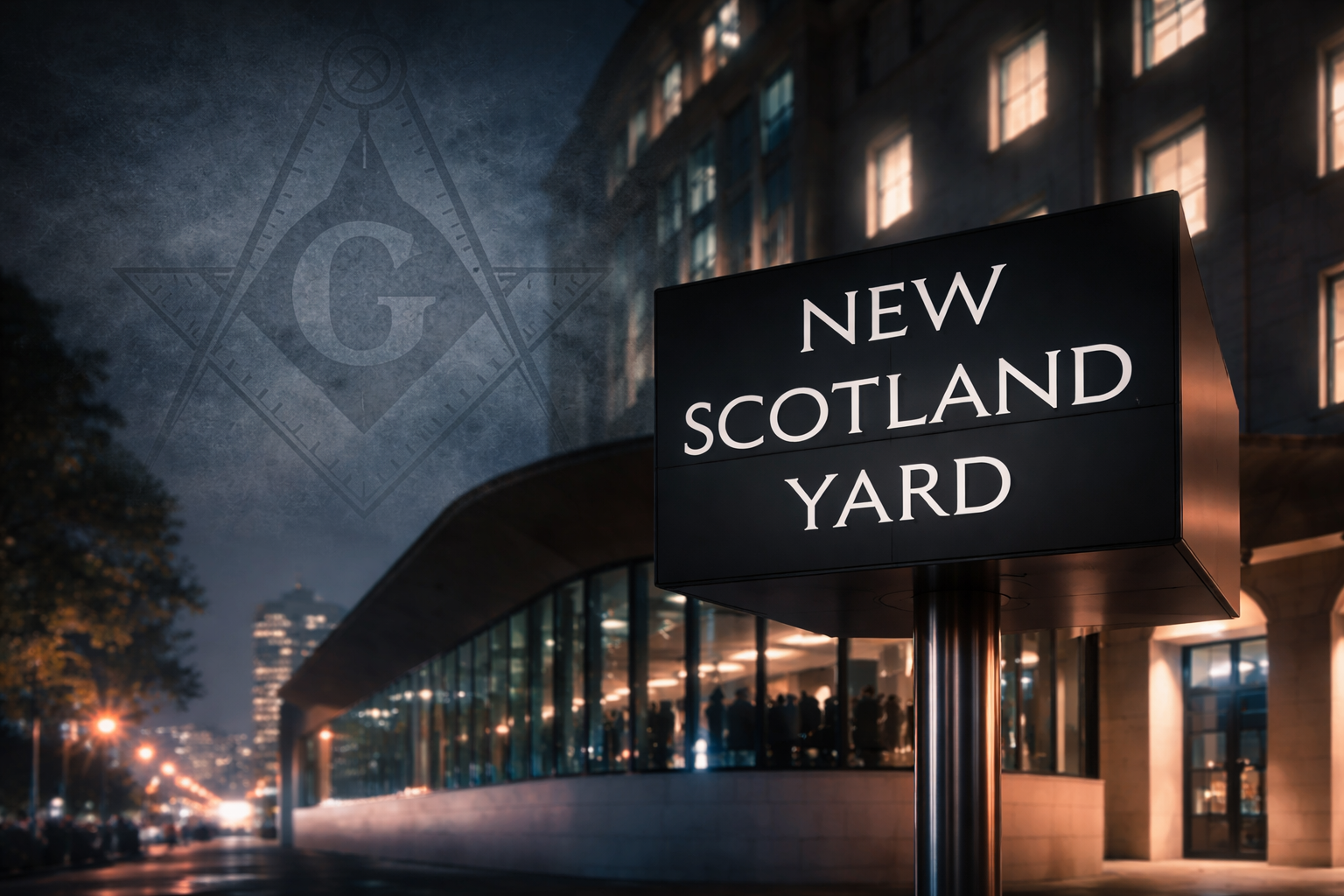
Freemasonry, the Metropolitan Police, and the Politics of Disclosure
History, perception, and the fragile boundary between transparency and suspicion
The Metropolitan Police’s decision to require officers and staff to declare membership of the Freemasons has reopened an old but unresolved question in British public life: when does transparency serve the common good, and when does it harden into suspicion by default?
In late 2025, the Met formally added Freemasonry to its list of declarable associations—lawful organisations whose membership must be disclosed internally by officers. The stated justification was not prohibition but public confidence. Where an organisation involves confidentiality, ritual obligation, or mutual support, undisclosed membership may give rise to perceived conflicts of loyalty, particularly in misconduct proceedings, promotions, or sensitive investigations.¹
Freemasonry bodies, led by the United Grand Lodge of England (UGLE), responded with a legal challenge. They argue that the policy is discriminatory, disproportionate, and unsupported by evidence of systemic wrongdoing. In their view, it treats a lawful fraternity—one whose membership includes judges, civil servants, clergy, and public servants—as uniquely suspect, thereby casting a collective stigma over its members.²
To understand why Freemasonry occupies this contested space in British policing, historical clarity is essential.
Freemasonry in Britain: origins and character
Modern British Freemasonry emerged in the early eighteenth century, formalised with the founding of the Grand Lodge of London in 1717. It developed as a fraternal society centred on moral self-improvement, charitable works, and symbolic ritual, shaped by Enlightenment ideals of virtue, reason, and civic responsibility. Its allegorical ceremonies and internal obligations were intended to cultivate fraternity and ethical conduct, not to exercise political power.³
Freemasonry is not a secret society in the conspiratorial sense. Its existence, structures, and charitable activity are public. It is more accurately described as a private society with public visibility and private rites. Yet this very combination—openness about identity alongside confidentiality of ritual and recognition—has long generated misunderstanding and suspicion, particularly in public institutions where transparency is prized.⁴
Why Catholics are prohibited from Freemasonry
One often overlooked element shaping public perception is the Catholic Church’s long-standing prohibition on membership of Masonic lodges. Beginning with In eminenti apostolatus (1738) under Pope Clement XII and reaffirmed most notably in Humanum genus (1884) under Leo XIII, the Church has consistently forbidden Catholics from joining Freemasonry—a prohibition that remains in force today.⁵
The objection is not political or conspiratorial but theological. Freemasonry is understood by the Church to promote religious indifferentism and a moral framework grounded in natural virtue detached from divine revelation. Its conception of God as the “Great Architect of the Universe,” its ritual oaths, and its relativised approach to truth are judged incompatible with Catholic doctrine, sacramental theology, and exclusive fidelity to Christ.⁶
This prohibition had an unintended sociological effect in historically Protestant Britain. Freemasonry became associated—rightly or wrongly—with establishment culture and civic authority, while Catholics were often excluded from these informal networks. Over time, this reinforced the perception of Freemasonry as an insider fraternity, characterised by mutual obligation and closed loyalty. Though this perception frequently exceeded reality, it has nevertheless shaped public intuition about influence and partiality.⁷
Freemasonry and the Metropolitan Police
Freemasonry’s historical overlap with policing is largely sociological rather than ideological. During the nineteenth and twentieth centuries, Masonic lodges attracted men in public service professions—law, local government, and policing—because they offered fraternity, charity, and mutual support in an era before modern welfare structures.⁸
Within the Metropolitan Police, this overlap became particularly visible in the post-war decades. Police-based lodges developed as social and charitable networks for officers working in a demanding and hierarchical profession. For many, Masonic membership functioned as a support system rather than a means of influence.⁹
Difficulties arose, however, where internal loyalty appeared to blur into institutional favouritism. Allegations—sometimes substantiated, often not—emerged that Masonic ties could affect promotions, disciplinary decisions, or the handling of complaints. Regardless of their accuracy in individual cases, such allegations proved corrosive to public trust.¹⁰
This dynamic was intensified by high-profile institutional failures and corruption inquiries, most notably those surrounding the Daniel Morgan murder investigation.¹¹ Even where no causal link to Freemasonry was established, the recurring presence of Masonic affiliation in contexts of secrecy and opacity hardened suspicion. In an organisation already struggling with credibility, any closed network became symbolically charged.¹²
How other British institutions manage conflicts of interest
It is at this point that the Metropolitan Police policy departs from the norm applied elsewhere in British public life.
In the judiciary, judges are not required to declare membership of lawful fraternities or associations as such. The obligation is situational and concrete: recusal is required where an actual conflict arises in a particular case. Impartiality is protected by conduct and case-specific disclosure, not by generalised suspicion of identity.¹³
The armed forces operate under strict loyalty and security requirements, yet membership of lawful organisations is not declarable unless it intersects with national security, foreign influence, or operational risk. Disclosure is driven by function and threat, not by reputational anxiety.¹⁴
Within the civil service, declarations focus on financial interests, political activity, and relationships that could influence decision-making. Lawful associative life remains private unless it creates a demonstrable conflict with official duties.¹⁵
Across these institutions, a consistent principle applies: the state regulates behaviour, not identity.
Perception, precedent, and the limits of transparency
The Metropolitan Police policy elevates perception—rather than demonstrable conflict—into the primary criterion. This is not unprecedented, but it is exceptional. It reflects the Met’s uniquely fragile credibility after years of scandal and failure. Leadership has judged that even lawful secrecy may be reputationally corrosive.¹⁶
Yet the Freemasons’ objection is not without force. Disclosure regimes, once normalised, rarely remain confined. If lawful membership becomes declarable because it involves confidentiality and mutual obligation, the logic has no obvious stopping point. Religious sodalities, charitable brotherhoods, professional guilds, alumni networks, or informal influence circles could all, in principle, be drawn under similar suspicion.¹⁷
This is why the present dispute matters far beyond Freemasonry itself. It sits at the intersection of institutional credibility and civil liberty. The Metropolitan Police seeks to restore trust after prolonged failure; Freemasonry defends the principle that lawful association should not require justification absent misconduct.¹⁸
The courts will decide whether the Met’s policy is lawful. But the deeper question will remain unresolved by any single judgment. A police force cannot govern by secrecy. Equally, a free society cannot govern by compelled disclosure alone. Whether public trust is rebuilt by enforcing conduct and accountability, or by widening disclosure and managing suspicion pre-emptively, will shape not only policing but the future norms of public-sector governance in Britain.
- Metropolitan Police, Standards of Professional Behaviour: Declarable Associations Guidance, 2025.
- United Grand Lodge of England, press release and pre-action correspondence regarding Metropolitan Police disclosure policy, December 2025.
- David Stevenson, The Origins of Freemasonry: Scotland’s Century, 1590–1710 (Cambridge University Press, 1988).
- John Hamill and Robert Gilbert, Freemasonry: A Celebration of the Craft (HarperCollins, 1992).
- Pope Clement XII, In eminenti apostolatus (1738).
- Pope Leo XIII, Humanum genus (1884), §§10–15.
- Callum G. Brown, Religion and Society in Twentieth-Century Britain (Pearson, 2006).
- Andrew Prescott, “The Social Composition of British Freemasonry,” Transactions of the Lodge of Research, vol. 23.
- United Grand Lodge of England, Freemasons and Policing: Historical Overview, archival briefing paper.
- Home Affairs Committee, Police Complaints and Discipline, HC 151 (1996).
- The Daniel Morgan Independent Panel Report (HC 131, 2021).
- Sir Richard Henriques, Review of Police Corruption Controls, Home Office, 2016.
- Judicial Conduct Investigations Office, Guide to Judicial Conduct, 2019 ed.
- Ministry of Defence, JSP 440: Defence Manual of Security, latest consolidated edition.
- Cabinet Office, Civil Service Management Code and Conflicts of Interest Guidance, updated 2023.
- HM Inspectorate of Constabulary and Fire & Rescue Services, State of Policing: The Metropolitan Police, 2022–2024 reports.
- European Court of Human Rights, Sidabras and Džiautas v Lithuania (2004), on proportionality and association.
- Equality and Human Rights Commission, Freedom of Association and Public Authority Obligations, guidance note.
RELATED ARTICLES


Latest ARTICLES
- TRADITION BEHIND THE FENCEThe Vatican’s prohibition of the traditional Ad Petri Sedem pilgrimage to St Peter’s Basilica has sparked controversy, especially among traditional Catholics. While some cite scheduling conflicts, the broader issue lies in the restrictive policies of Traditionis custodes, which may confine traditional liturgical practices to specific enclaves, risking the transmission and recognition of Catholic Tradition within the wider Church.
- Today’s Mass: October 24 St Raphael the ArchangelThe Feast of Saint Raphael the Archangel highlights his healing powers as depicted in the Book of Tobit, where he aids Tobit and his son, Tobiah. Venerated as a protector of travellers and the blind, Raphael is celebrated for his miraculous interventions. His legacy includes support for nurses, matchmakers, and Catholic studies.
- 25.10.26 Nuntiatoria CXXIX: CHRISTUS REXThe text discusses the relationship between Christ’s kingship and authority within the Church amidst contemporary challenges. It contrasts ecclesiastical power with genuine faith, emphasising that authority must protect divine truth rather than alter it. The witness of imprisoned priests illustrates the enduring significance of fidelity to Christ over institutional conformity.
- THE DOMESTIC CHURCH: 25 October – 2 November 2026 A Home with Room for Heaven: Preparing for All Saints and All SoulsThe content outlines a week’s plan for traditional Catholic families to prepare for the feasts of All Saints and All Souls. Emphasising daily prayers, remembrance of the deceased, and engagement with children’s activities, it aims to integrate Catholic customs into family life, enriching spiritual practices and fostering a shared faith experience.
- ORDO w/c 25.10.26The text outlines the liturgical calendar for the last week of October and the beginning of November, highlighting key celebrations. Notable events include the Feast of Christ the King, St Evaristus, the Vigil of Saints Simon and Jude, and the Feast of All Saints, emphasising themes of holiness, unity in faith, and the Church’s teachings.





Leave a Reply