

The Blessing of Bread on St. Stephen’s Feast (December 26)
The Feast of St Stephen Protomartyr, kept on 26 December, has long been associated in the Western Church with the blessing and sharing of bread. This custom, both liturgical and domestic, draws together the themes of martyrdom, charity, and the sanctification of daily life that characterise the Church’s earliest memory of her first martyr.
St Stephen stands at the threshold of the Church’s history. Chosen as one of the Seven to serve the daily needs of the Christian community (Acts 6:1–6), he embodies the Church’s first expression of organised charity. His martyrdom—recounted in Acts 7—unites service to the poor with fidelity unto death. The blessing of bread on his feast is therefore not merely a quaint seasonal custom, but a sacramental echo of the Church’s earliest diakonia: the sanctification of daily sustenance through charity, prayer, and sacrifice.
Liturgical Roots
The Roman Ritual contains a specific Benedictio Panis in Festo Sancti Stephani Protomartyris, traditionally performed during or after Mass on 26 December. The prayer recalls Stephen’s faith and martyrdom and petitions divine protection upon those who partake of the blessed bread.¹ This blessing is distinct from that of St Agatha’s bread or the Agnus Dei wax; it is explicitly linked to Stephen’s diaconal ministry and to the Church’s earliest care for the poor.
Cultural Traditions
In many regions, particularly in Germany, Austria, and parts of Central Europe, the blessed bread was distributed to the faithful to be eaten at home, shared with the poor, or even given to animals as a sign of God’s protection over household and livelihood. The practice reflects the medieval understanding that creation itself participates in the economy of redemption when ordered toward God.
Across Europe, the blessing of bread on St Stephen’s Day often accompanied other agrarian and domestic customs. In parts of Germany and Austria, loaves baked on this day were preserved throughout the year as tokens of divine protection. In rural England and Ireland, remnants of the custom survived in the sharing of special loaves or cakes among family members and servants, often accompanied by prayers for peace, provision, and blessing in the year ahead.
These practices were not superstitious survivals but expressions of a sacramental worldview in which the material order is elevated through prayer and ordered toward grace.
Regional Expressions
In Poland and other Slavic regions, bread baked on St Stephen’s Day was sometimes shaped into symbolic forms, including horseshoes, reflecting the saint’s later association with animals. The blessed bread was believed to protect both household and livestock.
In Austria, the feast—known as Stefanitag—included the blessing of horses, which were often fed holy bread and salt. This reflected both agricultural dependence and Stephen’s perceived intercessory care for animals.
In Ireland, St Stephen’s Day (Lá an Dreoilín) developed distinct folk customs involving communal processions and charitable collections. Though not directly tied to the blessing of bread, these practices embodied the same spirit of charity and communal obligation that defines the feast.
In England, the day later became known as Boxing Day, deriving from the distribution of alms boxes to servants and the poor. Though secularised over time, this custom retains the original theological impulse of St Stephen’s witness: generosity rooted in Christian duty.
Symbolism and Spiritual Meaning
Bread in Scripture is never neutral. It signifies sustenance, covenant, and divine provision. In Stephen’s martyrdom, bread becomes a silent witness to a deeper truth: that the Church is nourished not only by the Eucharist but by the witness of those who give their lives in love. As St Augustine teaches, Stephen’s death was not merely an imitation of Christ but a participation in His sacrifice, sealed in charity.
The proximity of St Stephen’s feast to the Nativity intensifies this symbolism. The Child laid in the manger—the feeding trough—is Himself the Bread of Life. Stephen, whose name means “crown,” becomes the first to receive the martyr’s crown for confessing that Incarnate Word. The blessed bread thus becomes a domestic echo of the Eucharistic mystery itself.
The Octave of Witness
The early Church arranged the days following Christmas to express distinct forms of martyrdom. The Feast of St Stephen on 26 December commemorates martyrdom by will and blood. The Feast of St John the Evangelist on 27 December honours martyrdom of will without bloodshed. The Feast of the Holy Innocents on 28 December commemorates martyrdom by blood without conscious will. Together, these feasts articulate the full spectrum of Christian witness.
Historically, these days were also associated with particular vocations: deacons on St Stephen’s Day, priests on St John’s, and children or choirboys on the Feast of the Holy Innocents, reinforcing the Church’s understanding of vocation as a shared participation in Christ’s sacrifice.
Conclusion
The blessing of bread on St Stephen’s Day is far more than a pious custom. It is a lived theology, a catechesis enacted through daily sustenance. It proclaims that holiness is not abstract but embodied; that charity begins at the table; and that the mystery of Christ’s Incarnation extends into the ordinary rhythms of life.
In a world increasingly detached from sacramental meaning, this ancient practice restores the grammar of Christian existence: Christ is given, Christ is shared, and Christ is lived—beginning in the home and extending outward into the world.
- Irish folkloric sources concerning Lá an Dreoilín.
- Rituale Romanum, Benedictio Panis in Festo Sancti Stephani Protomartyris.
- Augustine of Hippo, Sermon 316.
- Adolf Adam, The Liturgical Year: Its History and Meaning (Collegeville: Liturgical Press, 1981).
- Polish ethnographic sources on St Stephen’s Day customs.
- Austrian rural devotional practices recorded in regional liturgical handbooks.
St. Stephen’s Day Pie
The most common recipes that have “St. Stephen” in their titles are ones that use up leftovers from the Christmas feast. One such recipe is for St. Stephen’s Day Pie, which uses up leftover meat, vegetables, and mashed potatoes:
1 TBSP butter
1/2 onion, minced
2 cloves garlic, minced
2 cups leftover turkey or ham (or a combination of the both), chopped
1 cup mixed vegetable or peas or corn or combination therefor (frozen is fine)
1 cup turkey gravy, approximately*
salt & pepper to taste
2 tsp marjoram
4 cups mashed potatoes
Heat oven to 350F. In a medium-sized cast-iron skillet, melt butter, add onions and garlic, and cook until soft. Add meat and mixed vegetables. Add enough gravy for all the ingredients to come together, the marjoram, and salt and pepper. Turn off the heat, and evenly spread the mixture in the skillet (or transfer to a 9X13 pan). Warm up the mashed potatoes, and mix in enough milk to soften them and make them spreadable. When soft, spread over the filling in the skillet (or the 9X13 pan). Smooth the top of the meat mixture, making a pretty pattern in the top as you do. Bake at 350F for 25 minutes, or until the top turns golden.
- You can use one cup of chicken, turkey, or vegetable stock thickened by a roux (a TBSP of flour and a TBSP of butter cooked together for 1 minute)
related articles


Latest articles
- Today’s Mass: September 04 Feria of Sunday XIV Post PentecostThe Fourteenth Sunday After Pentecost emphasises the importance of serving one master—God—over the flesh. It urges Christians to focus on spiritual over temporal concerns, warning against anxiety. The readings highlight the contrast between the fruit of the spirit and the works of the flesh, encouraging a pursuit of divine life.
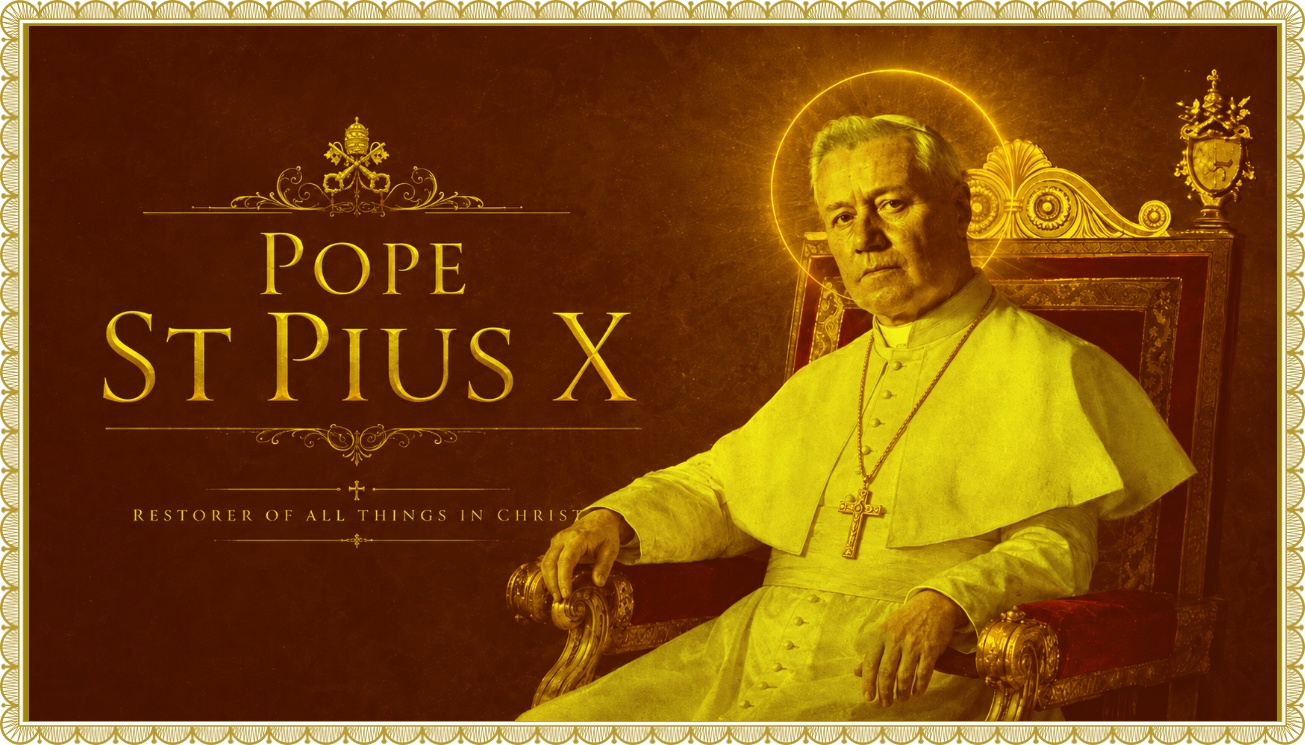
- Today’s homily: St Pius X, PopeThe text reflects on the life and legacy of Pope St Pius X, who was chosen from humble beginnings to reform the Church. His pontificate focused on defending the Catholic Faith, restoring liturgical sanctity, and fostering deeper connections between believers and Christ. Pius X exemplified a balance of truth and pastoral charity.
- Today’s Mass: September 03 Pope St Pius X,Pope St Pius X, born Giuseppe Melchiorre Sarto, was a significant reformer who emphasised preserving the Catholic Faith against Modernism. His pontificate (1903-1914) featured reforms in liturgy, frequent Holy Communion, and seminaries, rooted in a pastoral desire to restore everything in Christ. He died in 1914 and was canonised in 1954.
- Today’s homily: St Stephen of HungaryThe homily reflects on the life of Saint Stephen of Hungary, illustrating his transition from a powerful ruler to a saint. He embraced the responsibilities of kingship guided by faith, understanding his authority as stewardship. His legacy teaches that true governance comes with surrender to God, ultimately placing his kingdom under the protection of the Blessed Virgin Mary.
- Today’s Mass: September 02 St. Stephen the GreatSt. Stephen the Great, King of Hungary (977-1038), was a significant Christian ruler who reinforced the faith throughout Hungary. Anointed king in 1000 by Pope Sylvester II, he fought against paganism and promoted the Church. He was canonised in 1083 and is the patron saint of Hungary, symbolising national identity.



Leave a Reply