

Household Candle Blessings IN CHRISTMASTIDE
Among the most enduring and intimate devotions of Christmastide is the blessing and use of household candles. These candles, often blessed during the Christmas season or on the Feast of the Purification, were traditionally kept with reverence throughout the year and lit at moments of spiritual or physical need. Their flame was not regarded as mere illumination, but as a visible sign of Christ Himself—Lumen de lumine, Light from Light—who enters the darkness of the world.
Blessed candles were commonly lit during storms, invoking divine protection against danger and recalling Christ’s dominion over chaos and fear. They were also kindled at the hour of death, placed near the dying as a sign of hope, peace, and trust in the promise of eternal life. In times of illness or anxiety, the lighting of a blessed candle accompanied prayer for healing, comfort, and perseverance. In each case, the flame served as a silent proclamation of faith: a visible confession that Christ remains present even in suffering.
This practice embodied a deeply incarnational theology. The candle was not regarded as a talisman, but as a sacramental—an outward sign that disposed the faithful to receive grace. Through it, the material world was acknowledged as capable of bearing divine meaning. Light, warmth, and flame became theological signs of Christ’s presence, not in abstraction but within the concrete realities of domestic life.
The Symbolism of Beeswax and Virginity
Central to the theology of the blessed candle is the use of pure beeswax. From late antiquity onward, Christian tradition held that bees reproduced without sexual generation—a belief grounded in ancient natural philosophy and widely accepted throughout the patristic and medieval periods. On this basis, bees became symbols of virginity and purity, and their wax a fitting material for sacred use.
This symbolism was explicitly taken up by the Church. The Exsultet of the Easter Vigil praises the “work of bees” (apis mater eduxit), whose labor produces the wax that bears the Paschal flame. In this hymn, the wax signifies the pure flesh of Christ, born of the Virgin Mary without corruption; the wick represents His human soul; and the flame signifies His divinity. Thus, the candle itself becomes a compact theological confession of the Incarnation.
Because of this symbolism, the Church traditionally required candles used in the liturgy—and especially in sacred rites—to be made of pure beeswax. The same logic extended to domestic devotion. Candles kept in the home were often reserved for prayer, illness, storms, or moments of danger, precisely because they embodied this theology of purity, sacrifice, and divine presence.
The belief that bees themselves lived in chaste order reinforced this symbolism. Medieval writers regarded the beehive as a model of harmonious, selfless community—an image of the Church itself. Thus, lighting a beeswax candle in the home became a small but potent confession of faith in the Incarnation: that God took flesh without corruption, and that His light continues to dwell among His people.
Theological Meaning
The blessing of household candles reveals a deeply incarnational worldview. Fire, wax, and light are not treated as neutral elements but as bearers of meaning. In blessing them, the Church affirms that the material world is capable of sanctification and that divine grace works through created things.
The candle’s flame—steady, vulnerable, yet enduring—becomes a symbol of the Christian life itself. It teaches that holiness is not found only in grand gestures but in fidelity, constancy, and quiet illumination. In this way, the humble candle becomes a domestic sacramental, testifying that Christ, the Light of the world, continues to dwell among His people.
A Short Form of the Blessing of Candles for Home Use
| Latin | English |
|---|---|
| In nomine Patris, et Filii, et Spiritus Sancti. Amen. | In the name of the Father, and of the Son, and of the Holy Spirit. Amen. |
| V. Adjutorium nostrum in nomine Domini. | V. Our help is in the name of the Lord. |
| R. Qui fecit caelum et terram. | R. Who made heaven and earth. |
| Oremus. | Let us pray. |
| Benedic, Domine, has candelas, | Bless, O Lord, these candles, |
| ut, accensae, lumen Christi nobis significent, | that, when they are lit, they may signify to us the light of Christ, |
| et corda nostra ad te semper erigant. | and lift our hearts always toward You. |
| Per Christum Dominum nostrum. Amen. | Through Christ our Lord. Amen. |
- Rituale Romanum, Tit. IX, “De Benedictione Candelarum.”
- Prosper Guéranger, The Liturgical Year, vol. I (Advent–Christmas).
- Josef A. Jungmann, The Mass of the Roman Rite, vol. I (Westminster: Christian Classics, 1951).
- Augustine of Hippo, Sermon 190 and Sermon 272.
- Isidore of Seville, Etymologiae, XII.8, on bees and purity.
- Honorius of Autun, Gemma Animae, I.65.
- Amalarius of Metz, Liber Officialis, I.16.
- Rabanus Maurus, De Institutione Clericorum, II.
- Exsultet, Roman Missal, Paschal Vigil.
- Thomas Aquinas, Summa Theologiae, III, q. 27 (on the fittingness of the Virgin Birth).
related articles


Latest articles
- Today’s Mass: September 04 Feria of Sunday XIV Post PentecostThe Fourteenth Sunday After Pentecost emphasises the importance of serving one master—God—over the flesh. It urges Christians to focus on spiritual over temporal concerns, warning against anxiety. The readings highlight the contrast between the fruit of the spirit and the works of the flesh, encouraging a pursuit of divine life.
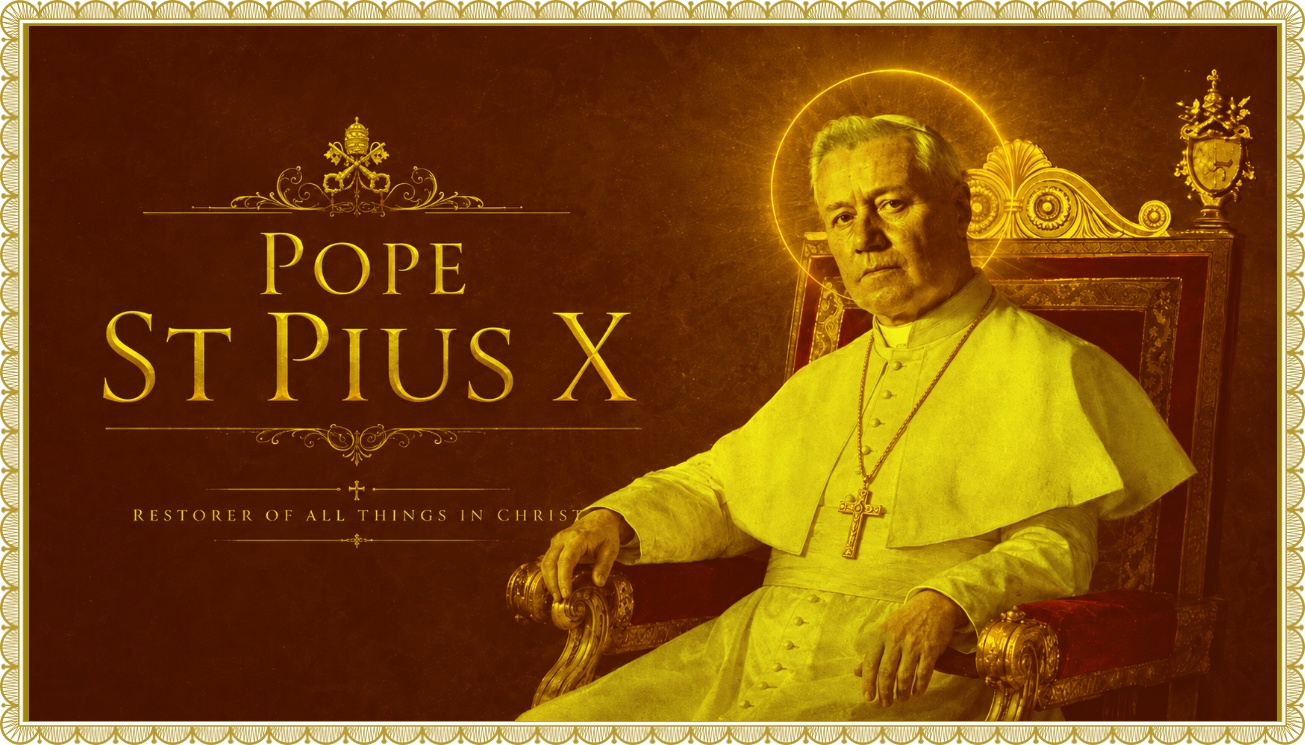
- Today’s homily: St Pius X, PopeThe text reflects on the life and legacy of Pope St Pius X, who was chosen from humble beginnings to reform the Church. His pontificate focused on defending the Catholic Faith, restoring liturgical sanctity, and fostering deeper connections between believers and Christ. Pius X exemplified a balance of truth and pastoral charity.
- Today’s Mass: September 03 Pope St Pius X,Pope St Pius X, born Giuseppe Melchiorre Sarto, was a significant reformer who emphasised preserving the Catholic Faith against Modernism. His pontificate (1903-1914) featured reforms in liturgy, frequent Holy Communion, and seminaries, rooted in a pastoral desire to restore everything in Christ. He died in 1914 and was canonised in 1954.
- Today’s homily: St Stephen of HungaryThe homily reflects on the life of Saint Stephen of Hungary, illustrating his transition from a powerful ruler to a saint. He embraced the responsibilities of kingship guided by faith, understanding his authority as stewardship. His legacy teaches that true governance comes with surrender to God, ultimately placing his kingdom under the protection of the Blessed Virgin Mary.
- Today’s Mass: September 02 St. Stephen the GreatSt. Stephen the Great, King of Hungary (977-1038), was a significant Christian ruler who reinforced the faith throughout Hungary. Anointed king in 1000 by Pope Sylvester II, he fought against paganism and promoted the Church. He was canonised in 1083 and is the patron saint of Hungary, symbolising national identity.



Leave a Reply