
The Militia Christi of the Christmas Octave: A Treatise on the Saints Placed Around the Crib
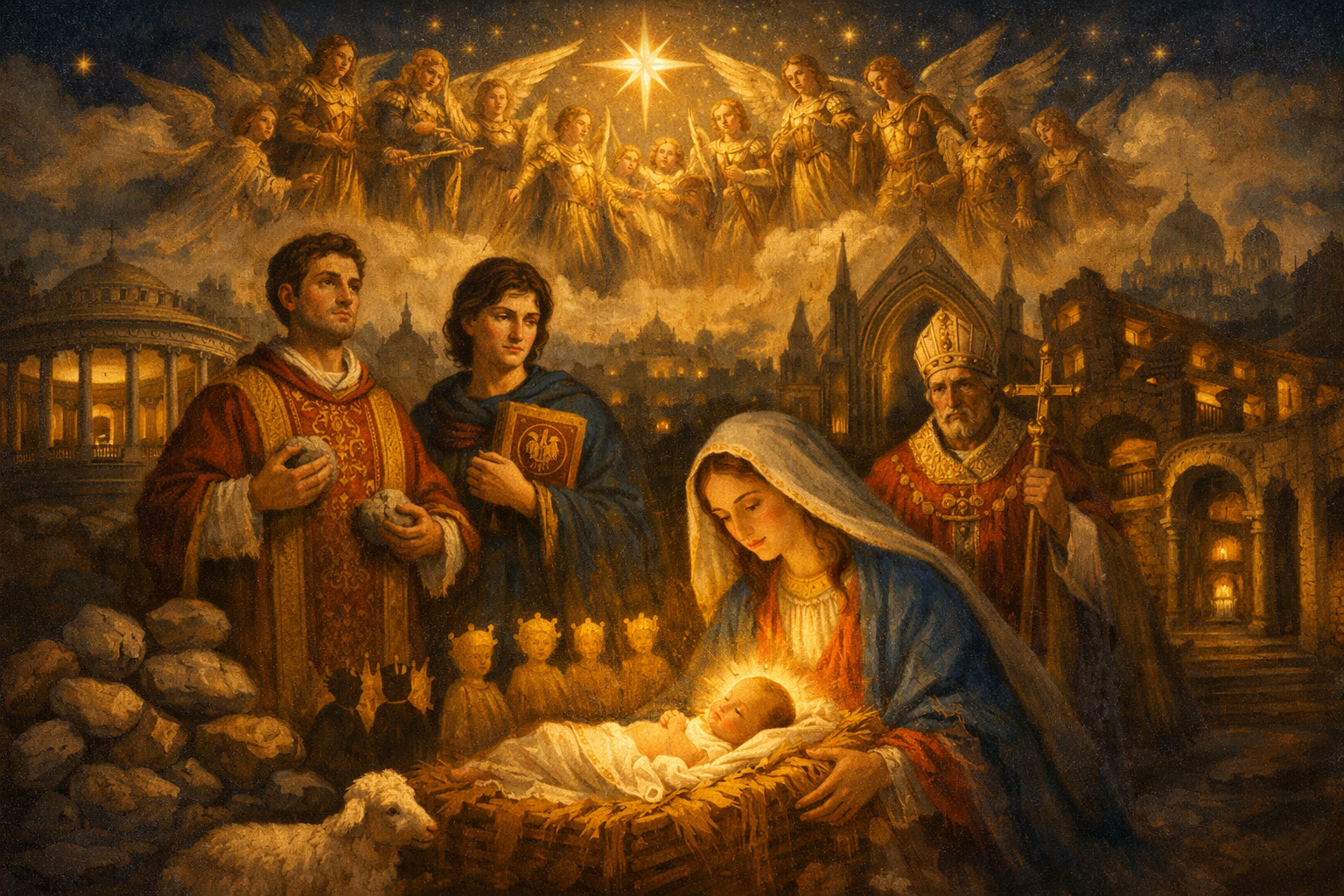
The ancient Roman instinct—shared and explained by the Fathers—was to treat Christmas not as a single day of warmth, but as a liturgical campaign. The Octave is a sustained proclamation that the Child in the manger is not merely “born,” but enthroned; not merely adored, but obeyed; not merely welcomed, but opposed. The Church therefore arranges, immediately around the crib, a formidable company: martyrs, apostles, confessors, and the helpless slain—those whom patristic tradition readily gathers under the image of the militia Christi, the soldiers of Christ.¹
This is not an aesthetic arrangement. It is a theological one. In the Roman Rite, the Octave makes a single, severe argument: the Incarnation is an invasion—God entering enemy-held territory to reclaim what is His. The saints of these days are not seasonal ornaments. They are witnesses that the Kingdom of Christ arrives with consequences, that divine light provokes hatred, and that the Church’s joy is never separable from combat.
What follows is not a set of “reflections,” but an integrated treatment: historical, archaeological, and contextual—because the Church’s liturgy is not merely poetry, but memory disciplined into worship.

The First Day: Christmas and the Martyr Hidden in the Dawn (St Anastasia)
Even before we reach the second day of the Octave, the Roman tradition has already planted a marker: the commemoration of St Anastasia at the Mass at Dawn. This is one of those details that reveals how early Rome understood Christmas. The liturgy refuses to let the Nativity be isolated from the cost of confessing Christ.
Historically, St Anastasia’s church—Sant’Anastasia al Palatino—is among the ancient tituli of Rome, established in the early fourth century in the shadow of imperial power, at the edge of the Palatine and the Circus Maximus. Archaeologically and topographically, its location matters: it stands amid the architecture of Rome’s public religion and political theatre, on pre-existing Roman structures and streetscapes.² The Christian basilica thus occupies, quite literally, contested ground: a confession of Christ planted where empire once performed its own sacral claims.
Liturgically, the commemoration of Anastasia at Christmas is not a medieval flourish but a remnant of antique Roman practice. By late antiquity her name had entered the Roman Canon, a sign of how prominent her cult had become in the city’s public worship.³ The point is not merely “honouring a saint,” but declaring that the Church’s Christmas is born already under persecution: at the very threshold of the feast, the Roman calendar remembers a martyr.
This is how the Octave begins: not with sentimental insulation, but with a sober declaration that the Child is born into a world that kills saints—and that the Church will not lie about it.
December 26: St Stephen and the Roman Memory of Blood
The second day of the Octave is the feast of St Stephen, Protomartyr—and the Church’s placement is deliberate. Stephen’s martyrdom occurs after the Ascension in historical sequence, yet the Roman Rite binds him to Bethlehem because Stephen interprets what Bethlehem means. The manger is the first throne of the King; Stephen is the first subject to die rather than deny that kingship.
To treat Stephen “contextually” is to refuse both pious vagueness and sceptical reductionism. The New Testament gives the primary narrative (Acts 6–7). But the afterlife of Stephen in Christian memory is equally important, because it is that memory which shaped Rome’s architecture, pilgrimage, and stational worship.
In 415, a tradition of discovery of Stephen’s relics was widely circulated, associated with the priest Loukian of Kfar Gamla, whose account (transmitted and translated in late antique Christian literature) became part of the historical scaffolding for Stephen’s cult across the Mediterranean.⁴ The point is not that archaeology can “prove” the bones; the point is that late antique Christians acted on this memory—and those actions created churches, liturgies, and processions whose traces remain.
In Rome, Stephen is anchored in stone. The station for his feast is associated with Santo Stefano Rotondo on the Caelian Hill, an ancient basilica with an unusual circular plan, consecrated in the fifth century and dedicated to the protomartyr. The building itself is a theological statement: Rome gives the first Christian martyr a monumental shrine near the city’s aristocratic and ecclesial heart, and the very novelty of the plan advertises the significance.⁵
The Caelian setting is not incidental. This is the Rome of old families, house-churches, and the early Christian negotiation with imperial space. The stational system—Rome’s discipline of gathering at particular churches as a unified act of civic worship—makes Stephen’s feast not merely devotional, but public. Here the militia Christi is not an interior metaphor. It is a people assembling, processing, and declaring: the newborn King will have witnesses unto death.
December 27: St John the Evangelist—The Soldier-Theologian and the Archaeology of Memory
If Stephen is the Church’s first blood-witness, St John is the Church’s great witness by endurance, doctrine, and proximity to the mysteries. He is placed within the Octave because Christmas must be interpreted by truth: the Church will not permit Bethlehem to be reduced to “a baby” without the metaphysical claim that “the Word was made flesh.”
John’s feast is also where archaeology and liturgy converge with particular force. Christian memory locates John’s later life and burial at Ephesus, and the Byzantine world monumentalised that claim in the Basilica of St John, rebuilt on a grand scale under Justinian in the sixth century. The ruins remain on Ayasuluk Hill near modern Selçuk, and the site’s significance is documented in literary and scholarly treatments of the basilica’s architectural evolution and its role as a pilgrimage centre.⁶ The basilica did not arise from nowhere; it stands as an imperial confirmation of an already-established cultic memory, and its very scale tells you what the early Church believed about apostolic foundations: they are not optional stories but pillars of Christian identity.
Rome, however, does not need Ephesus in order to honour John. The Roman stational tradition for December 27 is itself a lesson in how ancient Rome “mapped” theological meaning onto sacred space. The station is not mechanically attached to “St John Lateran,” because the Lateran’s later dedication to the two Johns postdates the fixing of the stations. Instead, Roman liturgical history preserves a more complex memory: the stational system matured early, and later dedications did not simply rewrite it.⁷
John therefore stands within the Octave as a corrective to sentimentalism: he forces the Church to say what Christmas is. The Fathers repeatedly treat John as the theologian of the Incarnation because he does not begin with shepherds and fields, but with eternity: In principio erat Verbum. That is not abstraction. It is warfare against error. When the Church places John beside the crib, she is telling you that the militia Christi fights not only with blood, but with doctrine—because falsehood about Christ is spiritual treason.
December 28: The Holy Innocents—Martyrs, Demography, Tyranny, and the Roman Station at St Paul’s
The fourth day of the Octave confronts the world’s response to Christ with a directness that modern piety often tries to evade: the Holy Innocents.
Historically, the event is rooted in Matthew 2:13–18, and the debate about Herod’s atrocities is often framed by modern expectations of bureaucratic record-keeping. But Herod’s documented character in ancient sources, and the known patterns of localised violence in client-king politics, make the massacre fully plausible as a small-scale atrocity that would not necessarily produce an independent archival footprint. The liturgy, however, is not interested in satisfying modern positivism. It is interested in proclaiming what the event means: the Incarnate King immediately threatens illegitimate power.
The Church’s commemoration is also materially grounded. Rome assigns the station of this feast to St Paul Outside the Walls, and traditional Roman explanations explicitly connect this to the presence (or claimed presence) of relics of some of the Innocents at that basilica.⁸ Whether one treats the relic-claim with maximal confidence or with cautious piety, the underlying point remains: Rome insisted on locating the feast within the city’s most solemn apostolic geography. Major solemnities gravitated to the tombs of Peter and Paul; the Innocents are placed there because their witness is not “secondary.” In the Church’s eyes, they are the first martyrs of the New Covenant—before Stephen, before the persecutions, before the catacombs.
And here the Fathers are relentless. They call these children martyrs not because they made articulate confession, but because they died because of Christ. Augustine famously names them the “flowers” (flores) of the martyrs—cut down in bud, yet crowned.⁹ This is the militia Christi in its most unsettling form: the Kingdom advances not only through chosen heroism but through the world’s exposure—through the revelation that tyrants will kill children rather than yield sovereignty.
If one wants “context,” it lies here: the Octave refuses to pretend that politics is neutral. Herod is not merely “a bad man.” He is the type of the ruler who treats truth as threat and life as disposable. The Holy Innocents are placed beside the crib so that no Christian may speak of Christmas as if it were compatible with a culture of child-sacrifice, whether overt or polite.
December 29: St Thomas Becket—The Martyrdom of Jurisdiction and the Medieval Church’s Public Theology
Within the Octave, the West also commemorates St Thomas Becket, murdered in Canterbury Cathedral on 29 December 1170. This is not a marginal English curiosity. It is one of the Middle Ages’ defining martyrdoms precisely because it exposes the permanent tension between sacred authority and political power—an issue the Fathers already understood in principle, and which medieval Christendom enacted in blood.
Becket’s biography matters here because it is the biography of a man converted by office. Formerly royal chancellor, he became archbishop and found himself forced into collision with the crown over the Church’s liberties and the limits of royal jurisdiction. His death was not a private tragedy; it was a public earthquake. Contemporary and later medieval memory turned Canterbury into one of Europe’s great pilgrimage destinations, and the cult’s spread is evidenced in art, reliquaries, and the rapidity of his canonisation.¹⁰
The institutional and architectural context is not incidental. Canterbury Cathedral is not merely a “building.” It is the symbolic seat of an ecclesial order older than any single monarch, and Becket’s murder within it dramatised, in one horrific episode, a question that never disappears: who governs the conscience; who appoints the limits of power; what happens when the state demands that the Church become its instrument? Canterbury’s own educational and historical materials preserve the core narrative and its consequences, including the immediate reports of popular veneration and miracles associated with Becket’s blood.¹¹
Placed within the Christmas Octave, Becket functions as a later historical echo of the same truth proclaimed by Stephen and the Innocents: the newborn King claims a realm that rulers often wish to control. Becket is therefore a soldier of Christ not because he led armies, but because he refused to surrender the Church’s divine commission to the administrative convenience of the state.
December 30: The “Within the Octave” Day—How the Liturgy Teaches Continuity
In the classical Roman calendar, December 30 is often a day within the Octave without a universally prominent saint replacing the Christmas mystery. That is itself part of the Church’s pedagogy. Not every day is an interruption by a named figure; some days are meant to immerse the faithful again in the central fact: Hodie Christus natus est—today Christ is born.
The stational principle here is spiritual as well as historical: Rome teaches the faithful to remain with the mystery long enough for it to reshape their instincts. Modern culture trains people to consume a feast in hours; the Roman Rite trains people to dwell.
This day is also where the militia Christi appears in another mode: perseverance. The soldier is not only the one who dies, but the one who holds position—day after day—when novelty has evaporated. The Octave’s structure itself is a discipline of watchfulness.
December 31: Pope St Sylvester I—Confessor, Catacombs, and the Church After Persecution
The seventh day of the Octave brings us to Pope St Sylvester I (d. 335), a figure inseparable from the Church’s transition from persecution to public existence. Sylvester is one of the earliest “confessors” honoured with a feast in the Roman liturgy: a saint not crowned by execution, but by governance under pressure.
Here the archaeology is unusually concrete. Tradition associates Sylvester’s burial with a basilica built above the Catacomb of Priscilla, and later Roman history records translations of relics and the development of churches connected with his memory.¹² Modern Roman cultural-historical descriptions of the Priscilla complex and its basilica traditions preserve the outline of this sacred geography.¹³
Liturgically, the Roman station for Sylvester’s feast was historically kept at the place of his burial—again showing how the Roman Rite binds worship to place, and place to memory.¹⁴ In other words: Rome does not merely “remember” Sylvester. Rome walks to him.
Why does this matter for the militia Christi? Because persecution is not the only theatre of war. Peace creates its own temptations: compromise, capture, spiritual softening, bureaucratic decay. Sylvester represents the soldiering of governance—holding the Church together as she emerges into a world where proximity to power can corrupt as effectively as hostility can frighten. The Octave ends its civil year (so to speak) not with fireworks but with a confessor pope: a reminder that institutional fidelity is itself a form of combat.
January 1: The Circumcision of the Lord—Blood of the Covenant and the King Who Submits
The Octave Day is traditionally the Feast of the Circumcision of Our Lord—and here the Church reaches something even more severe than martyrdom: the voluntary submission of the Incarnate Word to the Law.
Historically and contextually, circumcision on the eighth day is not a vague “Jewish custom.” It is a covenantal command rooted in the Abrahamic sign (Genesis 17) and maintained as a normative practice in Second Temple and rabbinic tradition. Ancient Jewish sources and later codifications preserve the eighth-day principle plainly; Josephus explicitly notes the eighth day as customary for Jews.¹⁵ The Mishnah discusses the timing across various circumstances, showing how embedded the practice was in Jewish legal consciousness.¹⁶
Now place that beside Luke 2:21. The point is not merely that Jesus is circumcised, but that the eternal Son enters, by blood, into the covenantal order He Himself ordained. The Church reads this as a moment of consecration and prophecy: the first shedding of Christ’s blood, the first public inscription of His saving Name, and the first demonstration that the King conquers by obedience before He conquers by judgment.
Rome marks this feast with the station at Santa Maria in Trastevere, one of the city’s ancient Marian churches—again showing how the Octave Day is not merely “about a ritual,” but about the Mother and the mystery of the Word made flesh.¹⁷ The stational logic matters: the Octave ends where the Church wishes the faithful to stand—within a Marian frame—confessing that the Incarnation is inseparable from the Mother who bore God in the flesh.
This is the climax of the Octave’s militia Christi. The soldiers around the crib—Anastasia, Stephen, John, the Innocents, Becket, Sylvester—are not random examples of “good people.” They are the Church’s declaration that the newborn King claims the whole human order: doctrine, governance, childhood, conscience, law, and blood. And then, on the eighth day, the King Himself submits to the Law, sanctifying obedience and anticipating the Cross.
The Octave as a Single Argument: Why the Church Places These Saints Here
If you read the Octave as a unified patristic argument, its structure becomes unmistakable:
Stephen teaches that Christmas births martyrdom.
John teaches that Christmas births doctrine and anti-heresy clarity.
The Innocents teach that Christmas provokes tyrants and exposes child-killing regimes.
Becket teaches that Christmas challenges the state’s attempt to rule the sacred.
Sylvester teaches that Christmas still demands vigilance when persecution subsides.
The Circumcision teaches that Christmas is covenantal, juridical, bloody, and obedient.
This is the “formidable company” around the crib. It is not romantic. It is military.
And this is why the Fathers speak so naturally of the militia Christi. The Church is not a society of seasonal tenderness. She is a people enlisted under a King whose first bed is a manger and whose last throne is a Cross. The Octave is the liturgical proof.
- On the patristic and liturgical instinct to interpret the Nativity in continuity with combat against sin, death, and the devil, see the Octave’s classical arrangement as preserved in the Roman tradition of stational feasts and martyr commemorations.
- On the antiquity, siting, and structural continuity of Sant’Anastasia al Palatino, including its early fourth-century origins and construction over pre-existing Roman buildings: Turismo Roma, “Basilica di Sant’Anastasia on the Palatine Hill.” Turismo Roma
- On St Anastasia’s unique commemoration in the Roman liturgy (including her insertion into the Roman Canon by late antiquity and her commemoration at the Christmas Dawn Mass): Catholic Answers Encyclopedia, “Anastasia, Saint.” catholic.com
- On the late antique narrative of the discovery (415) of Stephen’s relics and the transmission of that account: Oxford, Cult of Saints in Late Antiquity (CSLA), record on Stephen and Loukian of Kfar Gamla. csla.history.ox.ac.uk+1
- On the history, fifth-century dedication, and significance of Santo Stefano Rotondo (Caelian Hill) as an ancient basilica dedicated to the protomartyr: “Santo Stefano al Monte Celio.” Wikipedia
- On the Justinianic basilica at Ephesus built over the traditional tomb of St John and its architectural/pilgrimage development: N. Karydis (2016), “The Architectural Evolution of the Church of St John at Ephesos” (PDF). kar.kent.ac.uk
- On the Roman stational logic for December 27 and the historical note that the station is not fixed simply by later Lateran dedications: New Liturgical Movement, “The Station Churches of the Christmas Season (Part 2).” newliturgicalmovement.org
- On the Roman Station for December 28 being at St Paul Outside the Walls and the traditional connection with relics of the Holy Innocents: ExtraordinaryForm.org, “December 28, Holy Innocents” (PDF). extraordinaryform.org
- On Augustine’s classic description of the Holy Innocents as the “flowers” of the martyrs and the patristic rationale for their martyr title: the feast’s patristic reception as summarised in standard liturgical-historical treatments. (For the event’s liturgical placement and meaning in the Roman calendar, see CatholicCulture’s entry.) catholicculture.org
- On Becket’s death on 29 December 1170, its political-ecclesial context, and the shockwaves through medieval Christendom: British Museum, “Thomas Becket: the murder that shook the Middle Ages.” britishmuseum.org
- On the Canterbury narrative of the murder, the role of the knights, and immediate popular veneration associated with Becket’s blood: Canterbury Cathedral Learning Resources, “Becket.” learning.canterbury-cathedral.org
- On the association of Pope Sylvester I with the Catacomb of Priscilla and the later translation traditions and relic claims: “Catacomb of Priscilla.” Wikipedia
- On the Priscilla catacomb complex and the basilica traditions connected with Sylvester in Roman cultural-historical presentation: Turismo Roma, “The Catacombs of Priscilla.” Turismo Roma
- On the station tradition for St Sylvester’s day at the place of his burial and the early liturgical honouring of him as a confessor: New Liturgical Movement, “Station Churches of the Christmas Season (Part 2)” (historical note on December 31). newliturgicalmovement.org
- On circumcision on the eighth day as a Jewish norm and Josephus’ explicit statement of the eighth day: Josephus, Antiquities, 1.192 (Lexundria) and parallel text tradition. lexundria.com+1
- On Mishnah testimony to circumcision timing across cases (eighth day as standard, with exceptional computations): Sefaria, Mishnah Shabbat 19:5 (English explanation). sefaria.org.il
- On the Roman station for January 1 (Circumcision/Octave Day) at Santa Maria in Trastevere and the Roman liturgical tradition behind it: ExtraordinaryForm.org, “January 1, Circumcision of Our Lord” (PDF). extraordinaryform.org
related articles


Latest articles
- Today’s Mass: September 05 Saint Lawrence JustinianSaint Lawrence Justinian, the first Patriarch of Venice, dedicated his life to the poor and the establishment of monasteries, rejecting noble marriage. Renowned for his humility and pastoral dedication, he emphasised the spiritual integrity of Venice’s safety. He was a precursor to the reforms of the Council of Trent, dying on 8 January 1455.
- 06.09.26 Nuntiatoria CXXII: NOMEN MANET, RES DEESTThis edition of Nuntiatoria explores the disconnect between the names of Catholic institutions and the realities they signify. Despite retaining their titles, many aspects of Catholicism—such as episcopal authority in China and religious practice in Poland—exhibit deteriorating substance. The piece cautions against superficial continuity, stressing the importance of genuine faith and practice over mere nomenclature.
- ORDO w/c 06.09.26The document outlines the liturgical schedule for the week of 6 to 13 September 2026, highlighting significant religious observances such as the Fifteenth Sunday after Pentecost and the Nativity of the Blessed Virgin Mary. It reflects on themes of compassion, holiness, fidelity, and humility, underscoring their importance in Christian life.
- The Fifteenth Sunday after Pentecost: When the Procession of Death Meets the Lord of LifeThe Fifteenth Sunday after Pentecost focuses on the transformative power of Christ, emphasising the supernatural life granted through grace. The liturgy highlights the Church’s role as a nurturing mother, mourning the spiritually dead while seeking their restoration. Christ’s compassion leads to resurrection, demonstrating that true life is found in dependence on Him.
- If Cecchin Is Right, Fatima Is WrongFr Stefano Cecchin, President of the Pontifical International Marian Academy, has declared opposition to apparitions that speak of divine punishment, suggesting they are false. This stance contradicts fundamental Catholic doctrine, including teachings from Scripture, the Catechism, and specifically the Message of Fatima, which warns of divine consequences for sin.



Leave a Reply