
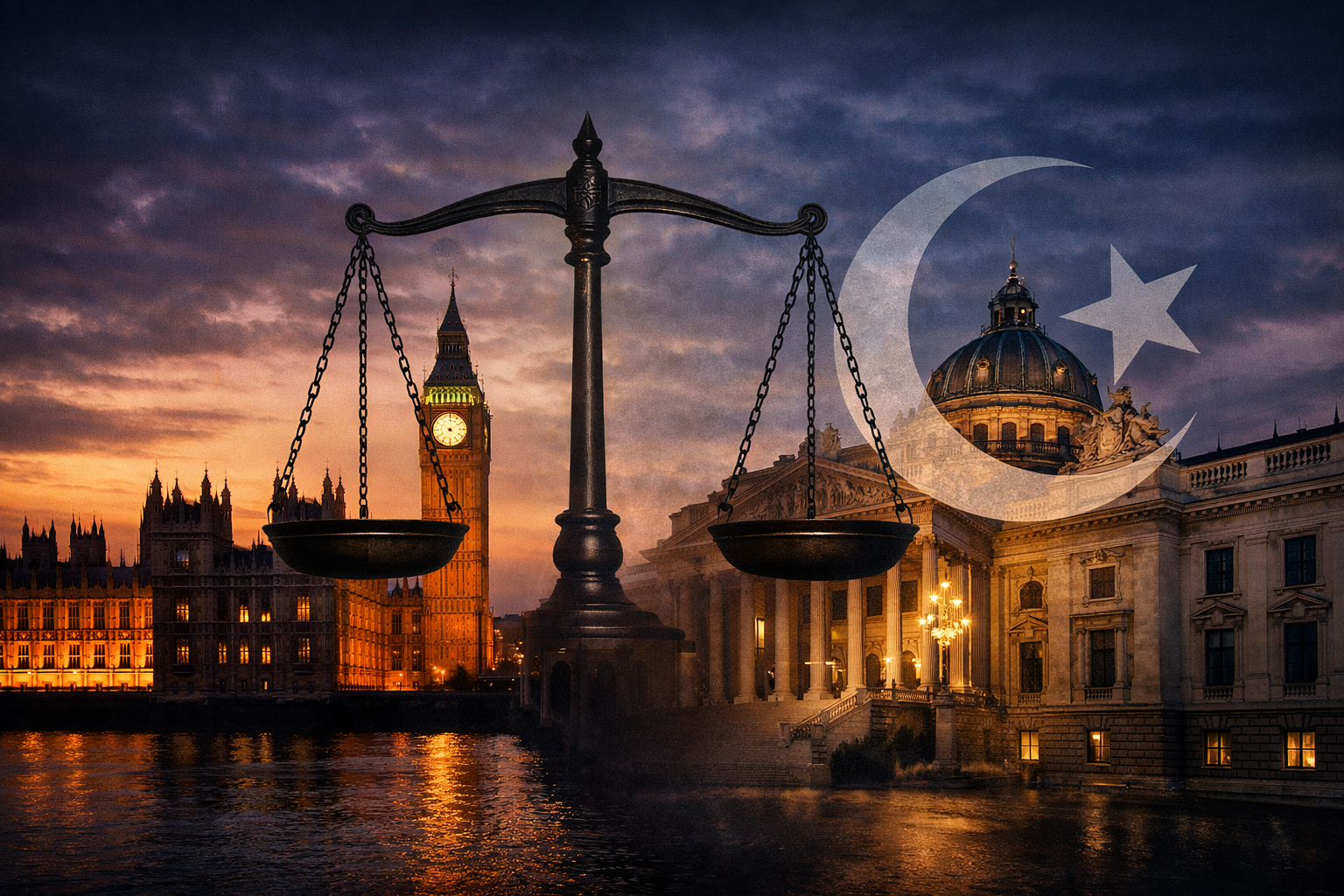
The Peril of Codifying “Islamophobia”: Free Speech, State Power, and the Politics of Definition
The British Government’s renewed effort to establish an official definition of “Islamophobia” raises profound legal, political, and constitutional questions. What is presented as a measure to combat hatred may, in practice, function as a mechanism to constrain lawful speech, inhibit theological and political critique, and blur the vital distinction between protecting persons and protecting ideas.
In February 2025, the Government under Angela Rayner, Deputy Prime Minister and Secretary of State for Housing, Communities and Local Government, announced the establishment of a Working Group tasked with advising on a definition of “anti-Muslim hatred/Islamophobia.”¹ The stated objective was to provide clarity for public bodies in addressing discrimination and hostility toward Muslims.
A subsequent briefing issued by the Free Speech Union (FSU), authored by its Director of Policy and Research David Rose, raised concerns regarding the composition of the Working Group and the prior affiliations of its members.² According to the FSU briefing, several members have had advisory or professional links with organisations that have historically promoted broad formulations of Islamophobia definitions in public life.
The Working Group is chaired by Dominic Grieve, former Conservative MP and Attorney General. Grieve previously wrote the foreword to the 2018 report of the All-Party Parliamentary Group (APPG) on British Muslims, which proposed a widely cited definition of Islamophobia.³ That definition describes Islamophobia as “a type of racism that targets expressions of Muslimness or perceived Muslimness.”³ Critics argue that the definitional language risks conceptual ambiguity when applied within legal or regulatory contexts.
Organisations such as the Muslim Council of Britain (MCB) and Muslim Engagement and Development (MEND) have long advocated adoption of the APPG definition in public policy.⁴⁵ Both organisations have publicly campaigned for institutional recognition of Islamophobia definitions across local authorities and political parties.
Protecting Persons vs Protecting Beliefs
British law already contains robust protections against religiously aggravated offences. The Public Order Act 1986 (Part IIIA) criminalises incitement to religious hatred.⁶ The Equality Act 2010 prohibits discrimination on grounds of religion or belief in the provision of services, employment, and public functions.⁷
The question, therefore, is not whether anti-Muslim hatred should be opposed—it must be—but whether an additional formalised definition is legally necessary and constitutionally prudent.
The concern lies in potential definitional overreach. If a state-endorsed definition extends beyond prohibiting hostility toward individuals and instead treats certain forms of criticism of religious doctrine as presumptively discriminatory, the line between protecting persons and shielding beliefs becomes blurred.
In a liberal constitutional order, individuals possess rights; ideas do not.
Austria and the Slippery Slope of Legal Pluralism
A recent development in Austria illustrates the complexity of integrating religious norms within secular legal frameworks.
In 2025, a Vienna civil court upheld the enforceability of a private arbitration award in which contracting parties had agreed that their dispute would be adjudicated according to principles of Islamic law (Sharia).⁸ Austrian arbitration law permits parties to determine the substantive rules governing pecuniary disputes, provided the outcome does not violate Austria’s constitutional “ordre public.”⁹
It is important to note that Austria has not “legalised Sharia” as state law. Rather, the ruling confirms that religious legal principles may be contractually selected within private arbitration agreements under existing civil procedure rules.
Nevertheless, critics within Austria have warned of a potential “slippery slope.”¹⁰ Once courts recognise the binding force of religious norms in civil arbitration, political and legal pressure may arise to extend recognition into other domains such as family law or inheritance disputes. Members of Austria’s governing coalition have since called for clearer legislative limits to prevent expansion of religious legal pluralism within the national legal system.¹⁰
The Austrian case demonstrates how incremental legal accommodations—though formally narrow—can generate broader constitutional debates about legal uniformity and state neutrality.
Why This Matters for Britain
The Austrian situation is not equivalent to the UK’s current deliberations. However, it illustrates a structural principle: when states formally codify religiously sensitive concepts, even in limited contexts, long-term implications may extend beyond the original remit.
If a broad definition of Islamophobia becomes embedded in public-sector guidance, policing practice, or regulatory frameworks, its practical application may expand. Even non-statutory definitions often shape institutional culture and risk assessments.
A plural democracy must be capable of both protecting Muslim citizens from hatred and permitting rigorous discussion of Islamic theology, political Islam, or comparative religious law. These two commitments are not contradictory—unless definitions collapse them into one.
A Constitutional Question
The core issue is not rhetorical but constitutional. Democracies depend upon clarity regarding:
• The supremacy of a single, uniform legal order.
• The distinction between discrimination against persons and criticism of ideas.
• The preservation of free expression within the rule of law.
Austria’s arbitration ruling has prompted debate precisely because of fears that incremental recognition of religious legal norms could widen over time. Britain would be wise to ensure that any definitional reform concerning Islamophobia preserves legal precision, neutrality, and the primacy of free speech.
Protect citizens. Enforce existing law. But do not, even inadvertently, narrow the boundaries of legitimate debate.
- Austrian parliamentary and ministerial responses calling for legislative clarification following the 2025 arbitration ruling.
- UK Government, “Government launches working group on anti-Muslim hatred/Islamophobia definition,” press release, February 2025.
- Free Speech Union, David Rose, “Briefing on the Government’s Islamophobia Working Group,” 2026.
- All-Party Parliamentary Group on British Muslims, Islamophobia Defined (London, 2018), p. 11.
- Muslim Council of Britain, public statements supporting adoption of the APPG Islamophobia definition (2018–2024).
- Muslim Engagement and Development (MEND), campaign materials advocating official Islamophobia definition.
- Public Order Act 1986, Part IIIA (ss.29A–29N).
- Equality Act 2010, Parts 3 and 4.
- Reporting on Vienna Regional Court arbitration decision permitting enforcement of Sharia-based contract arbitration (2025).
- Austrian Code of Civil Procedure (Zivilprozessordnung), provisions governing arbitration and ordre public review.
RELATED ARTICLES


Latest ARTICLES
- The Church Does Not Need Our Denial: Truth, scandal and the false defence of ecclesiastical reputationThe text explores the concept of “spiritual denial” within the Catholic Church regarding serious allegations against church leaders. It argues that this denial, often perceived as loyalty, leads to evasion of uncomfortable truths. The piece emphasises that acknowledging these failures does not undermine the Church’s integrity, urging faithful confrontation of wrongdoing while maintaining justice for all involved.
- The Dossier against the Victim: Bergoglio, Grassi and the Counter-Investigation the Church CommissionedAfter Fr Julio César Grassi was convicted of child sexual abuse, the Argentine Episcopal Conference, under Cardinal Bergoglio, commissioned a counter-investigation claiming his innocence, allegedly costing US$300,000. A new book by Grassi’s victim details intimidation faced by him post-conviction, highlighting the disparity in institutional support between the abuser and the victim.
- What takes priority? Leo XIV, Sexual Morality and the Synodal Reordering of Moral EmphasisPope Leo XIV has not rejected Catholic sexual morality, but his remarks hint at a pastoral shift prioritising issues such as justice and equality over sexual ethics. As the Amoris Laetitia synod approaches, concerns arise about whether moral teachings will remain authoritative as pastoral priorities evolve. The Church’s foundational beliefs may risk being undermined in this reordering.
- After the Mistrial: The Lindsay Clancy Spectacle DeepensThe mistrial concerning Lindsay Clancy’s case revealed a split jury regarding her criminal responsibility for the deaths of her three children. Although eleven jurors seemed to lean towards a lack of guilt due to mental illness, the incident highlights the complex interplay between compassion, public perception, and accountability in tragic cases.
- Today’s homily: Feria II of the Fifteenth Sunday Post PentecostSt Paul urges us not to grow weary in doing good: every prayer, sacrifice, act of charity and fidelity is seed sown for eternity. Our task is to persevere in the sowing and trust God for the harvest.


Leave a Reply