
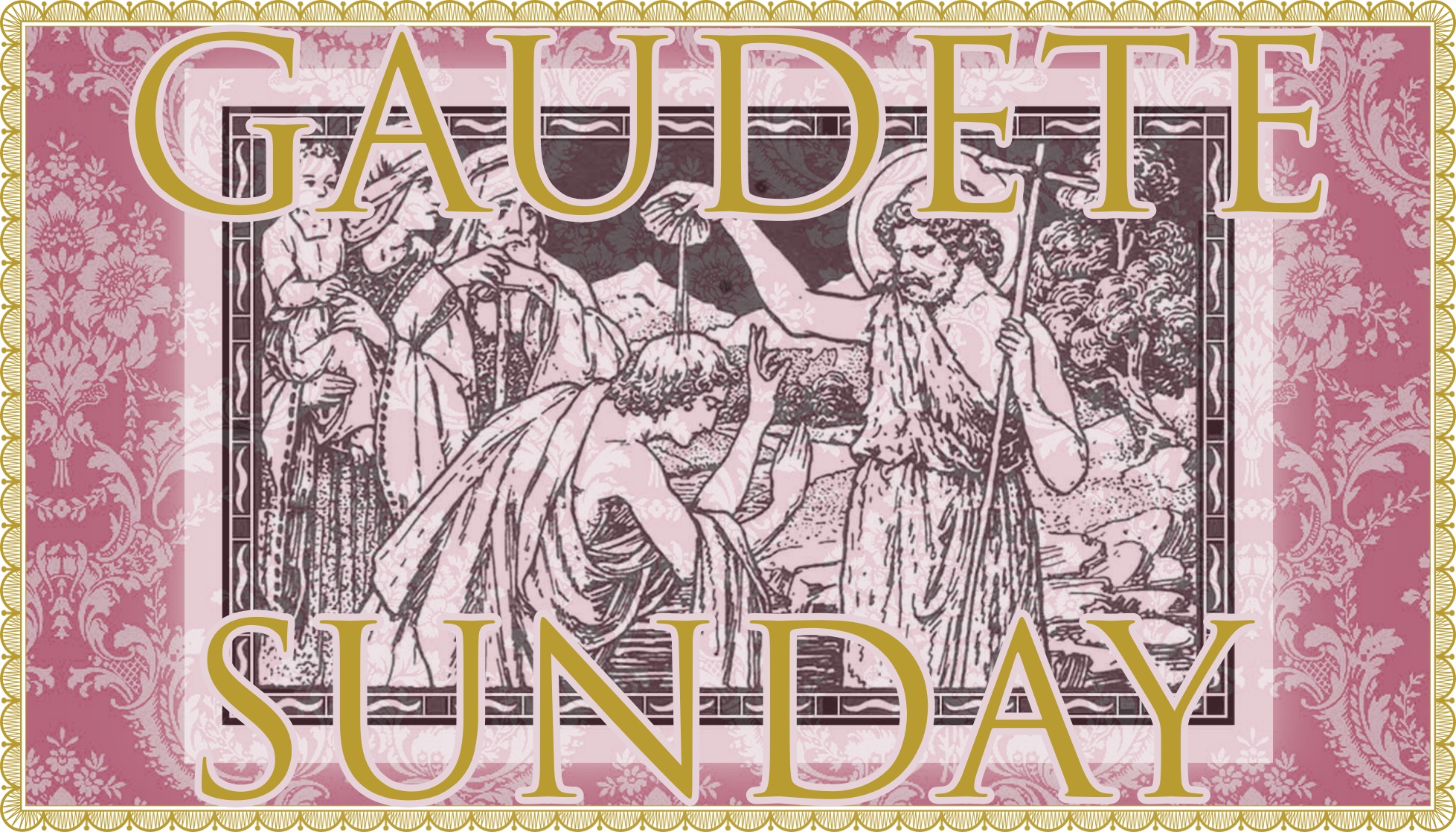
Gaudete: The Third Sunday of Advent, The Propers and the Discipline of Christian Joy
Introduction
The Third Sunday of Advent, traditionally known as Gaudete Sunday, marks a deliberate and carefully measured inflection within the Roman Rite. The Church does not suspend Advent’s penitential character; rather, she permits joy to emerge from within it, as light breaks through shadow before dawn. This joy is neither sentimental nor expressive. It is doctrinal, sacramental, and eschatological—rooted in the objective nearness of the Lord who comes to judge and to save.
The Tridentine liturgy articulates this joy not through exhortation alone, but through the architecture of the propers themselves. Each prayer, chant, and reading disciplines joy, situating it within repentance, humility, sacrifice, and hope. What follows is a sequential theological exposition of those propers, read in light of the Fathers and the classical Roman liturgical tradition.
The Introit: Joy Founded on Nearness, Not Fulfilment
*Gaudete in Domino semper: iterum dico, gaudete. Modestia vestra nota sit omnibus hominibus: Dominus enim prope est.*¹
The Introit establishes the governing theology of the day. Joy is commanded—gaudete—yet immediately circumscribed by modestia. Christian joy is never autonomous; it is morally ordered and eschatologically grounded. The cause of rejoicing is not relief, success, or arrival, but proximity: Dominus enim prope est.
St John Chrysostom insists that St Paul deliberately anchors joy not in circumstance but in divine presence. The Christian rejoices, Chrysostom writes, not because tribulation ceases, but because God stands near in judgment and in mercy.² The nearness proclaimed here is therefore solemn as well as consoling.
The psalm verse (Benedixisti, Domine, terram tuam) roots joy in memory. God has already acted in history; His prior deliverance guarantees His coming fulfilment. Dom Prosper Guéranger observes that the Roman Introit binds thanksgiving to expectation, ensuring that Advent joy does not become detached from repentance or truth.³
The Collect: Joy Requires Illumination of the Will
Aurem tuam, quaesumus, Domine, precibus nostris accomoda: et mentis nostrae tenebras gratia tuae visitationis illumina.
The Collect immediately corrects any misunderstanding of joy as spontaneous emotion. The Church asks not for consolation, but for visitation (visitatio), a term which in Scripture denotes divine intervention that both heals and judges.
St Augustine consistently interprets divine visitation as revelatory and purifying. God visits, Augustine writes, not to flatter the soul, but to uncover it, that what is crooked may be made straight before His coming.⁴ The prayer presumes darkness within the human mind and petitions for illumination before Christ’s arrival.
Liturgically, this Collect ensures that Gaudete joy remains conditional upon conversion. The rose vestment presupposes violet; illumination presupposes repentance.
The Epistle: Joy as Moral Discipline
Gaudete in Domino semper… Dominus prope est. (Phil. 4:4–7)
The Epistle expands the Introit’s imperative into a coherent moral vision. Joy, moderation, prayer, and peace form a single structure. The peace promised is not emotional calm but pax Dei quae exsuperat omnem sensum—the peace that transcends human comprehension.
St Ambrose interprets this peace as the fruit of rightly ordered desire. True joy, he teaches, arises when the soul ceases to grasp and instead entrusts judgment to God who is near.⁵ Joy, therefore, is not indulgence but restraint shaped by hope.
Within Advent, this reading situates joy firmly within ascetical realism. The Christian rejoices because he waits rightly.
The Gradual: Joy Before Majesty
Qui sedes, Domine, super Cherubim, excita potentiam tuam et veni.
The Gradual reintroduces awe. The God whose nearness brings joy is enthroned above the Cherubim. Liturgically, the Church interrupts consolation with reverence, reminding the faithful that divine proximity is never casual.
St Gregory the Great teaches that the soul cries veni not because God is absent, but because His coming always exceeds human readiness.⁶ The Gradual therefore guards Gaudete Sunday against familiarity and presumption.
The Alleluia: Joy as Invocation, Not Possession
Excita, Domine, potentiam tuam et veni, ut salvos facias nos.
The Alleluia of Advent is sober and restrained. It does not celebrate fulfilment but implores intervention. Salvation is presented as an act of divine power, not human progress.
For St Leo the Great, this cry embodies authentic Christian joy: the Church rejoices precisely because she knows she cannot save herself.⁷ The nearer Christ comes, the more urgently she cries for His power.
The Gospel: John the Baptist and the Purification of Expectation
(John 1:19–28) The Gospel provides the interpretive key to Gaudete Sunday. John the Baptist appears not as a triumphant herald, but as a witness who diminishes himself. His repeated negations—non sum ego Christus—purify expectation.
St Augustine notes that John teaches the Church how to rejoice rightly: by refusing false identities and pointing beyond oneself to the One already present yet unknown.⁸ Dom Guéranger observes that the Church deliberately places John before the faithful on Gaudete Sunday to prevent joy from degenerating into sentimentality.⁹ Christ is near—but hidden.
The Offertory: Joy Sustained by Memory and Sacrifice
Benedixisti, Domine, terram tuam; avertisti captivitatem Jacob.
As the gifts are offered, the Church recalls liberation already accomplished. Past mercy grounds present offering and future hope. Sacrifice becomes the bridge between memory and expectation.
St Leo the Great connects this movement explicitly to the Incarnation: God who once delivered Israel will now deliver humanity by entering history Himself.¹⁰ Joy here is sustained not by anticipation alone, but by faithful offering.
The Secret: Joy Deepened by Perseverance
Devotionis nostrae tibi, quaesumus, Domine, hostia iugiter immolata placet…
The Secret emphasizes continuity: iugiter immolata. The Church’s joy does not interrupt sacrifice; it intensifies it. Waiting is not passive. It is sustained through offering.
St Gregory the Great teaches that perseverance in sacrifice purifies desire, allowing joy to mature without illusion.¹¹
The Communion: Fear Dispelled by Divine Presence
Dicite: Pusillanimes, confortamini et nolite timere: ecce Deus noster veniet et salvabit nos.
Here the theology of Gaudete Sunday reaches its summit. The Church addresses fear directly—not by denying danger, but by proclaiming divine fidelity.
St Augustine insists that fear is conquered not by optimism, but by certainty that God Himself comes to save.¹² In Holy Communion, the nearness announced in the Introit becomes sacramentally intimate.
The Postcommunion: Joy Ordered Toward Salvation
Imploramus, Domine, clementiam tuam… ad salutem nos perducant.
The Postcommunion restores sobriety. Grace received must lead to perseverance. Joy, having been sacramentally tasted, is now ordered toward final salvation.
Dom Guéranger remarks that the Roman Rite never allows joy to terminate in itself; it must always propel the soul toward holiness.¹³
Conclusion: The Roman Discipline of Joy
The propers of Gaudete Sunday reveal a joy profoundly alien to modern sensibility. It is joy under judgment, joy shaped by repentance, joy sustained by sacrifice, joy illumined by truth. It rejoices not because waiting ends, but because God draws near.
The Tridentine Rite thus teaches the faithful how to rejoice without illusion, how to hope without presumption, and how to welcome Christ without reducing Him to sentiment. Joy, rightly ordered, is not the opposite of waiting—but its crown.
¹ Missale Romanum (1962), Dominica III Adventus, Introitus.
² St John Chrysostom, Homiliae in Epistolam ad Philippenses, Hom. XIII.
³ Dom Prosper Guéranger, The Liturgical Year: Advent, ch. 3.
⁴ St Augustine, Enarrationes in Psalmos, Ps. 101.
⁵ St Ambrose, De Officiis Ministrorum, I.28.
⁶ St Gregory the Great, Homiliae in Evangelia, Hom. I.
⁷ St Leo the Great, Sermo I de Adventu Domini.
⁸ St Augustine, Tractatus in Ioannem, IV.
⁹ Dom Prosper Guéranger, The Liturgical Year: Advent, commentary on Advent III.
¹⁰ St Leo the Great, Sermo XXII, De Nativitate Domini.
¹¹ St Gregory the Great, Moralia in Iob, XXIII.
¹² St Augustine, Sermo 185.
¹³ Dom Prosper Guéranger, The Liturgical Year: Advent, conclusion to Advent III.
related articles


Latest articles
- THE DATA YOU OUTSOURCE IS STILL YOUR RESPONSIBILITYThe RNLI’s exposure through the Beacon CRM cyberattack illustrates a problem far wider than one charity. Organisations can outsource their databases, hosting and technical security, but they cannot outsource responsibility for the information they choose to collect. Data minimisation, supplier scrutiny and controlled access are not merely GDPR exercises: they are duties of custodianship.
- “THAT THE WORLD MAY HAVE LIFE”: LEO XIV GOES TO FRANCEPope Leo XIV arrives in France five weeks after its assisted-dying law came into force and two years after guaranteed access to abortion was written into the Constitution. His first encyclical calls life from conception to natural death the first human right. At the Élysée, Notre-Dame and Lourdes, the question is now how explicitly he will apply that doctrine to France.
- Today’s homily: St Matthew, Apostle & EvangelistThe Reckoning of Mercy reflects on the transformative calling of St Matthew, a despised tax collector, by Christ. It illustrates the concept that God’s grace empowers genuine conversion, emphasising that true mercy requires both acknowledgment of one’s past and active adherence to justice. Matthew’s journey from publican to apostle embodies this principle.
- Today’s Mass: September 21 St Matthew, Apostle & EvangelistMatthew the Apostle and Evangelist, also called Levi, was sitting at his tax-collector’s desk in Capernaum when he was called by Christ. He followed Him at once, and also gave a feast for Him and the other disciples.
- Sermon for St. MatthewToday, we honour St. Matthew, a tax collector called by Jesus to discipleship. Despite their notorious reputation, tax collectors were essential to Jesus’ ministry of redemption. St. Matthew’s Gospel, aimed at a Jewish audience, emphasises Jesus as the fulfilment of prophecy and outlines Christ’s teachings, including the Sermon on the Mount.




Leave a Reply