- “No Fundamental Objections”: How General Synod Is Preparing the Ground for Same-Sex Marriage
The General Synod of the Church of England will debate a motion affirming that committed same-sex relationships can align with Christian discipleship. While it doesn’t change the marriage canon directly, the motion aims to establish a moral principle that could pave the way for later debates on same-sex marriage and recognition of such relationships.
- The Eucharistic Heart of Jesus: The Living Heart of the Church
The Feast of the Eucharistic Heart of Jesus, observed after the Sacred Heart feast, highlights Christ’s sacrificial love in the Blessed Sacrament. It emphasises that the Church thrives on Christ’s enduring presence, inviting Catholics to contemplate His love, which flows through the Eucharist, the heart of their spiritual life.
- The Most Sacred Heart of Jesus: The Source of the Sacrifice, the Fire of Charity, and the Judgment of Love
The Feast of the Most Sacred Heart of Jesus reveals the depth of Christ’s love as the source of the Eucharist and Salvation. This heart, symbolic of divine charity, necessitates a responsive love from humanity. Encountering this love transforms the soul, while indifference brings judgement. It embodies grace, devotion, and the essence of faith.
- Sermon for Sacred Heart
Today we celebrate the feast of the Sacred Heart of Jesus. This devotion is of medieval rather than ancient origin. It ultimately derives from the experiences of medieval mystics such as St. Gertrude and St. Mechtilde. It was then popularised in the seventeenth century by St. John Eudes and St. Margaret Mary Alacoque
- Sermon for Octave Day of Corpus Christi
The Octave Day of Corpus Christi focuses on the sacramental presence of Christ in the Eucharist, emphasising the significance of Jesus’ teachings about His body and blood. The discussion highlights the importance of recognising Jesus as the true bread from heaven, which offers eternal life, in contrast to the manna that sustained the Israelites but did not prevent death.
- Sermon for Second Sunday after Pentecost/In Octave of Corpus Christi
The Second Sunday after Pentecost reflects on the duality of fearing and loving God, emphasising our dependence on divine grace for salvation. The Collect highlights the need for ongoing reverence amidst modern challenges, reminding believers of the transformational nature of God’s sacrificial love, which calls for genuine actions aligned with faith.
- ORDO w/c 07.06.26
The week commencing 7 June focuses on the Octave of Corpus Christi, marking daily Eucharistic celebrations and commemorating various saints, culminating in the Feast of the Most Sacred Heart of Jesus on 12 June. It highlights the Church’s reflection on Christ’s presence and love, emphasising the interconnectedness of the Eucharist, devotion, and mercy.
- Consecration to the Sacred Heart of Jesus
The devotion to the Sacred Heart of Jesus gained prominence with Pope Leo XIII’s 1899 consecration of humanity to it, emphasising Christ’s universal sovereignty. This practice acknowledges both personal and social dimensions of faith, calling for the sanctification of souls and restoration of communities. It remains a vital expression of Christianity today.
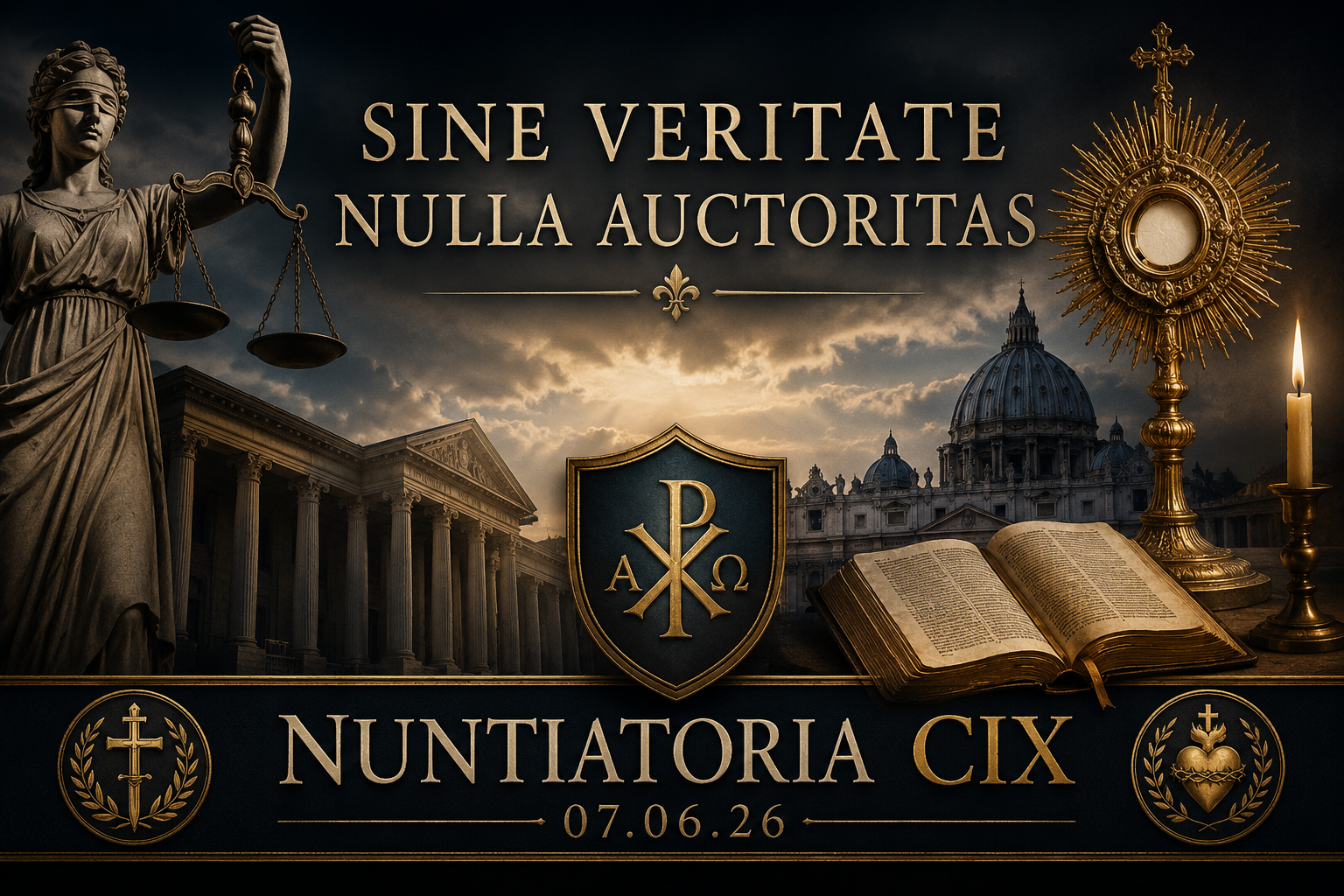
- 07.06.26 Nuntiatoria CIX: Sine Veritate Nulla Auctoritas
This edition of Nuntiatoria highlights a growing crisis of confidence in institutions, such as the Church, universities, and the police, where uncertainty about truth erodes trust. Ambiguity in doctrine and ideological pressures undermine authority, while a resurgence of traditional practices signals a desire for stability and objective truth amidst societal upheaval.
- The Banquet of the King and the Bread of Angels: The Second Sunday after Pentecost and the Sunday Within the Octave of Corpus Christi
The Second Sunday after Pentecost and Corpus Christi highlight the significance of the Eucharist in Christian life. The Gospel invites believers to reflect on their priorities, emphasising that earthly concerns can overshadow spiritual nourishment. The celebration of Corpus Christi reaffirms Christ’s enduring presence, urging the faithful to accept His invitation to the sacramental banquet.
- The Synod That Forgot to Save the Church
The Irish Synodal Pathway faces profound critique from within the Catholic community, questioning its purpose amid declining belief and sacramental participation. While processes emphasise themes like inclusion and participation, they risk neglecting the Church’s core mission of glorifying God and salvaging souls. Without clarity on this supernatural aim, renewal efforts remain ineffective.
- The Flag They Fear: Hastings Pride and the Crisis of Belonging in Britain
Bishop Athanasius Schneider criticized the Vatican-sanctioned LGBTQ+ Jubilee pilgrimage as a scandalous event promoting sin, labeling supportive clergy as “spiritual criminals” and “murderers of souls.” He condemned the lack of repentance during the pilgrimage, warning of spiritual consequences and calling for accountability from Church leaders to uphold moral teachings.
- The Quieting of the Academy: Fear, Conformity, and the Future of British Freedom
A recent study by the Office for Students highlights a troubling culture of self-censorship among students in British universities. While legal protections for free speech exist, many students feel uncomfortable discussing essential topics like race and immigration due to fear of social ostracism. This decline in open discourse poses a significant threat to the health of democracy and intellectual freedom.
- The Exorcist, the Intelligence Officer, and the Modern Fear of the Supernatural
The removal of Monsignor Stephen Rossetti from his role as an exorcist in the Archdiocese of Washington highlights cultural discomfort with the supernatural and a societal incapacity to recognise it. His suggestion that unidentified aerial phenomena might have preternatural origins challenges modern assumptions, revealing a deeper crisis within the Church regarding its own teachings on spiritual realities.
- When the Law Is Ignored: Schools, Safeguarding, and the Reassertion of Reality
The discourse surrounding school safeguarding, gender identity, and parental rights reveals a crucial distinction: the law itself is not absent but has often been ignored. Recent judicial decisions reaffirm that institutions must adhere to established legal frameworks, prioritising accountability, safeguarding, and the objective realities that underpin the Equality Act and related legislation.
- When reality becomes controversial: Henry Nowak, truth, and the erosion of legitimate authority in Britain
The death of Henry Nowak has become more than a criminal case. It is now a national debate about truth, authority, and whether Britain’s institutions still recognise reality before interpreting it.
- The future is tradition: the young are passing judgement on the modern Church
Britain faces a significant spiritual crisis, with declining church attendance and a growing population identifying as non-religious. The Covid-19 pandemic has accelerated this trend, revealing a nation grappling with a loss of meaning. While some express renewed spiritual curiosity, genuine commitment remains elusive, highlighting a profound need for revival and transformation.
- The core question of truth: Econe, Authority, and the limits of post-conciliar unity
The upcoming episcopal consecrations by the Priestly Society of Saint Pius X at Écône on 1 July 2026 highlight a persistent crisis in the Catholic Church regarding doctrinal clarity and authority. This situation is not merely disobedience but a crucial moment questioning how truth is recognised, urging resolution beyond legalism and ambiguity.
- Questions Remain After the Suppression of the Marian Franciscans
The dissolution of the Marian Franciscans on 31 May 2026 has sparked debate, raising questions about their future viability. Despite attracting vocations and engaging in active ministry, the community concluded it could not secure the necessary support for long-term sustainability. This incident highlights broader challenges in fostering new religious life within the contemporary Church.
- From Peel to Politics: Identity, Legitimacy, and the Unravelling of Policing by Consent
The controversy over the National Association of Muslim Police (NAMP) highlights a significant shift in British policing, moving from impartial law enforcement to identity politics. This transformation threatens public trust and the legitimacy of policing, as institutions increasingly prioritise group identities over shared citizenship, compromising the foundational principle of policing by consent.
- From the Clementine Chapel to Walsingham: Apostolicae Curae and the Problem of Ecclesiastical Symbolism
The recent actions of Archbishops Sarah Mullally and John Wilson in ecumenical settings highlight a longstanding tension between Catholic and Anglican traditions, particularly concerning the validity of Anglican orders as judged by Apostolicae Curae. This editorial explores the implications of these events, noting a disjunction between doctrinal positions and contemporary symbolic expressions in inter-church relations.
- Imagine There’is No Heaven: A Theology Without End and a Church Without Mission
The controversy involving Bishop Antonio Staglianò reflects deeper theological disputes within Christianity concerning the nature of religious belief and its relevance. By suggesting that John Lennon’s “Imagine” aligns with Christ’s teachings, Staglianò invokes a vision of peace achieved by eliminating religious transcendence, contradicting traditional Christian doctrine centred on Heaven and salvation.
- The Month of the Sacred Heart: The Burning Centre of Christianity
The Feast of the Most Sacred Heart of Jesus reveals the depth of Christ’s love as the source of the Eucharist and Salvation. This heart, symbolic of divine charity, necessitates a responsive love from humanity. Encountering this love transforms the soul, while indifference brings judgement. It embodies grace, devotion, and the essence of faith.


 The General Synod of the Church of England will debate a motion affirming that committed same-sex relationships can align with Christian discipleship. While it doesn’t change the marriage canon directly, the motion aims to establish a moral principle that could pave the way for later debates on same-sex marriage and recognition of such relationships.
 The Feast of the Eucharistic Heart of Jesus, observed after the Sacred Heart feast, highlights Christ’s sacrificial love in the Blessed Sacrament. It emphasises that the Church thrives on Christ’s enduring presence, inviting Catholics to contemplate His love, which flows through the Eucharist, the heart of their spiritual life.
 The Feast of the Most Sacred Heart of Jesus reveals the depth of Christ’s love as the source of the Eucharist and Salvation. This heart, symbolic of divine charity, necessitates a responsive love from humanity. Encountering this love transforms the soul, while indifference brings judgement. It embodies grace, devotion, and the essence of faith.
 Today we celebrate the feast of the Sacred Heart of Jesus. This devotion is of medieval rather than ancient origin. It ultimately derives from the experiences of medieval mystics such as St. Gertrude and St. Mechtilde. It was then popularised in the seventeenth century by St. John Eudes and St. Margaret Mary Alacoque
 The Octave Day of Corpus Christi focuses on the sacramental presence of Christ in the Eucharist, emphasising the significance of Jesus’ teachings about His body and blood. The discussion highlights the importance of recognising Jesus as the true bread from heaven, which offers eternal life, in contrast to the manna that sustained the Israelites but did not prevent death.
 The Second Sunday after Pentecost reflects on the duality of fearing and loving God, emphasising our dependence on divine grace for salvation. The Collect highlights the need for ongoing reverence amidst modern challenges, reminding believers of the transformational nature of God’s sacrificial love, which calls for genuine actions aligned with faith.
 The week commencing 7 June focuses on the Octave of Corpus Christi, marking daily Eucharistic celebrations and commemorating various saints, culminating in the Feast of the Most Sacred Heart of Jesus on 12 June. It highlights the Church’s reflection on Christ’s presence and love, emphasising the interconnectedness of the Eucharist, devotion, and mercy.
 The devotion to the Sacred Heart of Jesus gained prominence with Pope Leo XIII’s 1899 consecration of humanity to it, emphasising Christ’s universal sovereignty. This practice acknowledges both personal and social dimensions of faith, calling for the sanctification of souls and restoration of communities. It remains a vital expression of Christianity today.
 This edition of Nuntiatoria highlights a growing crisis of confidence in institutions, such as the Church, universities, and the police, where uncertainty about truth erodes trust. Ambiguity in doctrine and ideological pressures undermine authority, while a resurgence of traditional practices signals a desire for stability and objective truth amidst societal upheaval.
 The Second Sunday after Pentecost and Corpus Christi highlight the significance of the Eucharist in Christian life. The Gospel invites believers to reflect on their priorities, emphasising that earthly concerns can overshadow spiritual nourishment. The celebration of Corpus Christi reaffirms Christ’s enduring presence, urging the faithful to accept His invitation to the sacramental banquet.
 The Irish Synodal Pathway faces profound critique from within the Catholic community, questioning its purpose amid declining belief and sacramental participation. While processes emphasise themes like inclusion and participation, they risk neglecting the Church’s core mission of glorifying God and salvaging souls. Without clarity on this supernatural aim, renewal efforts remain ineffective.
 Bishop Athanasius Schneider criticized the Vatican-sanctioned LGBTQ+ Jubilee pilgrimage as a scandalous event promoting sin, labeling supportive clergy as “spiritual criminals” and “murderers of souls.” He condemned the lack of repentance during the pilgrimage, warning of spiritual consequences and calling for accountability from Church leaders to uphold moral teachings.
 A recent study by the Office for Students highlights a troubling culture of self-censorship among students in British universities. While legal protections for free speech exist, many students feel uncomfortable discussing essential topics like race and immigration due to fear of social ostracism. This decline in open discourse poses a significant threat to the health of democracy and intellectual freedom.
 The removal of Monsignor Stephen Rossetti from his role as an exorcist in the Archdiocese of Washington highlights cultural discomfort with the supernatural and a societal incapacity to recognise it. His suggestion that unidentified aerial phenomena might have preternatural origins challenges modern assumptions, revealing a deeper crisis within the Church regarding its own teachings on spiritual realities.
 The discourse surrounding school safeguarding, gender identity, and parental rights reveals a crucial distinction: the law itself is not absent but has often been ignored. Recent judicial decisions reaffirm that institutions must adhere to established legal frameworks, prioritising accountability, safeguarding, and the objective realities that underpin the Equality Act and related legislation.
 The death of Henry Nowak has become more than a criminal case. It is now a national debate about truth, authority, and whether Britain’s institutions still recognise reality before interpreting it.
 Britain faces a significant spiritual crisis, with declining church attendance and a growing population identifying as non-religious. The Covid-19 pandemic has accelerated this trend, revealing a nation grappling with a loss of meaning. While some express renewed spiritual curiosity, genuine commitment remains elusive, highlighting a profound need for revival and transformation.
 The upcoming episcopal consecrations by the Priestly Society of Saint Pius X at Écône on 1 July 2026 highlight a persistent crisis in the Catholic Church regarding doctrinal clarity and authority. This situation is not merely disobedience but a crucial moment questioning how truth is recognised, urging resolution beyond legalism and ambiguity.
 The dissolution of the Marian Franciscans on 31 May 2026 has sparked debate, raising questions about their future viability. Despite attracting vocations and engaging in active ministry, the community concluded it could not secure the necessary support for long-term sustainability. This incident highlights broader challenges in fostering new religious life within the contemporary Church.
 The controversy over the National Association of Muslim Police (NAMP) highlights a significant shift in British policing, moving from impartial law enforcement to identity politics. This transformation threatens public trust and the legitimacy of policing, as institutions increasingly prioritise group identities over shared citizenship, compromising the foundational principle of policing by consent.
 The recent actions of Archbishops Sarah Mullally and John Wilson in ecumenical settings highlight a longstanding tension between Catholic and Anglican traditions, particularly concerning the validity of Anglican orders as judged by Apostolicae Curae. This editorial explores the implications of these events, noting a disjunction between doctrinal positions and contemporary symbolic expressions in inter-church relations.
 The controversy involving Bishop Antonio Staglianò reflects deeper theological disputes within Christianity concerning the nature of religious belief and its relevance. By suggesting that John Lennon’s “Imagine” aligns with Christ’s teachings, Staglianò invokes a vision of peace achieved by eliminating religious transcendence, contradicting traditional Christian doctrine centred on Heaven and salvation.
 The Feast of the Most Sacred Heart of Jesus reveals the depth of Christ’s love as the source of the Eucharist and Salvation. This heart, symbolic of divine charity, necessitates a responsive love from humanity. Encountering this love transforms the soul, while indifference brings judgement. It embodies grace, devotion, and the essence of faith.



Leave a Reply