
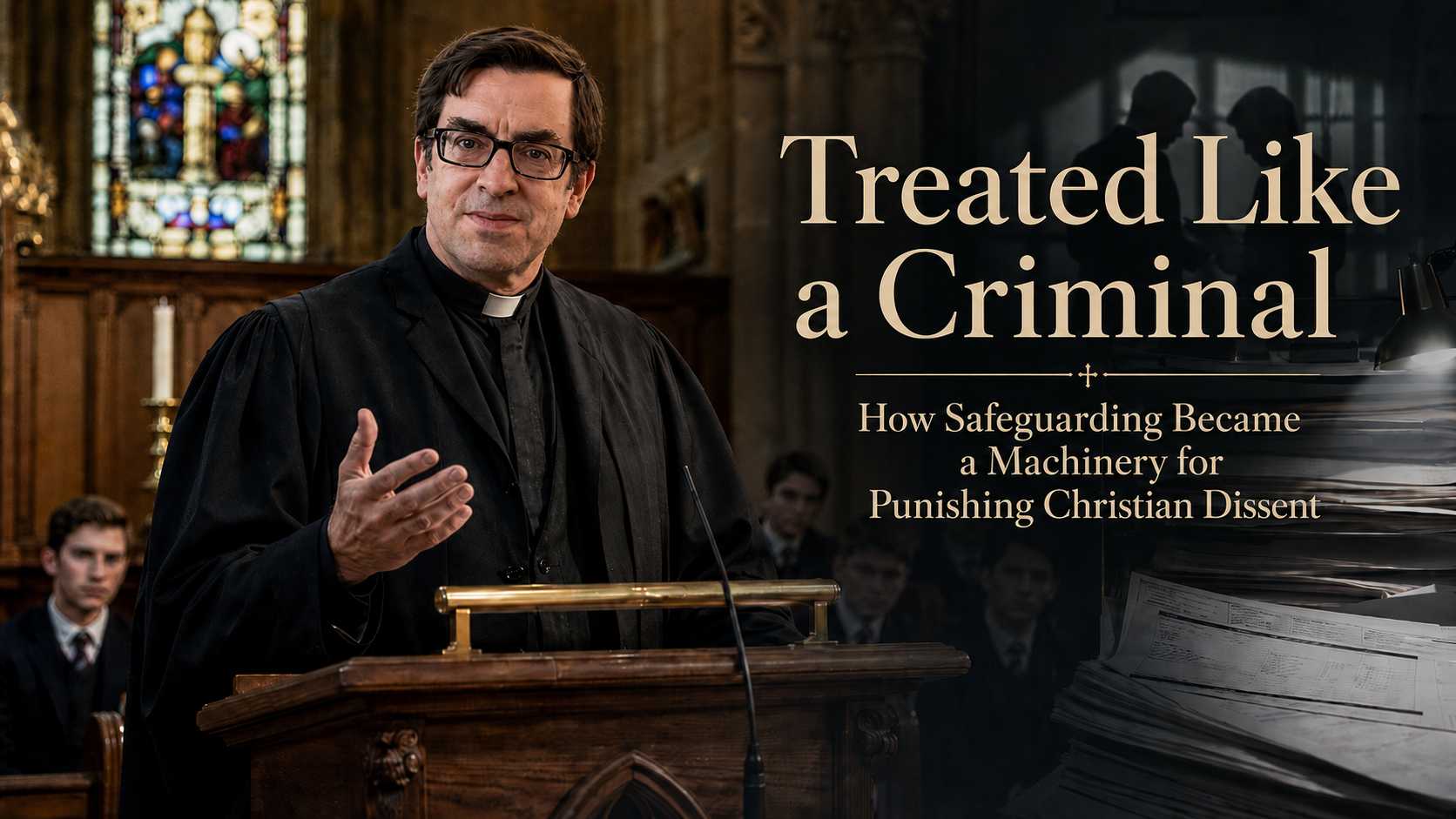
Treated Like a Criminal: How Safeguarding Was Weaponised against Christian Dissent
The Reverend Dr Bernard Randall preached that pupils should respect those with whom they disagreed, distinguish persons from propositions, and remain free to reject an ideology after examining it. For this he was dismissed, reported to Prevent and excluded from public ministry. Seven years later, the safeguarding allegation has been found unsubstantiated—but the institutions responsible have yet to confront what they did.

The most disturbing feature of the Bernard Randall affair is not that a Christian minister expressed Christian beliefs in a Christian school. Nor is it merely that those beliefs offended some who heard them. It is that disagreement was progressively translated into danger: a sermon became a safeguarding concern; the safeguarding concern became a counter-extremism referral; and an orthodox clergyman came to be treated as though his convictions disclosed some latent threat to children.
In 2019 Randall was chaplain of Trent College, an independent school in Derbyshire whose constitutional objects included the education of pupils according to the “Protestant and Evangelical principles of the Church of England”. The school had introduced a programme supplied by Educate & Celebrate, an organisation promoting the institutional adoption of ideas concerning sexual orientation and gender identity. During a staff-training session, its chief executive encouraged teachers to chant “smash heteronormativity”—an exercise which the subsequent Employment Tribunal judgment recorded as having been found “cringeworthy” by some members of staff.¹
A pupil later asked why students were being told that they had to accept “all this LGBT stuff in a Christian school”. Randall answered in two chapel sermons entitled Competing Ideologies. The sermons did not call for the mistreatment, exclusion or humiliation of anyone. They condemned personal abuse and discrimination and distinguished between respect for persons and assent to propositions. Pupils, Randall maintained, remained free to examine an ideology and conclude: “No, not for me.”²
That distinction was once understood to be indispensable to civilised disagreement. It is also elementary Christianity. Charity does not require the surrender of judgement, nor does respect for a person confer immunity upon every proposition that person may advance. Saint Paul writes that charity “rejoiceth not in iniquity, but rejoiceth with the truth”. To separate charity from truth is not to perfect charity but to empty it of moral content.
Randall’s sermons were not beyond criticism. Some of their language was blunt. His suggestion that certain activists were willing to “lie” about the legal status of gender identity was needlessly accusatory and could reasonably have been expressed with greater precision. The school also maintained that an earlier sermon had caused distress, that Randall had previously been warned about addressing sensitive subjects without sufficient regard for the age and vulnerability of his audience, and that his subsequent response displayed insufficient recognition of those concerns. School authorities have genuine responsibilities towards children who may be bullied, distressed or struggling with questions of sexuality and identity. Those responsibilities cannot simply be dismissed because the disputed speaker is a clergyman.³
That is the strongest case for the school. It might have justified pastoral discussion, closer supervision, a request for clarification or proportionate disciplinary measures concerning manner and judgement. It did not justify the conversion of doctrinal disagreement into suspected extremism.
The school’s designated safeguarding lead was uncertain whether the threshold for referring Randall to Prevent had been met. She therefore sought advice from the local authority and was told that the matter might not be progressed but that it was “better to do the referral”. The sermon and an account of the controversy were consequently submitted to the Government’s counter-radicalisation programme. Prevent replied that, although Randall’s message contradicted what the school and wider society were saying, there was “no Counter Terrorism risk, or risk of radicalisation”.⁴
That finding should have ended any suggestion that Randall belonged within a counter-extremism framework. Instead, the mere fact that such a referral had been made became part of the cloud surrounding him. The process achieved its expressive purpose even though Prevent identified no terrorist or radicalisation risk: the chaplain had been placed within the category of persons whose ideas required examination by the security apparatus.
According to Randall’s representatives, other secular authorities reached similarly uncomplicated conclusions. The local authority designated officer determined within a day that the matter did not warrant treatment as a safeguarding case, while the Teaching Regulation Agency and the Disclosure and Barring Service subsequently found that he had no case to answer. Those reported decisions do not prove that his pastoral judgement was beyond criticism. They do, however, illustrate the disparity between the conclusions of bodies responsible for assessing professional misconduct and identifiable risk, and the prolonged suspicion maintained by the Church.⁵
Randall’s lawyers later said that he had been “treated like a criminal”. The phrase must be understood accurately. Randall was not prosecuted, convicted or formally accused of terrorism. Yet he was subjected to a structure of suspicion normally associated with dangerous conduct: suspension, investigation, referral to Prevent, safeguarding restrictions and eventual exclusion from public ministry. What was being treated as potentially dangerous was not violence, coercion or abuse, but his refusal to accept that contemporary identity claims must be affirmed without contradiction.
Randall was initially dismissed for gross misconduct, subsequently reinstated on appeal under numerous management instructions, and later made redundant. His claims against the school were rejected by an Employment Tribunal in 2023. That judgment repeatedly distinguished between his protected beliefs and what it called their “objectionable manifestation”, accepting the school’s argument that its actions arose from safeguarding concerns rather than hostility towards Christianity. The tribunal itself nevertheless accepted that the Prevent referral was unwanted conduct which had created an intimidating environment for him.⁶
That judgment did not remain legally secure. After social-media posts by one of the tribunal’s lay members raised questions about apparent hostility towards conservative Christian views, Randall added a bias ground to his appeal. In March 2025 the appeal was allowed by consent, the original judgment was set aside as unsafe, and a full rehearing was ordered. Trent College was also ordered to pay £20,000 in costs. The parties later concluded the employment dispute through a confidential settlement.⁷
The legal position must be stated precisely. The confidential settlement was not a public judicial determination that every allegation made by Randall had been proved, nor was it necessarily an admission of liability by the college. Equally, the 2023 judgment can no longer be treated as the final legal vindication of the school’s conduct. It was set aside, and the proposed rehearing was overtaken by settlement.
The parallel ecclesiastical process was still more protracted. The Diocese of Derby treated Randall as the subject of a continuing safeguarding concern and declined to grant him Permission to Officiate while the matter remained unresolved. Randall’s representatives state that diocesan officers described biblical teaching concerning marriage—and even “the Church itself”—as a potential “risk-factor”. He was also told that he would have to submit to an independent psychological safeguarding assessment conducted by a practitioner whose professional work included the assessment of serious offenders. Randall refused, believing that participation would imply that preaching the sermons disclosed a pathology or dangerous propensity requiring clinical investigation.⁸
The contrast with the Church’s own doctrinal position is extraordinary. According to the published account of the case, Church of England bishops concluded in 2021 that Randall’s sermon contained nothing outside the doctrine and teaching of the Church of England. The difficulty was therefore not that he had contradicted the Church’s formal doctrine, but that he had expressed it within an institutional culture increasingly unwilling to permit that doctrine to challenge the prevailing assumptions of identity politics.⁹
The published account of the subsequent independent safeguarding review quotes the investigator as concluding:
“After full consideration and review of the available information I cannot establish, on the balance of probabilities, that harm was caused by the delivery of the sermons. This allegation is therefore unsubstantiated.”
The investigator further recommended that the allegation be recorded as unsubstantiated and that there were no continuing safeguarding concerns. Randall has completed the required safeguarding training and is now eligible to apply for Permission to Officiate, although the granting of any particular licence or permission remains a matter for the relevant ecclesiastical authority.¹⁰
This is a substantial vindication, but its limits should not be exaggerated. The investigator did not declare every expression used by Randall impeccable, nor conclude that every institutional decision had been malicious. The employment settlement did not produce a public finding of unlawful discrimination. What has been established is narrower—and, for that reason, more damning. Prevent identified no counter-terrorism or radicalisation risk; the original Employment Tribunal judgment was set aside as unsafe; no harm caused by the sermons could be substantiated; and no continuing safeguarding concern remains.
After seven years, the machinery arrived at conclusions which should have been reached near the beginning.
Yet even the language of Randall’s exoneration reveals the persistence of the underlying problem. Having found the allegation unsubstantiated and identified no continuing safeguarding concern, the investigator nevertheless criticised Randall because his conviction that he had acted correctly supposedly demonstrated “a failure to fully understand what safeguarding both means and strives to achieve”.¹¹
That sentence deserves close attention. Randall was told, in effect, that although no harm could be proved, no safeguarding allegation could be upheld and no continuing risk could be identified, his refusal to concede that the sermons had been wrongful itself disclosed a deficient understanding of safeguarding. The process no longer required evidence that he had harmed anyone. It required evidence that he had internalised the judgement of those who had accused him.
This is how safeguarding becomes ideological discipline. To maintain one’s innocence becomes a failure to “reflect”; to defend one’s beliefs becomes evidence that those beliefs are “entrenched”; and to insist that lawful Christian doctrine may be lawfully preached becomes a refusal to understand safeguarding. Exoneration is offered, but only with a residue of moral suspicion attached to the person who declined to confess an offence that could not be substantiated.
Authentic safeguarding concerns evidence, conduct and demonstrable risk. It proceeds with urgency where a child is endangered, but with fairness where an accusation remains unproved. Ideological safeguarding operates differently. It begins with a prohibited conclusion, translates the discomfort caused by dissent into psychological harm, and then treats the accused person’s refusal to recant as evidence of deficient insight.
The false opposition between doctrine and welfare is especially revealing. Christian teaching does not grant a chaplain permission to disregard the genuine needs of pupils. Pastoral prudence governs how, when and before whom difficult truths are taught. Yet neither can “welfare” be defined to mean freedom from encountering beliefs that contradict one’s self-understanding. Were that the standard, every serious religious, moral and philosophical education would become harmful, because all serious education exposes the learner to claims that may disturb, challenge or even offend.
A Christian school may properly require tact from its chaplain. It cannot require him to teach that Christianity is merely one private identity among others while the assumptions of identity politics constitute the institution’s unquestionable public truth. Once that arrangement is established, the school’s Christian ethos becomes decorative. The chapel remains, but its doctrine may be preached only when it coincides with the conclusions already authorised elsewhere.
The scandal is intensified when the Church itself adopts the same categories. The Church of England’s record of genuine safeguarding failure should have taught its authorities the absolute necessity of evidence, proportionality, timely investigation and procedural justice. Safeguarding is too important to be used as a theological disciplinary device. Every time the language of child protection is deployed against someone whose alleged offence is doctrinal dissent, the credibility of safeguarding itself is diminished.
There has been no institutional apology proportionate to the length and gravity of the ordeal. Secular bodies reportedly found no basis for further action; the ecclesiastical system continued to treat Randall as a risk. The Church’s own bishops reportedly recognised that his sermon remained within Anglican doctrine; yet the minister who preached it remained excluded from public ministry.
Catholics should not regard this as a peculiarly Anglican collapse. Catholic schools, dioceses and charitable institutions are exposed to the same temptation: to retain Christian names, symbols and ceremonies while allowing secular equality orthodoxies to determine which Christian beliefs may still be expressed. Once “inclusion” means affirmation, “safety” means protection from contradiction and “pastoral care” means ratification of every asserted identity, the Christian institution has subordinated Christian anthropology to an incompatible secular creed.
The Randall case concerns more than one sermon. It concerns the preservation of the moral categories without which justice becomes impossible. A person is not an ideology. Disagreement is not abuse. Offence is not harm. Orthodoxy is not extremism. Safeguarding is not a means of rendering disputed opinions professionally or psychologically suspect.
Randall has said that seven years were taken from him for doing what he understood to be his duty as a Church of England chaplain in a Church of England school. “I encouraged pupils to think, to debate, and to love their neighbours whatever they believed,” he said. “No minister, teacher or chaplain should be punished for upholding Christian teaching in a Christian setting.”¹²
The Diocese of Derby has indicated that Randall may apply for Permission to Officiate or for another ministerial or educational role. Eligibility, however, is not restoration. The practical possibility of applying for future ministry does not answer the institutional question. How did sermons counselling reasoned disagreement and neighbourly love become the occasion for a Prevent referral, psychological scrutiny and seven years of exclusion?
The answer is that the governing ideology had ceased to recognise disagreement as legitimate. It could accommodate Christianity as heritage, spirituality and private consolation, but not Christianity as a public claim about truth. When Randall refused that reduction, the institution did not answer his argument. It classified him as a risk.
The safeguarding process has now ended without a substantiated finding of harm. The employment proceedings have concluded without the original judgment standing. But unless the institutions involved acknowledge the categorical errors that produced the ordeal, the underlying danger remains. Another chaplain, teacher or pupil may be told that he is free to believe—provided that he never speaks as though his belief were true.
That is not pluralism. It is compelled conformity administered in the language of care.
¹ Employment Tribunal, Mr B. Randall v. Trent College Limited and Others, Case No. 2600288/2020, judgment, 21 February 2023, paras. 37, 75–83.https://assets.publishing.service.gov.uk/media/63fc8d90e90e0740d3cd6eb8/Mr_B_Randall_v_Trent_College_Limited___others_2600288_2020_Judgment.pdf
² Bernard Randall, “Competing Ideologies,” sermons delivered at Trent College, June 2019, reproduced by Christian Concern, 10 May 2021; Employment Tribunal, Mr B. Randall v. Trent College Limited and Others, paras. 87–94.https://christianconcern.com/resource/a-school-sermon-by-bernard-randall-competing-ideologies/https://assets.publishing.service.gov.uk/media/63fc8d90e90e0740d3cd6eb8/Mr_B_Randall_v_Trent_College_Limited___others_2600288_2020_Judgment.pdf
³ Employment Tribunal, Mr B. Randall v. Trent College Limited and Others, paras. 252–91.https://assets.publishing.service.gov.uk/media/63fc8d90e90e0740d3cd6eb8/Mr_B_Randall_v_Trent_College_Limited___others_2600288_2020_Judgment.pdf
⁴ Employment Tribunal, Mr B. Randall v. Trent College Limited and Others, paras. 119–23.https://assets.publishing.service.gov.uk/media/63fc8d90e90e0740d3cd6eb8/Mr_B_Randall_v_Trent_College_Limited___others_2600288_2020_Judgment.pdf
⁵ Christian Concern, “Chaplain Wins Double Vindication after Sermon on Identity,” 9 July 2026.https://christianconcern.com/news/chaplain-wins-double-vindication-after-sermon-on-identity/
⁶ Employment Tribunal, Mr B. Randall v. Trent College Limited and Others, paras. 1–5, 298–365.https://assets.publishing.service.gov.uk/media/63fc8d90e90e0740d3cd6eb8/Mr_B_Randall_v_Trent_College_Limited___others_2600288_2020_Judgment.pdf
⁷ “Bernard Randall vs Trent College,” Tribunal Tweets, updated 4 March 2025; “Bernard Randall: Vicar Settles Case after Dismissal Following Gender Identity Sermon,” Premier Christian News, 10 July 2026.https://tribunaltweets.substack.com/p/bernard-randall-vs-trent-collegehttps://premierchristian.news/en/news/article/bernard-randall-vicar-settles-legal-battle-after-dismissed-preaching-gender-identity
⁸ Christian Concern, “Chaplain Wins Double Vindication after Sermon on Identity,” 9 July 2026.https://christianconcern.com/news/chaplain-wins-double-vindication-after-sermon-on-identity/
⁹ Christian Concern, “Chaplain Wins Double Vindication after Sermon on Identity,” 9 July 2026.https://christianconcern.com/news/chaplain-wins-double-vindication-after-sermon-on-identity/
¹⁰ “Chaplain Sacked over Gender Sermon Reinstated Seven Years Later,” The Times, 9 July 2026; Christian Concern, “Chaplain Wins Double Vindication after Sermon on Identity,” 9 July 2026.https://www.thetimes.com/uk/religion/article/chaplain-sacked-over-gender-sermon-reinstated-px9kjv37mhttps://christianconcern.com/news/chaplain-wins-double-vindication-after-sermon-on-identity/
¹¹ Christian Concern, “Chaplain Wins Double Vindication after Sermon on Identity,” 9 July 2026.https://christianconcern.com/news/chaplain-wins-double-vindication-after-sermon-on-identity/
¹² Bernard Randall, quoted in Christian Concern, “Chaplain Wins Double Vindication after Sermon on Identity,” 9 July 2026.https://christianconcern.com/news/chaplain-wins-double-vindication-after-sermon-on-identity/
RELATED ARTiCLES


LATEST ARTICLES
- Today’s homily: Fifteenth Sunday Post PentecostIn the Gospel of Naim, two processions converge—one of life led by Christ and another of death following a young man. Christ’s compassion interrupts the funeral, symbolising hope amid despair. This message resonates today as Catholics face challenges, encouraging perseverance in faith, tradition, and prayer for revival in families and community.
- Today’s Mass: September 06 Sunday XV Post PentecostThe Fifteenth Sunday After Pentecost’s Mass emphasises the importance of living in accordance with the Holy Spirit, cultivated through the Eucharist. It reflects on Jesus’ compassion for humanity, recalling His miracles. The readings encourage believers to prioritise spiritual matters over worldly anxieties and to embody love for one another, resonating with St. Paul’s teachings.
- Sermon for Fifteenth Sunday after PentecostIn St. Paul’s epistle to the Galatians, he urges believers to live by the Spirit, embodying charity and truth without envy. He emphasises that faith, not race or ritual, defines the people of God. Through Jesus, Gentiles can worship without conversion to Judaism, receiving the Holy Spirit by repentance and baptism.
- Today’s Mass: September 05 Saint Lawrence JustinianSaint Lawrence Justinian, the first Patriarch of Venice, dedicated his life to the poor and the establishment of monasteries, rejecting noble marriage. Renowned for his humility and pastoral dedication, he emphasised the spiritual integrity of Venice’s safety. He was a precursor to the reforms of the Council of Trent, dying on 8 January 1455.
- 06.09.26 Nuntiatoria CXXII: NOMEN MANET, RES DEESTThis edition of Nuntiatoria explores the disconnect between the names of Catholic institutions and the realities they signify. Despite retaining their titles, many aspects of Catholicism—such as episcopal authority in China and religious practice in Poland—exhibit deteriorating substance. The piece cautions against superficial continuity, stressing the importance of genuine faith and practice over mere nomenclature.
CURRENT EDITION


Today’s Mass Propers
- Today’s Mass: September 06 Sunday XV Post Pentecost
 The Fifteenth Sunday After Pentecost’s Mass emphasises the importance of living in accordance with the Holy Spirit, cultivated through the Eucharist. It reflects on Jesus’ compassion for humanity, recalling His miracles. The readings encourage believers to prioritise spiritual matters over worldly anxieties and to embody love for one another, resonating with St. Paul’s teachings.





Leave a Reply