
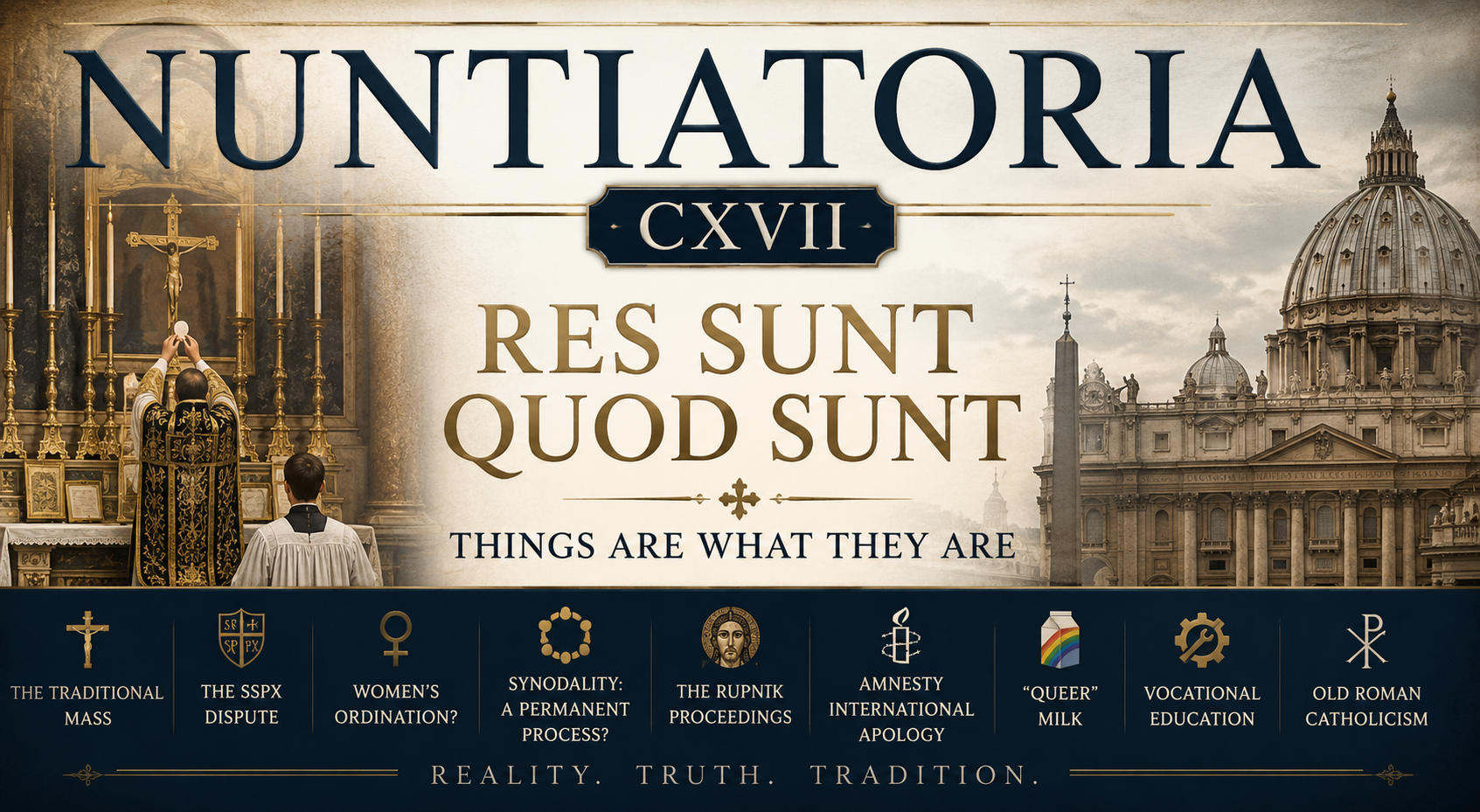
Editorial: Things Are What They Are
Nuntiatoria CXVII examines a series of disputes united by the tension between institutional narratives and observable reality: Cardinal Roche and the traditional Roman Mass; Rome’s handling of the SSPX crisis; Cardinal Hollerich and women’s ordination; the continuing institutionalisation of synodality; secrecy surrounding the Rupnik proceedings; Amnesty International’s apology following its controversial briefing; the publicly funded “Queer Milk” project; the recovery of vocational education; and the Old Roman response to ecclesial disorder. Under the theme Res Sunt Quod Sunt — “Things Are What They Are” — the edition argues for distinctions which neither ecclesiastical nor secular fashion can safely abolish.

From Rome’s treatment of the traditional Mass and the Society of St Pius X to women’s ordination, synodality, the Rupnik proceedings, Amnesty International’s selective contrition, “Queer Milk”, vocational education and the Old Roman inheritance, this edition returns repeatedly to one elementary principle: reality does not become something else because an institution finds another description more convenient.
Several of the stories gathered in this edition of Nuntiatoria concern institutions asking to be believed. Cardinal Arthur Roche asks Catholics attached to the traditional Roman liturgy to accept that the settlement represented by Traditionis Custodes is not about to be reversed. The synodal establishment asks the faithful to regard an apparently permanent process of consultation as an expression of ecclesial renewal. Those conducting the proceedings against Fr Marko Rupnik ask victims and observers to trust a process whose workings remain largely hidden. Amnesty International asks Christians to accept an apology after publishing a briefing which placed Christian organisations under scrutiny while failing adequately to confront the Islamist dimension of the problem it purported to examine.
These are different controversies and ought not to be forced into an artificial unity. Yet the same difficulty repeatedly presents itself: authority cannot indefinitely compensate for a deficit of credibility.
That difficulty is especially acute in Rome.
Cardinal Roche’s latest remarks about the traditional Roman Mass matter because they diminish hopes that the pontificate of Leo XIV will produce an early restoration of the settlement established by Benedict XVI in Summorum Pontificum. The question extends beyond liturgical preference. The older rite was the ordinary worship of generations of Catholics and remains an unmistakable expression of the doctrinal, sacramental and devotional inheritance of the Roman Church. To treat attachment to it principally as an ecclesiological problem is itself an ecclesiological statement.
The consequences are visible in the continuing rupture with the Society of St Pius X. The events surrounding Écône cannot simply be reduced to a contest between obedience and rebellion. Episcopal consecrations without pontifical mandate are gravely illicit; papal authority is real; ecclesiastical communion is not optional. Yet Rome also possesses responsibilities proportionate to that authority. If reconciliation is genuinely desired, refusing an audience, leaving longstanding doctrinal questions unresolved, allowing matters to proceed towards consecrations and censures, and intervening decisively only at the last moment deserves scrutiny. A plea to “turn back” is less persuasive when no practicable road back has been made visible.
Cardinal Jean-Claude Hollerich’s intervention on women’s ordination exposes another aspect of the same ecclesial disorder. The Catholic priesthood cannot be reconstructed according to contemporary expectations of representation because the priest does not act merely as a community delegate. At the altar he acts in persona Christi Capitis. He offers sacramentally the Sacrifice of Christ and stands in a relation to Christ and His Church which the Church understands herself to have received rather than invented. St John Paul II therefore declared in Ordinatio Sacerdotalis that the Church has no authority whatsoever to confer priestly ordination upon women.
To describe women’s ordination as essential to the Church’s future consequently raises a rather more serious question than whether ecclesiastical structures have kept pace with modern expectations. It suggests that the Church’s future may require something which the Church has already said she has no authority to do.
Synodality appears repeatedly in this edition because it has become the institutional environment in which such questions are increasingly discussed. What began as a synodal event has become a method, then a vocabulary, and increasingly something resembling a permanent constitutional principle. Dialogue, listening and consultation have legitimate places within the Church. None, however, can substitute for the Church’s duty to teach what she has received. Inviting representatives of other religions into the synodal process may have diplomatic or inter-religious value, but it also sharpens the question of what precisely the process is intended to accomplish. The Catholic Church can listen to everyone without pretending that everyone participates in her discernment of revealed truth on equal terms.
The Rupnik affair presents a less theoretical test of institutional credibility. Reports that alleged victims have not been summoned, together with the complaint of their lawyer that attempts to participate in the proceedings have gone unanswered, cannot simply be brushed aside by invoking canonical process. Secrecy may sometimes protect justice; opacity can also prevent anyone from knowing whether justice is being done. After the scandals of recent decades, ecclesiastical authorities should understand the difference.
Outside Rome, the vocabulary changes but the temptation is recognisable.
Amnesty International’s apology following its July briefing deserves acknowledgement. An institution which admits error has done something preferable to an institution which refuses to admit one. Yet an apology must be judged partly by whether it demonstrates that the original failure has been understood. Nuntiatoria therefore examines not merely the fact of Amnesty’s apology but its sincerity and adequacy. If Christian organisations were identified in a discussion of threats while the Islamist ideological component was treated with conspicuous caution, withdrawing or regretting the offending presentation does not by itself answer the underlying criticism.
The controversy over public money reaching the “Queer Milk” project brings the conflict over language and biological reality into an unusually concrete setting. Here euphemism eventually encounters anatomy. A male person does not become female because an ideological vocabulary requires institutions to describe him as such. Where children, bodily development and public funding are involved, the obligation to speak accurately becomes more rather than less important. Compassion for individuals cannot require public institutions to pretend that sex is infinitely negotiable.
There is, however, a welcome counterpoint in this edition.
Andy Burnham’s advocacy of stronger vocational and technical education deserves support. Britain has spent decades behaving as though academic university education represented the natural summit of educational achievement. The conversion of the polytechnics into universities under the reforms implemented from 1992, followed by the Blair Government’s ambition to send half of young people into higher education, helped entrench a cultural hierarchy in which practical, technical and vocational ability could appear second-rate.
It never was.
A competent electrician, engineer, machinist, builder or technician possesses knowledge requiring intelligence, discipline and experience. Education should help discern the aptitudes of a child and cultivate them towards useful, dignified and purposeful adulthood. From a Christian perspective those aptitudes are not inconvenient deviations from an academic norm. They are among the talents entrusted by Providence to particular persons. A society which teaches a young man or woman to despise genuine ability because it does not naturally lead towards a university lecture theatre has misunderstood both education and work.
That argument may initially appear distant from disputes about liturgy, synodality or institutional language. It is not entirely so. It begins with accepting that things possess a nature which ought to be discovered before somebody decides what they should mean.
The Old Roman discussion in this edition approaches the same problem from within the traditional Catholic world itself. Tradition can become a slogan just as easily as progress. Personal experience, grievance and even genuine suffering do not confer universal interpretative authority upon anyone. Nor does resistance to post-conciliar disorder relieve traditional Catholics of the obligation to distinguish doctrine from opinion, necessity from preference, and legitimate criticism from private judgement elevated into an ecclesiology.
Old Roman Catholicism, properly understood, is not an exercise in constructing another Church because the visible Church has disappointed us. Its claim is more modest and, for that reason, more demanding: to preserve what was received, to worship according to the inherited Roman tradition, to profess the Catholic Faith without alteration, and to endure an irregular ecclesial situation without pretending that irregularity itself has somehow become the norm.
That distinction matters particularly after the events of this summer. The temptation presented by ecclesiastical confusion is always to solve uncertainty by declaring oneself certain. Sedevacantism offers one such solution; indiscriminate submission to every novelty offers another. The Old Roman position refuses both shortcuts. The failures of churchmen do not abolish the Church, while the existence of authority does not make every prudential decision wise, every disciplinary act just, or every theological fashion orthodox.
Across these pages, then, the reader will encounter disagreement: with cardinals, dicasteries, activists, charities, educational assumptions and occasionally with other traditional Catholics. The purpose is not disagreement for its own sake. There are quite enough professional controversialists already.
The more useful task is discrimination: between what is asserted and what has been proved; between authority and its exercise; between doctrine and policy; between compassion and euphemism; between obedience and acquiescence; between an apology and repentance; between education and credentialism; between the Catholic tradition and the various parties which claim exclusive possession of it.
The Latin theme chosen for CXVII is deliberately uncomplicated: Res sunt quod sunt — things are what they are. It is hardly an adventurous philosophical proposition. There was a time when it scarcely needed saying.
Yet institutions survive mistakes more readily than they survive the habit of denying the obvious. A dicastery can make a bad prudential judgement; a charity can publish a defective report; an educational establishment can pursue a mistaken policy; churchmen can misunderstand the causes of a crisis. Correction remains possible because reality remains available against which the mistake can be measured.
The greater danger begins when language is employed to prevent that measurement: when exclusion is called inclusion, opacity becomes process, innovation is presented as continuity, a man becomes a woman, an inherited liturgy becomes a threat, or disagreement with an institutional judgement is treated as disagreement with reality itself.
Reality is considerably less accommodating.
Nuntiatoria CXVII therefore begins from something simpler than a programme and older than any contemporary controversy.
Things are what they are.
Our first duty is to see them.
IN THIS EDITION
- August beneath the Immaculate Heart of Mary
 August is dedicated to the Immaculate Heart of Mary, culminating in the feast of the Assumption. This month invites contemplation of Mary’s virtues, including her purity, compassion, and unwavering fidelity. Devotion involves deeper introspection, encouraging the faithful to align with Christ’s teachings and embody true obedience, charity, and sorrow for sin.
 - 02.08.26 Nuntiatoria CXVII: Res Sunt Quod Sunt
 Nuntiatoria CXVII explores various conflicts arising from the tension between institutional narratives and reality, including issues related to the traditional Roman Mass, women’s ordination, and synodality. The edition argues for the importance of recognising clear distinctions in these matters, emphasising that reality cannot be altered by institutional preference.
 - Ordo w/c 02.08.26
 The content outlines the liturgical celebrations and saints commemorated from August 2nd to August 9th, including their corresponding Mass colors and types. It specifies the calendar dates, feasts of saints, and mentions various permissible votive Masses.
 - The Publican’s Prayer and the Order of Grace: The Tenth Sunday after Pentecost
 The Mass of the Tenth Sunday after Pentecost emphasises humility as essential in the relationship between humanity and God. By contrasting the Pharisee and the publican, it illustrates that true justification comes from recognising one’s sinfulness and reliance on divine mercy rather than self-righteousness. Humility leads to a deeper faith and cooperation with grace.
 - Rome’s Treatment of the SSPX Exposes the Fraud of Synodality
 The Society of Saint Pius X (SSPX) has sought doctrinal discussions with Rome, which contrasts with the Church’s synodal approach. Their treatment reflects a reluctance by authorities to address deep-rooted disagreements regarding Vatican II. This raises questions about synodality’s genuine commitment to listening and dialogue, particularly when facing criticisms of the post-conciliar direction.
 - Papal Positivism and the Reinvention of Catholic Orthodoxy
 The text examines the concept of papal positivism, criticising the belief that the Pope’s statements inherently define Catholic truth. It argues that while the Pope holds supreme authority, he should not be seen as the source of revelation. True fidelity involves adhering to the historical Faith rather than contemporary papal interpretations.
 - Cardinal Roche’s Disclosure: Traditionis Custodes, Écône and the Limits of Leo XIV’s Reconciliation
 Cardinal Arthur Roche clarified that Pope Leo XIV will not repeal Traditionis Custodes or restore Summorum Pontificum, indicating a policy shift that allows some accommodation for traditional Catholics while maintaining existing restrictions. The Pope’s approach differentiates communities accepting the post-conciliar settlement from those challenging it, notably the Society of Saint Pius X.
 - Sheikh Hojjat Ramzy, Sharia and Islam’s Future in Britain
 Sheikh Hojjat Ramzy advocates a peaceful interpretation of Islam that opposes domestic abuse and welcomes diversity. However, his perspective clashes with traditional interpretations of Islamic texts and contemporary practices observed in Britain, indicating that multiple interpretations of Islam coexist and contribute to complex societal dynamics, including political mobilisation around religious identities.
 - The Measure of a Child: Andy Burnham’s reforms and the recovery of vocation in education
 Andy Burnham’s proposed education reforms aim to rectify the longstanding British bias towards academic qualifications over vocational skills. By establishing technical pathways from age fourteen, the initiative seeks to honour diverse intelligences and emphasise the value of skilled trades. This approach encourages recognition of each child’s unique abilities and promotes meaningful, purposeful work.
 - Rupnik’s “Phantom” Trial and the Women Left Outside It
 Marko Rupnik’s canonical trial is ongoing, yet the lawyer for five of his accusers reports a lack of communication, with no summons or responses to their applications to participate. This procedural silence amid serious allegations raises concerns about transparency and justice within the Church’s handling of abuse claims, highlighting institutional failures.
 - Cardinal Rouco’s Admission: Liturgical Anarchy Drove Catholics Back to Tradition
 Cardinal Antonio María Rouco Varela asserts that post-conciliar liturgical abuses led many Catholics to seek the traditional Roman rite, as the Mass became trivialised. His reflections challenge the Church’s hierarchy about its responses to those adhering to tradition versus those who caused the disorder, highlighting a need for reevaluation of liturgical practice and authority.
 - Queer Milk, Public Money and the Child Made Secondary
 A health charity in Edinburgh, Queer Milk, supports males seeking to induce lactation for infant feeding, raising medical and ethical concerns. Although the Scottish Government states that no public funds support such services, it remains unclear how the organisation’s activities are funded. The implications for child welfare in these practices require thorough examination.
 - Other Religions Enter the Synodal Process
 The Vatican has allowed non-Christian representatives to participate in the Synod on Synodality, marking a significant shift in the Church’s approach to authority and decision-making. This change raises questions about the Church’s identity and mission, blurring the lines between ecclesial discernment and interreligious dialogue, potentially impacting Catholic doctrine and evangelisation efforts.
 - Rome’s Synodal Process Reaches 2028 — and Begins Again
 The Synod on Synodality concluded in October 2024, but more extensive assemblies leading to an ecclesial gathering in October 2028 are set to evaluate and relaunch its process. This ongoing synodal effort raises concerns about clarity regarding authority and effectiveness, risking a permanent culture of consultation without meaningful outcomes for the Church’s mission.
 - Permission Without a Future: Father Paul Fliss and the containment of the traditional Roman Mass
 Father Paul Fliss, a Wisconsin pastor, has instructed traditional Roman Mass attendees not to invite others, viewing the old rite as a temporary pastoral issue rather than a permanent part of Church life. This reflects a broader trend under Pope Francis’s Traditionis Custodes, limiting the traditional Mass’s future within the Church.
 - Amnesty Has Apologised. Has It Changed Its Mind?
 Amnesty International UK has apologised for its controversial briefing labelling certain organisations as part of an “anti-rights movement”. Despite this, it continues to maintain the premise of such a movement on its website, raising questions about the sincerity of its apology and the criteria used to classify organisations as “anti-rights”. An independent review is promised to ensure accountability.
 - Archbishop Wester, the Albuquerque Mosque and the One-Way Doctrine of Religious Liberty
 Archbishop John Wester’s support for a mosque in Albuquerque raises concerns about equating civic duty with moral obligation, particularly as it overlooks Christian persecution in Muslim-majority countries. While advocating for Muslim rights, he fails to address the need for reciprocal support for Christians, leading to an incomplete dialogue on religious liberties.



Leave a Reply