
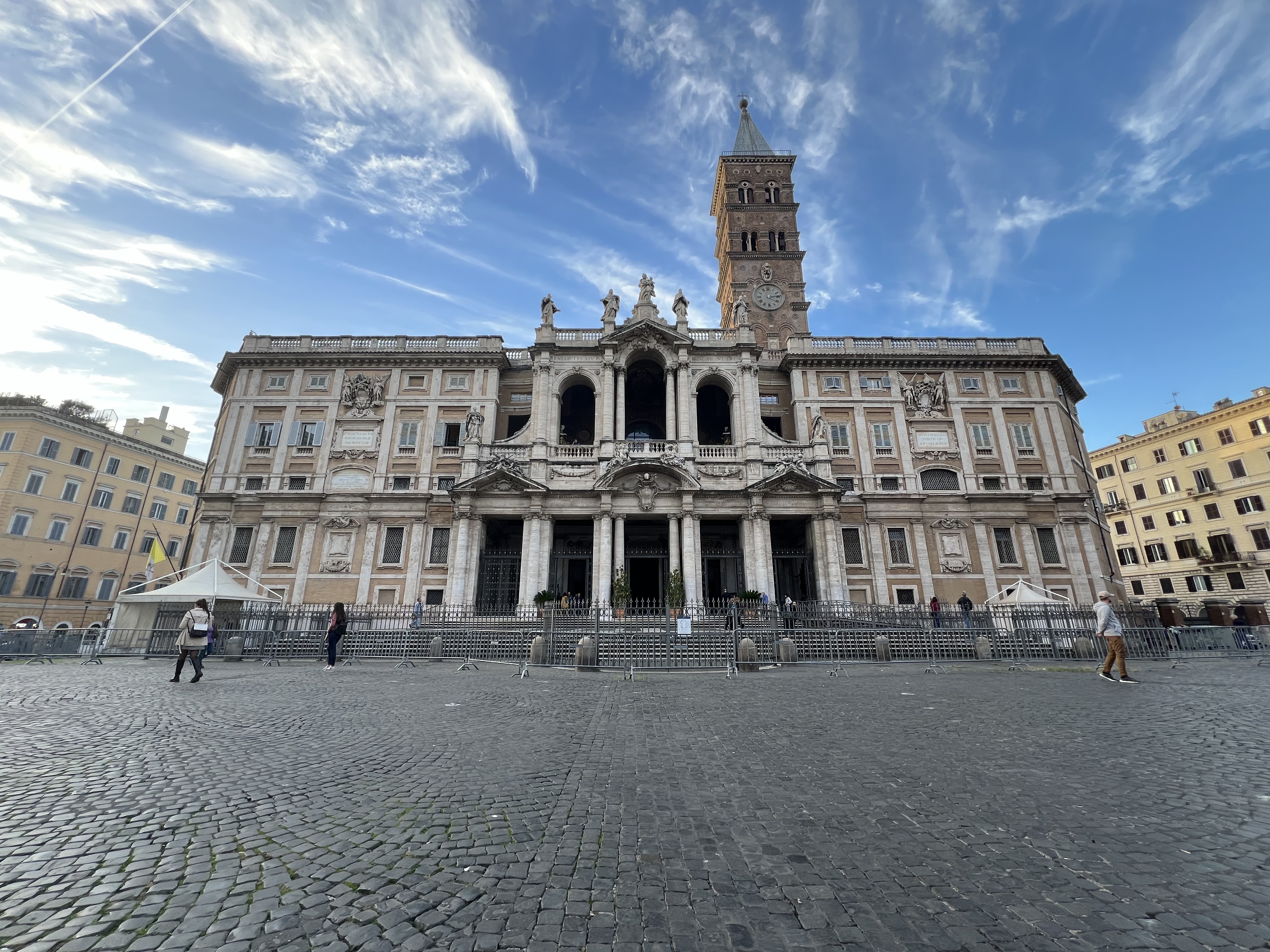
Statio ad St Mariam Majorem
Grant, we beseech Thee, O almighty God, that we who are continually afflicted by reason of our excesses, may be delivered through the passion of Thine only-begotten Son…

As the Church enters the shadowed threshold of the Sacred Triduum, the stational liturgy gathers us once more at Basilica of Saint Mary Major, placing us deliberately beneath the maternal gaze of the Blessed Virgin. Spy Wednesday—marked by the treachery of Judas—sets before us the contrast between betrayal and fidelity, darkness and light. It is therefore profoundly fitting that the Roman Church returns to the greatest Marian basilica in the West, that here, in the presence of the Mother of Sorrows, the faithful may learn how to stand with Christ when others conspire against Him. The liturgy itself presses this interior disposition: watchfulness, sorrow for sin, and steadfast union with the Redeemer in His approaching Passion.
The very origin of this basilica bears the mark of divine initiative. The ancient tradition recounts the apparition of the Blessed Virgin to a Roman patrician couple, directing that a church be built in her honour, confirmed by the miraculous snowfall of August 5 upon the Esquiline Hill. From this event she is invoked as Our Lady of the Snow. Yet the deeper theological foundation of this sanctuary emerges from the dogmatic clarity of the Council of Ephesus, which solemnly affirmed Mary as Theotokos, Mother of God. In response, Pope Sixtus III erected the present basilica, making it not merely a devotional site, but a monumental proclamation in stone and mosaic of the Incarnation itself. The fifth-century mosaics that line the nave—drawn from the Old Testament—are not decorative accidents; they are typological witnesses, showing how all salvation history converges in the womb of the Virgin and is fulfilled in Christ.
Descending into the crypt, one enters what has long been called the “Bethlehem of Rome.” Here, the cave of the Nativity is mystically reproduced, linking the birth of Christ inseparably to His sacrifice. The relics of the Holy Manger (Santa Culla) remind the pilgrim that the wood of the crib already points toward the wood of the Cross. It is no coincidence that Saint Jerome, who dwelt beside the cave in Bethlehem and gave the Church the Latin Scriptures, rests here; nor that Saint Ignatius of Loyola offered his first Mass at this altar, placing his entire mission beneath the sign of the Incarnate Word. The presence of Gian Lorenzo Bernini—both in his sculptural work and his burial within the basilica—further testifies that this is not only a sanctuary of doctrine, but of beauty ordered to divine truth.
Within the confessio lies the relic of Saint Matthias, the apostle chosen to replace Judas. This is no incidental detail on Spy Wednesday. Where Judas fell through betrayal, Matthias stands as a sign of restoration, fidelity, and apostolic continuity. Above, the revered icon of Salus Populi Romani watches over the faithful—a reminder that even in times of crisis, the Mother of God remains the protectress of the Church. Nearby rest the relics of Pope Pius V, the pontiff of Lepanto and the codifier of the Roman Rite, anchoring this basilica firmly within the continuity of Catholic tradition.
Thus, the stational pilgrimage on this day is not merely historical or aesthetic—it is profoundly spiritual. In a moment marked by betrayal, we are brought to the Mother who never betrayed; in the face of human weakness, we are shown divine fidelity. The crib, the Cross, and the altar are revealed as one continuous mystery. And standing beneath the vast Marian nave of this basilica, the pilgrim is invited to choose: to follow Judas into darkness, or to remain with Mary in steadfast, sorrowful, and ultimately triumphant love.
Look down, we beseech Thee, O Lord, on this Thy family, for which our Lord Jesus Christ was contented to be betrayed and to be delivered into the hands of wicked men, and to suffer the torment of the cross…
RELATED ARTICLES


LATEST ARTICLES
- Anglican Orders II: Saepius Officio — Anglicanism’s Strongest Reply to Apostolicae CuraeIn 1897, the Archbishops of Canterbury and York defended Anglican Orders against Leo XIII’s Apostolicae Curae through Saepius Officio. While it challenges Leo’s arguments on sacramental theology and order validity, it acknowledges significant theological alterations in the Edwardine rites, questioning the continuity of sacrificial meaning in priesthood and Eucharist within Anglicanism.
- Today’s homily: Sunday XVI Post PentecostThe sermon focuses on the themes of humility and pride as depicted in the Gospel. It contrasts the visible illness of a man with dropsy and the invisible pride of his companions. Highlighting Christ’s teachings, it emphasises the necessity of recognising one’s dependence on God’s grace, advocating that true Christian humility leads to spiritual healing and lasting fulfilment.
- Today’s Mass: September 13 Sunday XVI Post PentecostThe Sixteenth Sunday After Pentecost celebrates the importance of humility and the grace of God, emphasised in the Gospel through Jesus’ healing and teachings. As believers are called to seek God’s mercy, the commemoration of the Blessed Virgin Mary’s Nativity highlights the beginning of salvation and the pursuit of good works through divine grace.
- Sermon for Sixteenth Sunday after PentecostIn the epistle to the Ephesians, St. Paul encourages believers to remain steadfast amid trials, highlighting the significance of humility and unity in Christ. He contrasts worldly values of pride with the Kingdom’s values, emphasising that true fulfilment comes from reliance on God’s grace and prioritising love for God and neighbour.
- The Line Held Again: UK Parliament Rejects Assissted Suicide Bill – and Reverses Its Own VerdictThe House of Commons has rejected the Terminally Ill Adults (End of Life) Bill, marking a significant parliamentary reversal in views on assisted suicide, shifting from a 55-vote majority for to a 16-vote majority against in less than two years. Concerns over safeguards and support for vulnerable patients informed this decision.



Leave a Reply