
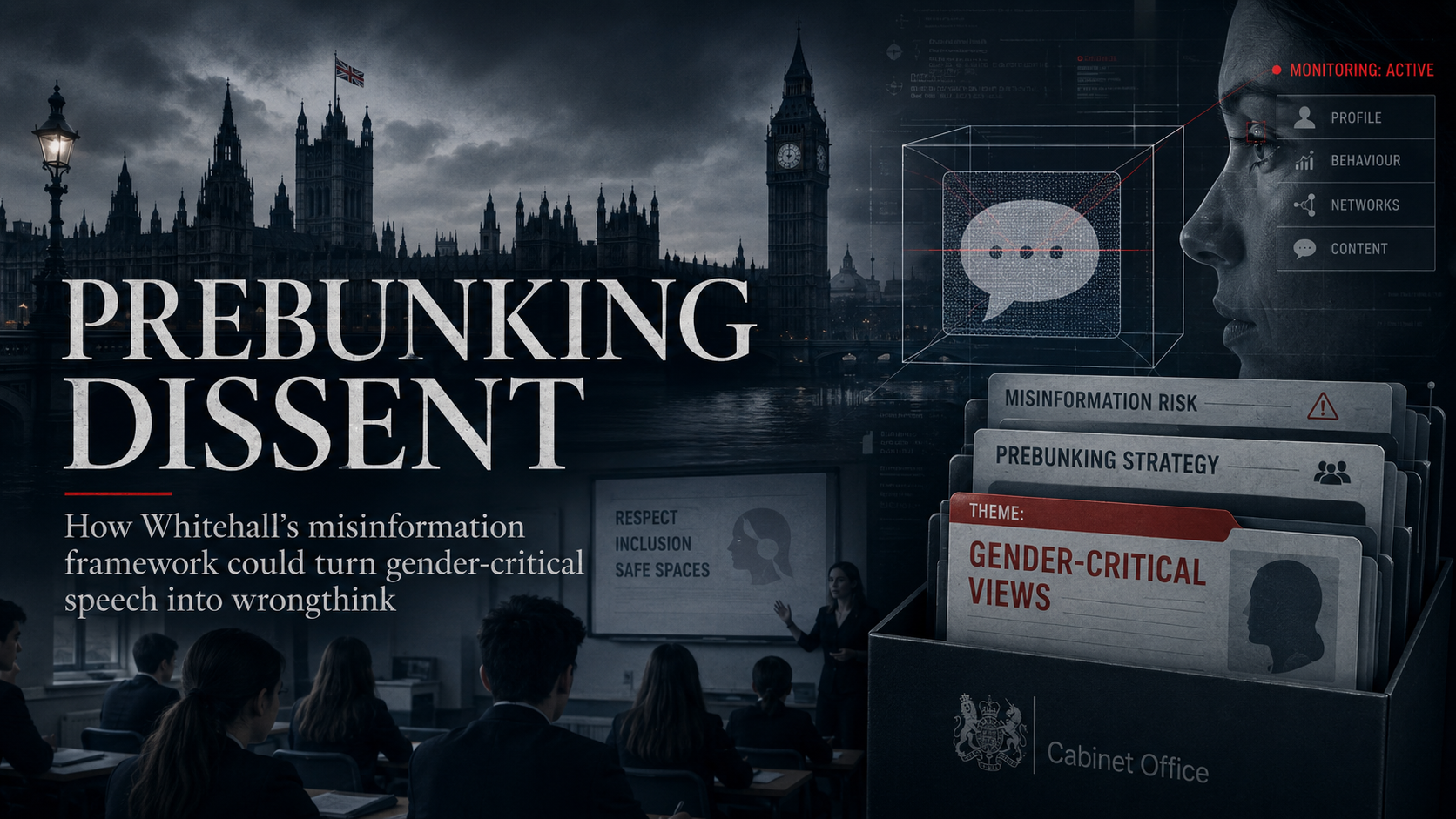
Prebunking Dissent: How Whitehall’s Misinformation Framework Could Turn Gender-Critical Speech into Wrongthink
A Government-commissioned report places arguments about “gender ideology”, schools, Pride and transgender sport within a system for monitoring, psychologically neutralising and suppressing “false and misleading information”. The issue is no longer merely who decides what is true, but whether lawful dissent will be permitted to reach the public before officialdom has inoculated them against it.

A government does not have to prohibit an opinion in order to suppress it. It need only classify that opinion as misinformation, describe its circulation as a social harm, teach children to recognise it as manipulation, instruct public bodies to “prebunk” it and require technology companies to reduce its visibility. The speaker may remain technically free to speak, but the audience will have been trained not to listen.
That is the danger presented by False and Misleading Information: An Evidence Summary and Map for Policy and Practice, published in May 2026. It is not an Act of Parliament, a statutory code or a declaration of settled Government policy, and ministers are entitled to make that distinction. It is nevertheless a report commissioned by the Government Office for Science on behalf of the Government Chief Scientific Adviser and departmental scientific advisers, expressly intended to inform policy and operations across Whitehall. It was funded through a Government tender and overseen by a steering group containing Government Office for Science representatives.¹
It is therefore neither official policy nor irrelevant academic speculation. It is precisely the kind of document from which future policy is constructed.
The report divides material identified through the European Digital Media Observatory’s fact-checking network into thematic categories of false and misleading information. One category includes “anti-LGBTQ+ narratives, ‘gender ideology’ claims targeting schools and public institutions”, together with representations of Pride events and controversies concerning transgender athletes.²
That classification is extraordinary because it does not identify a single false proposition. It gathers an entire field of political, moral, scientific and safeguarding controversy beneath the heading of misinformation.
There are, of course, false claims about transgender issues. Fabricated photographs, invented quotations, fictitious school policies and demonstrably inaccurate medical assertions should be corrected. The same is true in every sphere of public life. Opposition to gender ideology, however, is not itself a factual error.
The belief that human beings are male or female, that sex is not changed by declaration, that women’s sport requires sex-based categories, that children should not be encouraged to adopt transgender identities or that schools should not conceal social transition from parents is neither inherently false nor inherently misleading.
Indeed, much of it now corresponds more closely to British law and official safeguarding policy than the doctrines promoted by many institutions only a few years ago.
The Supreme Court ruled unanimously in April 2025 that the words “man”, “woman” and “sex” in the Equality Act 2010 refer to biological sex. The judgment confirmed the legal coherence of sex-based services, associations, accommodation and sporting provisions while making clear that transgender people remain protected against discrimination through the separate protected characteristic of gender reassignment.³
Keeping Children Safe in Education 2026, which comes into force on 1 September, similarly describes social transition as an active intervention whose long-term effects are not supported by good evidence. It requires parental involvement in the vast majority of cases, accurate recording of biological sex, the maintenance of sex-separated facilities and careful consideration of the effects of any decision upon other children.⁴
The Government is therefore in the remarkable position of commissioning one document that places claims about gender ideology in schools within a misinformation category while publishing another that validates many of the safeguarding concerns for which parents, teachers and campaigners were previously condemned.
This is not a minor inconsistency. It reveals the impossibility of constructing a reliable system of information control around disputed political classifications. Yesterday’s misinformation can become tomorrow’s statutory guidance without the institutions responsible for the original denunciation ever admitting their error.
The report itself acknowledges that false information may be difficult to distinguish from legitimate opinion and warns that aggressive moderation can suppress protected speech and legitimate dissent. Yet its principal policy recommendation weakens the very distinction required to prevent that outcome. It urges policymakers to concentrate upon perceived harm rather than becoming constrained by questions of definition or intention, declaring that “definitions should support intervention design, not constrain it”.⁵
That sentence contains the problem in miniature. A factual test asks whether a proposition is true, while an impact-led test asks whether those in authority approve of its social consequences.
Under the first approach, evidence determines the classification. Under the second, an accurate statement may still become a target because it is said to encourage distrust, reinforce prejudice, undermine an institution or contribute to a supposedly hostile narrative.
The category of misinformation then ceases to describe what is false and becomes a mechanism for regulating what is socially permissible.
The report recommends a comprehensive database of false and misleading narratives circulating in Britain, updated every month and linked where possible to European fact-checking data. It advocates continuous monitoring across subjects and platforms rather than merely responding to isolated falsehoods. It also proposes stronger intervention in recommendation systems, enforceable platform governance and the use of external “quality signals” to influence what material platforms present to users.⁶
None of these mechanisms is politically neutral. Every database requires classifiers, every quality signal requires a definition of quality, and every decision to suppress amplification requires someone to decide which claims deserve to be heard.
When those responsible have already placed criticism of gender ideology within a misinformation category, assurances of neutrality are not enough.
The report’s enthusiasm for “prebunking” is more troubling still. Prebunking uses psychological inoculation: members of the public are exposed to weakened examples of allegedly manipulative claims and given counterarguments before encountering those claims in ordinary public debate. The report proposes embedding such measures within education, crisis preparation and Government communications, with repeated reinforcement because their effects diminish over time.⁷
Applied to scams, fabricated medical cures and hostile-state deepfakes, this may have legitimate uses. Applied to political and moral controversies, it becomes anticipatory ideological conditioning.
A pupil may not be taught: “Here is an argument about sex, safeguarding or women’s sport; examine its evidence, assumptions and consequences.” Instead, the pupil may be taught: “People will attempt to manipulate you using arguments about gender ideology; here is how to resist them.”
The conclusion has then been supplied before the argument has been heard. That is not education in critical thinking but the management of permissible thought.
The danger does not end with gender. The report’s category concerning racism includes false narratives associating minority communities with crime or cultural threat. The qualification “false” is essential, but the proposed system depends upon institutions consistently distinguishing malicious racial generalisation from substantiated reporting about particular crimes, institutional failures or patterns of offending.²
The history of Britain’s grooming-gang scandal provides no grounds for confidence that this distinction will always be made. Authorities repeatedly allowed fear of appearing racist to obstruct the proper investigation and public acknowledgement of organised sexual exploitation. A misinformation framework driven by perceived harm rather than exact factual falsity could reproduce the same institutional failure in a more sophisticated form: reports are not disproved, but discouraged because officials fear the social consequences of their publication.
The result would not be the prevention of racism. It would be the concealment of reality, ultimately damaging both victims and innocent members of minority communities who are burdened with responsibility for crimes they neither committed nor condoned.
The methodological limitations of the report should also moderate its authors’ confidence. It is a rapid scoping review, not a full assessment of the strength of the evidence behind every proposed intervention. The researchers did not extract assessments of evidential quality or certainty and did not collect quantitative data establishing the effectiveness of the policies considered. They state that more focused and rigorous systematic reviews would be required to determine the quality and efficacy of individual approaches.⁸
Artificial-intelligence tools were used to generate themes, help identify experts, summarise selected material and extract findings. Not every full-text article was read in its entirety because of time constraints, although the researchers state that human review and oversight were maintained.⁹
Those limitations do not make the report worthless. They do make it an unsafe foundation for interventions affecting public speech, children’s education, algorithmic visibility and the boundaries of legitimate dissent.
The controversy surrounding Olympic boxer Imane Khelif illustrates the need for exact distinctions. False claims that Khelif was a transgender woman can be corrected as false. Questions concerning sporting eligibility, testing procedures, biological advantage or differences of sexual development are distinct questions. They cannot responsibly be dissolved into a single allegation of anti-transgender, racist or Islamophobic misinformation merely because they are politically sensitive.
This is the distinction a misinformation bureaucracy is least capable of preserving, because bureaucracies classify by category while public controversies turn upon particulars.
The broader danger is circular. A network of academics, campaigners or fact-checkers identifies a type of argument as harmful misinformation. A Government-commissioned report reproduces that classification. Departments, schools, regulators, employers and technology platforms then treat the classification as authoritative. Those who continue to express the contested opinion are restricted, excluded or professionally penalised. Their exclusion is then cited as proof that the opinion lies beyond respectable public discourse.
The designation manufactures the consensus that is subsequently invoked to justify the designation.
We have seen the same process elsewhere. Christian and gender-critical organisations are labelled “anti-rights”; funders and public bodies treat the label as evidence; the resulting exclusion is then presented as confirmation that such organisations do not belong within legitimate civil society. What begins as activist terminology becomes administrative fact without ever passing through an impartial tribunal of evidence.
This is why the Government’s assertion that the report is not policy cannot be the end of the matter. Ministers should state explicitly that criticism of gender ideology, defence of biological sex, objections to school materials, opposition to social transition and advocacy of female sporting categories are not inherently false, misleading or hateful.
Any misinformation policy derived from this report must be limited to identifiable factual claims capable of objective verification. Opinions, moral judgements, religious doctrines, political arguments and good-faith interpretations of contested evidence must remain outside its scope.
The classification process must be public, the evidence relied upon must be disclosed, and those whose speech is labelled misleading must have a right to challenge the designation. Fact-checking bodies must declare relevant ideological and financial interests. No school should employ psychological prebunking to condition children against lawful positions in active political, moral or scientific controversy.
There is a legitimate role for Government in confronting fraud, fabricated evidence, hostile foreign interference and deliberately manipulated media. There is no legitimate role for Government in preparing citizens to reject dissent before they have heard it.
The modern thought police will not necessarily arrive in uniforms, seize printing presses or prosecute private beliefs. They may arrive as behavioural scientists, content moderators, trusted flaggers, curriculum designers and information-quality specialists. They will not forbid citizens to speak. They will ensure that algorithms conceal them, institutions discredit them and children are psychologically inoculated against them.
The decisive question is not whether Whitehall currently possesses a Ministry of Truth. It is whether it is assembling the intellectual machinery from which one could be built.
Once government decides that lawful opinions are misinformation because of their supposed effects, fact-checking has ceased to defend truth and has become ideological government.
¹ False and Misleading Information: An Evidence Summary and Map for Policy and Practice, Government Office for Science and University of Edinburgh, May 2026, commissioning, funding and governance statements.
² Ibid., thematic analysis of false and misleading information drawn from European Digital Media Observatory fact-checking data.
³ For Women Scotland Ltd v Scottish Ministers [2025] UKSC 16, Supreme Court of the United Kingdom, 16 April 2025.
⁴ Department for Education, Keeping Children Safe in Education 2026, Department for Education. It comes into force on 1 September 2026.
⁵ False and Misleading Information, section on definitions, impact and intervention design.
⁶ Ibid., recommendations on narrative databases, continuous monitoring, platform governance and recommendation systems.
⁷ Ibid., sections on prebunking, psychological inoculation, education and public communications.
⁸ Ibid., methodology and limitations of the rapid scoping review.
⁹ Ibid., methodological statement on the use of artificial-intelligence tools and human oversight.
RELATED ARTiCLES


LATEST ARTICLES
- Today’s Mass: September 05 Saint Lawrence JustinianSaint Lawrence Justinian, the first Patriarch of Venice, dedicated his life to the poor and the establishment of monasteries, rejecting noble marriage. Renowned for his humility and pastoral dedication, he emphasised the spiritual integrity of Venice’s safety. He was a precursor to the reforms of the Council of Trent, dying on 8 January 1455.
- 06.09.26 Nuntiatoria CXXII: NOMEN MANET, RES DEESTThis edition of Nuntiatoria explores the disconnect between the names of Catholic institutions and the realities they signify. Despite retaining their titles, many aspects of Catholicism—such as episcopal authority in China and religious practice in Poland—exhibit deteriorating substance. The piece cautions against superficial continuity, stressing the importance of genuine faith and practice over mere nomenclature.
- ORDO w/c 06.09.26The document outlines the liturgical schedule for the week of 6 to 13 September 2026, highlighting significant religious observances such as the Fifteenth Sunday after Pentecost and the Nativity of the Blessed Virgin Mary. It reflects on themes of compassion, holiness, fidelity, and humility, underscoring their importance in Christian life.
- The Fifteenth Sunday after Pentecost: When the Procession of Death Meets the Lord of LifeThe Fifteenth Sunday after Pentecost focuses on the transformative power of Christ, emphasising the supernatural life granted through grace. The liturgy highlights the Church’s role as a nurturing mother, mourning the spiritually dead while seeking their restoration. Christ’s compassion leads to resurrection, demonstrating that true life is found in dependence on Him.
- If Cecchin Is Right, Fatima Is WrongFr Stefano Cecchin, President of the Pontifical International Marian Academy, has declared opposition to apparitions that speak of divine punishment, suggesting they are false. This stance contradicts fundamental Catholic doctrine, including teachings from Scripture, the Catechism, and specifically the Message of Fatima, which warns of divine consequences for sin.
CURRENT EDITION


Today’s Mass Propers
- Today’s Mass: September 05 Saint Lawrence Justinian
 Saint Lawrence Justinian, the first Patriarch of Venice, dedicated his life to the poor and the establishment of monasteries, rejecting noble marriage. Renowned for his humility and pastoral dedication, he emphasised the spiritual integrity of Venice’s safety. He was a precursor to the reforms of the Council of Trent, dying on 8 January 1455.





Leave a Reply